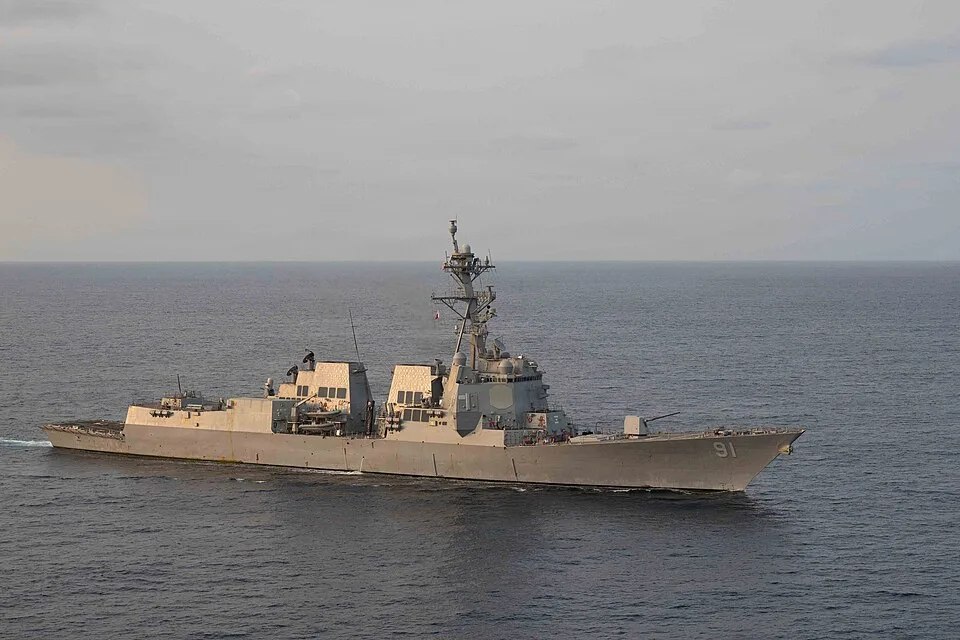
Donald Trump has announced a naval blockade of Iran and, in what can only be described as a bold new frontier in unhinged foreign policy, declared that cargo ships will be charged a 20% fee for the privilege of not being stopped by the United States Navy. Yes, really. The President of the United States is apparently running a protection racket in the Strait of Hormuz now.
What Trump Actually Said, God Help Us
According to Axios, Trump announced Monday that the U.S. is reinstating a naval blockade on Iran, preventing any ships from leaving or entering Iranian ports. He then added that the U.S. would be "reimbursed" at a rate of 20% for securing safe passage for cargo ships through the region.
Axios notes, diplomatically, that "the details and seriousness of the initiative were not immediately clear." That is journalist-speak for: nobody in the room could tell if this was real policy or a bit. Which is, genuinely, where we are as a country.
To be clear about what 20% means in practice: global oil markets move through the Strait of Hormuz. About 20% of the world's oil supply passes through that chokepoint every single day. We are talking about an unimaginably large volume of energy trade. Charging a 20% toll on that traffic is not a foreign policy position. It is a shakedown.
Why This Is Happening Now
The blockade is a response to renewed clashes between the U.S. and Iran in recent days, Axios reports. This is the context you need: the two countries have been escalating against each other, and Trump's answer is to slam shut one of the most economically critical waterways on the planet.
The Strait of Hormuz is roughly 21 miles wide at its narrowest point. It connects the Persian Gulf to the Gulf of Oman and is the only sea route out of the Gulf for Saudi Arabia, Iraq, Kuwait, Bahrain, Qatar, and Iran. There is no detour. If you blockade it, you do not just pressure Iran. You pressure everyone.
The ripple effects on energy prices alone could be staggering. Oil markets are already nervous institutions on a quiet Tuesday. A U.S. naval blockade of Iranian ports, combined with a stated policy of charging ships for transit, is not a quiet Tuesday.
The 20% 'Reimbursement' Is the Part That Should Haunt You
Set aside the blockade for a second, because the reimbursement claim is its own category of alarming. The United States does not charge foreign commercial vessels tolls for operating in international waters. That is not a thing. It has never been a thing. The entire framework of free navigation on the high seas that American foreign policy has defended for decades is premised on the idea that we are not doing that.
Who gets paid? Where does the money go? What legal authority authorizes it? Which ships qualify for "safe passage" and which don't? Axios reported that none of this was immediately clear, because Trump apparently announced a fundamental restructuring of maritime law with the same planning he applies to a fast food order.
The closest historical analogy here is the Barbary pirates, who operated in the early 19th century by charging European and American ships for protection in the Mediterranean. The United States literally went to war over that practice. Twice. Thomas Jefferson sent the Navy specifically to stop it. We are now apparently the Barbary pirates.
What This Does to the Global Economy
The Strait of Hormuz is not just about oil, though oil is enough. Liquefied natural gas, petrochemicals, and commercial cargo all move through this corridor. Qatar, one of the world's largest LNG exporters and a country that hosts a major U.S. military base, depends on this waterway. Any serious enforcement of a blockade starts creating problems with American allies almost immediately.
Energy analysts have warned for years that a Hormuz closure scenario would spike oil prices globally within days. The scale of disruption would dwarf anything seen in recent memory, including the post-pandemic supply chain chaos or the Russia-Ukraine energy crisis in Europe. Gas prices in the United States, which Trump has made a centerpiece of his economic identity, would almost certainly rise sharply.
The international shipping industry is already watching this with the kind of attention that precedes panic. Whether markets believe Trump is serious, half-serious, or just talking is now itself a destabilizing variable. Uncertainty in a strait that moves a fifth of the world's oil is not a small thing.
Has Anyone Checked in With the Rest of the World
China is the largest buyer of Iranian oil. Russia has economic interests in regional stability. The European Union has been trying for years to preserve what remains of nuclear diplomacy with Tehran. Every one of those actors just watched the U.S. President announce a naval blockade and a toll booth in the same breath.
None of them were consulted. None of them agreed to this. Several of them have ships that would be subject to whatever this policy turns out to mean. The response from foreign capitals, when it comes, is unlikely to be warm.
And Iran itself has threatened in the past to close the Strait of Hormuz entirely if it felt militarily cornered. A blockade of its ports is about as cornered as it gets. The question of how Tehran responds, and how quickly, is now the most important open question in global geopolitics.
The Dingo Take
Here is what makes this particular moment so difficult to process: we have genuinely no idea how seriously to take it. Trump has announced things before that dissolved into nothing within 48 hours. He also has, on other occasions, done exactly what he said he would do. The problem is that in the Strait of Hormuz, with oil markets and regional military forces all watching, the cost of finding out which one this is could be catastrophic.
The 20% reimbursement line is the tell. That is not a policy. That is the kind of thing someone says when they are improvising in front of a camera and a thought crosses their mind. Real blockades have legal frameworks, rules of engagement, diplomatic groundwork, and coalition partners. This one was announced with the detail level of a tweet. The people who have to actually implement it, the Navy, the State Department, the Treasury, are presumably reading the same Axios report the rest of us are.
The United States is a country that once built an entire foreign policy doctrine around keeping the Strait of Hormuz open, spending enormous military resources to guarantee it, because we understood that global economic stability depended on it. That doctrine just got replaced with a vibe and a percentage. Sleep well.




Comments