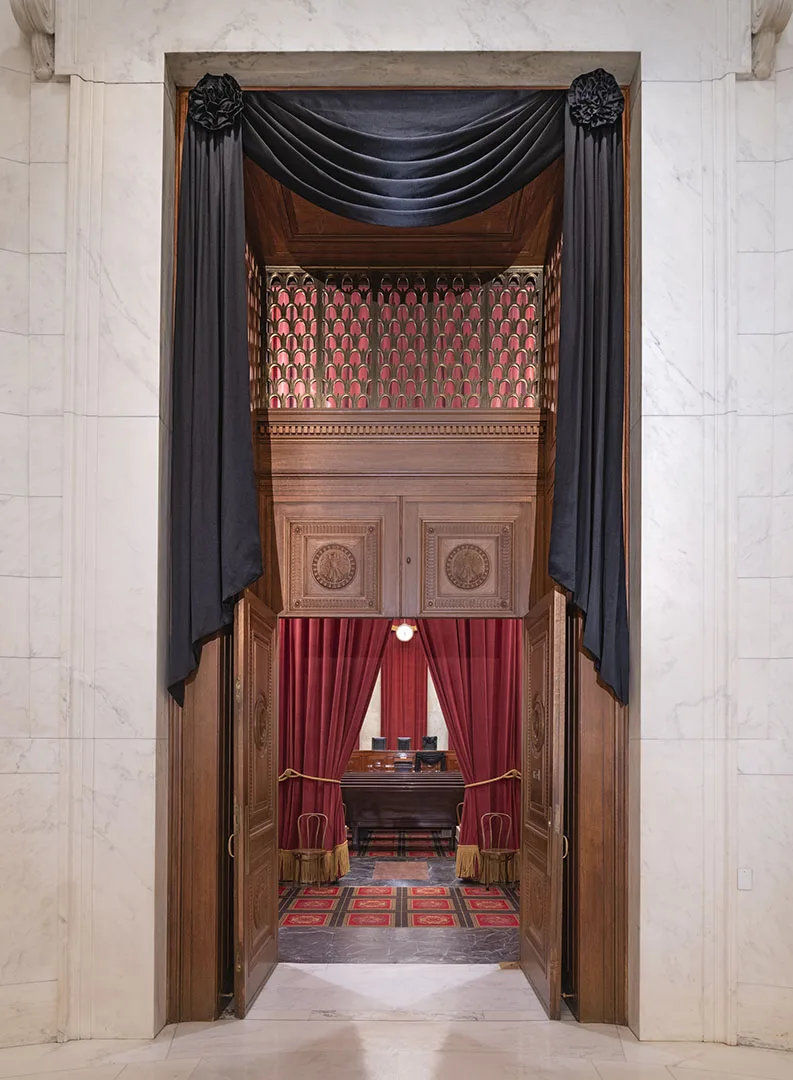
Amy Coney Barrett sat before Congress on Tuesday and described putting on a bulletproof vest before going home, then trying to explain to her 12-year-old son why his mother needed one. It's the kind of detail that cuts through the noise, and it landed the way it was supposed to. The Supreme Court of the United States is asking for more money to protect its justices from being murdered, and that sentence alone tells you something has gone badly wrong.
Two Justices Walk Into a Hearing Room
Barrett and Justice Elena Kagan appeared together before Congress on Tuesday in what AP News reports is the first time justices have testified before Congress since 2019. That's already unusual. Justices testifying about anything is rare, and the fact that they're doing it now, in this climate, is a sign of how serious the situation has gotten.
The occasion was a budget request. The Supreme Court is seeking millions of dollars to beef up security, and it sent two of its own to make the case in person. Barrett, appointed by Trump, and Kagan, appointed by Obama, sat side by side. Whatever you think of either of them, they both apparently need protection from people who want to kill them. That's the bipartisan issue nobody wanted.
The Vest, and the Kid Who Asked About It
Barrett's testimony was the emotional gut-punch of the hearing. According to AP News, she said the surge in threats has increasingly encroached on her personal and family life, and then she gave the committee a specific example that's going to be hard to shake.
A few years ago, she had to wear a bulletproof vest on her way home. Her then-12-year-old son noticed. She had to explain it. "I didn't expect that performing this service would put me in the position of explaining to my children what a bulletproof vest was, why I had to wear one," she told the committee. That's the whole argument, right there in one sentence. Whatever your politics, a kid shouldn't have to learn what body armor is because of their parent's job on the federal bench.
Kagan addressed the trajectory of the threat environment more broadly. AP reports she noted that threats against the Court spiked after the leaked draft of the Dobbs decision, the opinion that eventually overturned Roe v. Wade, and have kept climbing since. The arc here is not encouraging. In 2022, a man was arrested near Justice Brett Kavanaugh's home carrying weapons and zip ties. He was there to kill him. That's not hyperbole, that's the criminal complaint.
Roberts Has Already Said the Quiet Part Out Loud
This isn't the first alarm being raised. As AP News notes, Chief Justice John Roberts condemned the threats against judges during a speech back in March, drawing a line between legitimate criticism of judicial opinions, which he called understandable, and personally directed hostility, which he called "dangerous" and said it "has got to stop."
That Roberts felt the need to give that speech at all is telling. That it apparently wasn't enough to stop anything is more telling. The Court is now sending justices to Capitol Hill with their hands out, asking Congress to fund the kind of protection that shouldn't need to be negotiated in a committee hearing.
Meanwhile, the Fed Chair Is Also Having a Day
Down the street from the Supreme Court hearing, Federal Reserve Chair Kevin Warsh was testifying before a House committee with his own set of problems. His written testimony, as AP News reports, pledged that the Fed will make high inflation "a thing of the past" and declared Fed policymakers have "no tolerance for persistently elevated inflation." Strong words. Bold commitment. Very reassuring language.
Here's what he did not provide: any signal about what the Fed is actually going to do next. That's because, per AP, the Fed's own interest rate-setting committee is almost perfectly split. About half the 19 members expect they'll need to raise rates by the end of the year. Nearly the other half have penciled in no change or even a cut. Warsh is essentially the referee of a committee that cannot agree on which direction the field is facing. His testimony amounted to: we will fix inflation, and we are deeply divided about how. Cool. Very reassuring.
The Iraq Meeting, and the Iran Blockade Restarting
Over at the White House, Trump was welcoming new Iraqi Prime Minister Ali al-Zaidi for an Oval Office meeting. AP reports that al-Zaidi, described as a political novice, received strong backing from Trump for the job. What awaits him is anything but novice territory.
Al-Zaidi is under significant pressure to disarm Iran-backed militias operating inside Iraq, some of which have attacked U.S. bases and diplomatic facilities following the U.S. and Israeli military campaign against Iran. Renad Mansour, director of the Iraq Initiative at the Chatham House think tank, told AP that the U.S. will push hard on disarmament, and al-Zaidi will push back asking for intelligence, technical, and military support in return. The complicating factor, as Mansour noted: "There is a scenario in which, if the Iraqi government starts going after these groups, they will also go after the government." So the guy the U.S. is leaning on may be in physical danger from the groups he's being asked to dismantle. Great situation all around.
Separately, the U.S. military announced it will resume its blockade of Iranian ports in the Strait of Hormuz at 4 p.m. ET Tuesday, AP reports, after Trump vowed to reinstate it. The Strait of Hormuz carries roughly a fifth of the world's oil supply through it. Blocking it is not a minor diplomatic gesture.
South Carolina Gets Its First Female Senator, Under the Worst Possible Circumstances
And in the news cycle's most quietly significant footnote: Darline Graham, sister of the late Senator Lindsey Graham, was sworn in Tuesday afternoon as his temporary replacement, per AP. Graham died unexpectedly over the weekend. Senate Majority Leader John Thune confirmed she will serve out the remainder of his term through January.
Darline Graham holds a master's degree in rehabilitation counseling and has worked as an optician and at various state agencies. She will be the first woman to represent South Carolina in the United States Senate. "Lindsey has always been there for me," she said at a statehouse press conference. "And now, I will be there for him." She said this with dozens of his former staffers standing behind her. Whatever you thought of Lindsey Graham, that image lands hard.
The Dingo Take
Let's just sit with this for a second. A sitting Supreme Court Justice had to put on body armor before going home to her family. Her kid asked what it was. She had to explain it. And the Court's response to this situation is to show up to Congress and request a budget increase to pay for more security. That's where we are. The highest court in the country is in a threat environment so severe that its members are testifying before legislators to beg for protection money, and this is a Tuesday in July.
The Roe leak didn't just expose a draft opinion. It turned the Court into a target in a way that has never fully wound back down. Roberts can give speeches about how personal hostility is dangerous. Barrett can describe bulletproof vests to lawmakers. None of that changes the fact that there is apparently a meaningful population of Americans who have decided that murdering a federal judge is a legitimate response to a ruling they dislike. The Court's security problem is a symptom of a much larger one, and no budget allocation is going to fix what's actually broken.
Meanwhile, the Fed is split down the middle on interest rates, the U.S. just blockaded Iran's ports again, a foreign policy novice is getting squeezed between Washington and Iranian-backed militias in Baghdad, and South Carolina is sending its first female senator to Washington as a last act of tribute to her dead brother. Normal Monday. Tuesday. Whatever. The news doesn't stop.




Comments