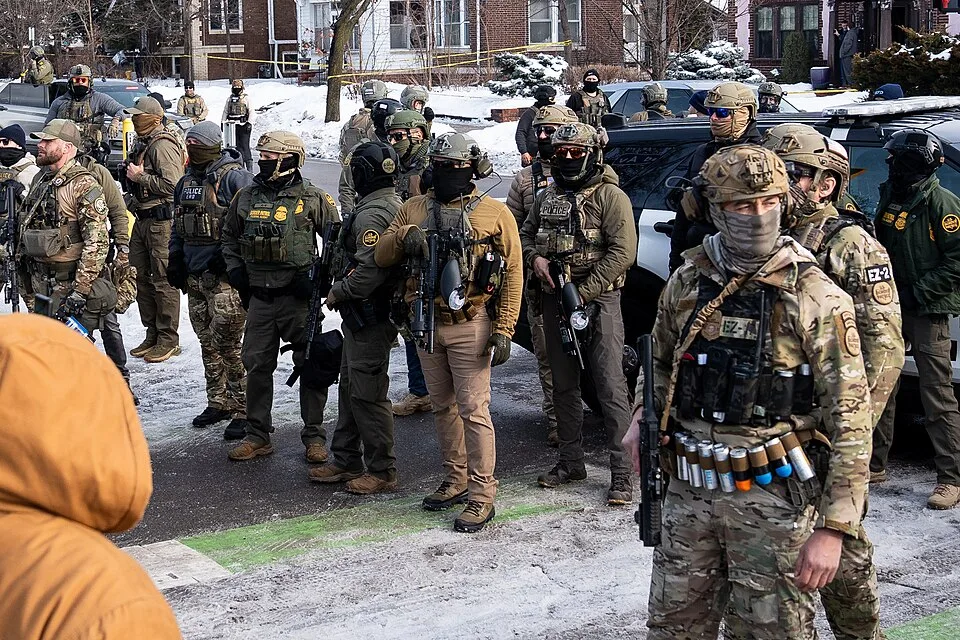
ICE officers pushed, tackled, choked, tased, and rammed cars so often that a new ACLU report had to invent a phrase for it: 'default tool.' The report, released Thursday, documents more than 1,200 immigration enforcement operations across eight states and finds that nearly one in three involved the use of force or the explicit threat of it. This is the same agency that just shot two men dead during traffic stops in the same week.
What the ACLU Found, and Why the Government Didn't Find It First
The report covers ICE operations from January 2025 through the end of last year, pulling data from news coverage, hospital and school press releases, and community organization accounts. The ACLU tracked who got hurt, how, and where. That last part is the kicker: grocery stores, bus stops, roads. Not exactly the targeted operations ICE likes to describe when it's trying to sound professional.
Here's what a law professor said when he heard the ACLU had to do this work themselves. Seth Stoughton of the University of South Carolina told NPR, 'My first thought is it's a little embarrassing for this information to be gathered, aggregated, analyzed and shared by the ACLU instead of the Department of Homeland Security.' He then pointed out, with some restraint, that democracy requires the government to be transparent about what it's doing in our name. The Department of Homeland Security did not respond to questions about the report's findings. ICE also did not respond. Big surprise.
Naureen Shah, director of policy and government affairs for immigration at the ACLU and one of the report's authors, put it plainly: 'You're seeing the threat of using force and actually using it become the default tool for immigration enforcement agents.' Not a last resort. Not a proportional response. The default.
Knees on Necks, Tasers, Rubber Bullets: The Actual Numbers
Let's be specific, because vague outrage doesn't cut it. According to the ACLU report, researchers documented ICE agents pushing, tackling, or pinning people to the ground more than 400 times in the period studied. Officers deployed weapons, including chemical irritants, rubber bullets, and tasers, at roughly the same frequency.
The report also found dozens of instances of tactics that many local police departments explicitly restrict or outright ban. We're talking knees on necks. Chokeholds. The kind of tactics that got a Minneapolis police officer convicted of murder. ICE is out here using them on people at bus stops, and the agency running the operation hasn't said a word in response.
The researchers were careful to note that this data is not exhaustive. It's a snapshot from eight states, and a huge number of immigration operations simply go unrecorded. What they found is almost certainly the floor, not the ceiling.
Two Men Shot Dead in Their Cars in One Week
The report lands in the aftermath of two killings that happened within just over a week of each other, both in situations that should give anyone pause. Lorenzo Salgado Araujo was shot and killed by ICE officers in Texas. Joan Duran Guerrero was shot and killed by an ICE officer in Maine. Both men were in their cars. Neither was the subject of a targeted ICE operation.
In the Texas case, ICE claimed Salgado Araujo had 'weaponized his vehicle.' Witnesses dispute that account, according to NPR. In the Maine case, DHS said officer fired because Duran Guerrero attempted to flee and the officer was 'fearing for public safety.' Fearing for public safety from a man driving away. In both shootings, officers were not wearing body cameras. So we have dead men, disputed facts, and no footage. That's the situation.
Jillian Snider, a retired NYPD officer who now lectures at John Jay College of Criminal Justice, told NPR that most police agencies would not authorize an officer to shoot in a car stop situation where there's no imminent threat of deadly force or serious physical injury. ICE officers apparently operate under different standards, and those standards are now getting people killed.
Car Stops Are the New ICE Playbook, and Nobody Trained for This
ICE's enforcement strategy has shifted substantially under the Trump administration, and that shift matters. Snider told NPR that historically, ICE officers were not out in communities regularly. Operations were targeted. Officers knew where a wanted person was, and they went there.
Now, according to NPR's reporting, there's been a significant increase in car stops. That is a completely different kind of enforcement encounter, one that requires specific training, clear protocols, and careful judgment under pressure. Snider said directly that the increase in car stops is 'a big concern if you're not afforded the proper car stop training.' The ACLU's report documented dozens of instances where immigration officers rammed other people's vehicles, boxed cars in, and smashed windows. This is not a carefully targeted law enforcement operation. This is a rolling brawl on public roads.
And it's going to get worse. The Trump administration has pushed enormous amounts of federal funding into ICE operations, and Shah told NPR she is 'really worried there's going to be even more of these killings.' She described 'a culture of abuse and impunity' driven by 'unprecedented arrest quotas,' a practice of force and intimidation, 'and then you multiply that by tens of billions of dollars.' That math does not produce fewer dead people.
Citizens, Kids, Journalists: Who's Getting Caught Up
One of the uglier findings in the ACLU report is who keeps showing up in these enforcement incidents. The organization documented hundreds of incidents involving children, U.S. citizens, bystanders, protesters, and journalists. Not undocumented immigrants. Not people with criminal records. American citizens. Kids. Reporters doing their jobs.
This is what happens when you abandon targeted enforcement in favor of dragnet operations run by underprepared agents operating under quota pressure with no body cameras and no meaningful accountability. You stop getting precise law enforcement and start getting something that looks a lot more like a blunt instrument swung at entire communities.
The Dingo Take
The Trump administration has spent a year and a half insisting that its immigration crackdown is tough but lawful, firm but professional. The ACLU just spent months documenting what it actually looks like, because the Department of Homeland Security sure wasn't going to do it. Nearly a third of 1,200 documented operations involved force or the threat of it. Chokeholds. Knees on necks. Cars rammed and windows smashed. Two men shot dead during traffic stops with no body camera footage to explain what happened. This is the federal government doing this. With your tax money. In grocery store parking lots.
The government's response to all of this? Silence from ICE. Silence from DHS. A statement about a man 'weaponizing his vehicle' that witnesses say isn't true, and a statement about 'fearing for public safety' that describes an officer shooting at a fleeing car. That's the entire accountability structure here. Disputed press releases and no cameras.
Shah said she's worried there are going to be more killings. She's right to be worried. When you combine a culture of impunity with ballooning funding, quota pressure, minimal training for new tactics, and zero transparency, you don't get fewer violent incidents. You get a machine optimized to produce them. The ACLU had to build a database to prove it. The least the rest of us can do is pay attention.


Comments