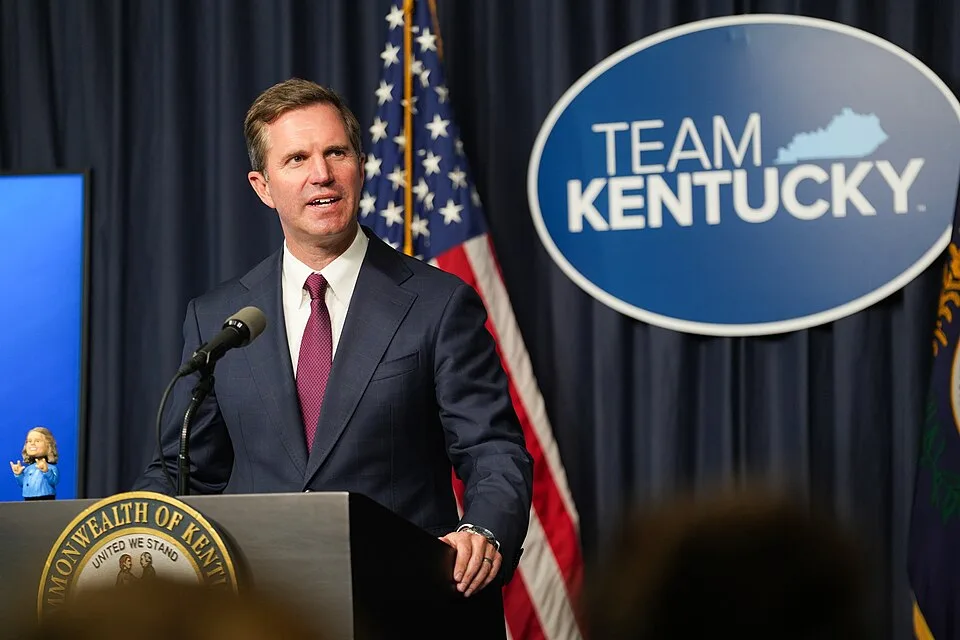
Kentucky Governor Andy Beshear says he received calls from two separate agencies suggesting Mitch McConnell had died — and this happened before McConnell's office had released so much as a single official statement about his month-long hospitalization. Let that sit for a second. The sitting U.S. Senator from Kentucky went dark for an entire month, and the governor of his own state was getting death notices from unnamed agencies before anyone in McConnell's orbit bothered to issue a press release.
A Month of Silence, Then a Bombshell
McConnell was hospitalized on June 14. His office said nothing publicly for nearly a month. No statement, no update, no spokesperson briefing, nothing. Beshear told journalist Katie Couric in a July 15 interview that his office had zero direct communication with McConnell or his staff during that entire stretch, according to the Courier-Journal.
Then came the kicker. 'I'd gotten two calls from different agencies, not state agencies, suggesting he's passed,' Beshear said. He did not name the agencies, did not specify when the calls came in, and spokespeople for both Beshear and McConnell had not responded to requests for comment as of publication. But the implication is hard to miss: people with access to official channels thought the longest-serving Republican Senate leader in American history was dead, and nobody in McConnell's camp had said a word to correct that impression.
This is a United States Senator. Not a private citizen. Not a retired figure living quietly off the grid. A sitting member of the world's most self-important legislative body, and for a month his constituents, his governor, and apparently multiple agencies had absolutely no idea if he was alive.
McConnell Finally Speaks, Says He Fell
On July 12, McConnell released a statement. A fall at his home, he said. He was briefly unconscious. The medical evaluation showed no fractures, no cardiac abnormalities, no stroke, no tumor, no hemorrhage. A health professional quoted in the statement said McConnell developed pneumonia early in the hospitalization but recovered from it quickly with antibiotics, the Courier-Journal reports.
Beshear called the statement 'a step in the right direction.' He also said Kentuckians 'deserve to see a little bit more and hear a little bit more' about their senator's condition. Which is a remarkably diplomatic way of saying: one statement after 28 days of total silence is not exactly transparency in action.
For context, Beshear had already gone public on July 8, four days before McConnell's statement dropped, calling on McConnell to share information. He was asking a sitting senator from his own state to confirm he existed. That is where we are.
The Senate Seat Question Nobody Wants to Answer Out Loud
McConnell's term ends in January 2027. If his seat were vacated before then, Beshear has been publicly chewing over what a Democratic governor actually does with that scenario in deep-red Kentucky. The Courier-Journal notes that Kentucky law would require Beshear to call a special election if certain timing requirements can be met, but there is also a Kentucky constitutional provision allowing governors to make appointments for statewide vacancies.
Beshear told Couric he is keeping his options open. 'Before there was ever a statute that the Republican majority could change or not change, Kentucky governors made appointments, and that constitutional provision was the only thing in writing at the time,' he said, adding there are 'a lot of options on the table.' Republicans in the Kentucky legislature have been eyeing ways to strip that appointment power, so the legal fight, if it comes to that, would get ugly fast.
A Democratic appointment to a Senate seat in Kentucky would be a political earthquake. The math in the Senate is thin enough that it would matter enormously. Everyone knows this, which is exactly why the maneuvering around McConnell's condition has the feel of a slow-motion constitutional standoff.
Who Was Calling, and Why Does It Matter
The unanswered question here is obvious: what agencies were calling the governor of Kentucky to report that a U.S. Senator had died? Beshear was careful to say they were not state agencies. Federal agencies? Congressional offices? Law enforcement? Hospital administration relaying information through official channels? He did not say, and right now nobody is talking.
This matters beyond the gossip of it. If official agencies were reporting McConnell dead based on information they had access to, that speaks to a stunning breakdown in communication from McConnell's office. Or it raises questions about what those agencies knew and when. Neither possibility is reassuring.
The fact that McConnell's spokesperson still had not responded to the Courier-Journal by the time of publication tells you roughly how forthcoming Team McConnell plans to be about any of this.
The Dingo Take
Here is what is remarkable about this story: we have normalized the idea that a United States Senator can disappear into a hospital for a month, issue zero communication to the public or to his own state's governor, and when people start calling that governor to say the senator is dead, the takeaway is supposed to be that the governor was being presumptuous for asking questions. Mitch McConnell has spent decades as one of the most powerful people in American government. The people of Kentucky sent him to Washington. They had a right to know he was alive. He apparently did not feel obligated to tell them.
And now Beshear is sitting on a constitutional puzzle that could reshape the Senate, being as careful and lawyerly as possible about his options while Republicans in the state legislature sharpen their knives trying to block anything he might do. The cynicism is total and bipartisan in its ugliness. McConnell's team stonewalls. Republicans try to legislate away the governor's power preemptively. Beshear threads the needle publicly while clearly knowing a lot more than he is saying.
Somewhere in a Kentucky hospital, the man who spent decades blocking legislation, freezing Supreme Court seats, and running the Senate like a personal chessboard is recovering from a fall. Whether he returns to that Senate seat, and what happens if he does not, is a question that affects millions of people. They have been given one statement in over a month. The bar for transparency has collapsed so completely that people are genuinely impressed a press release exists at all. This is not how any of this is supposed to work.

Comments