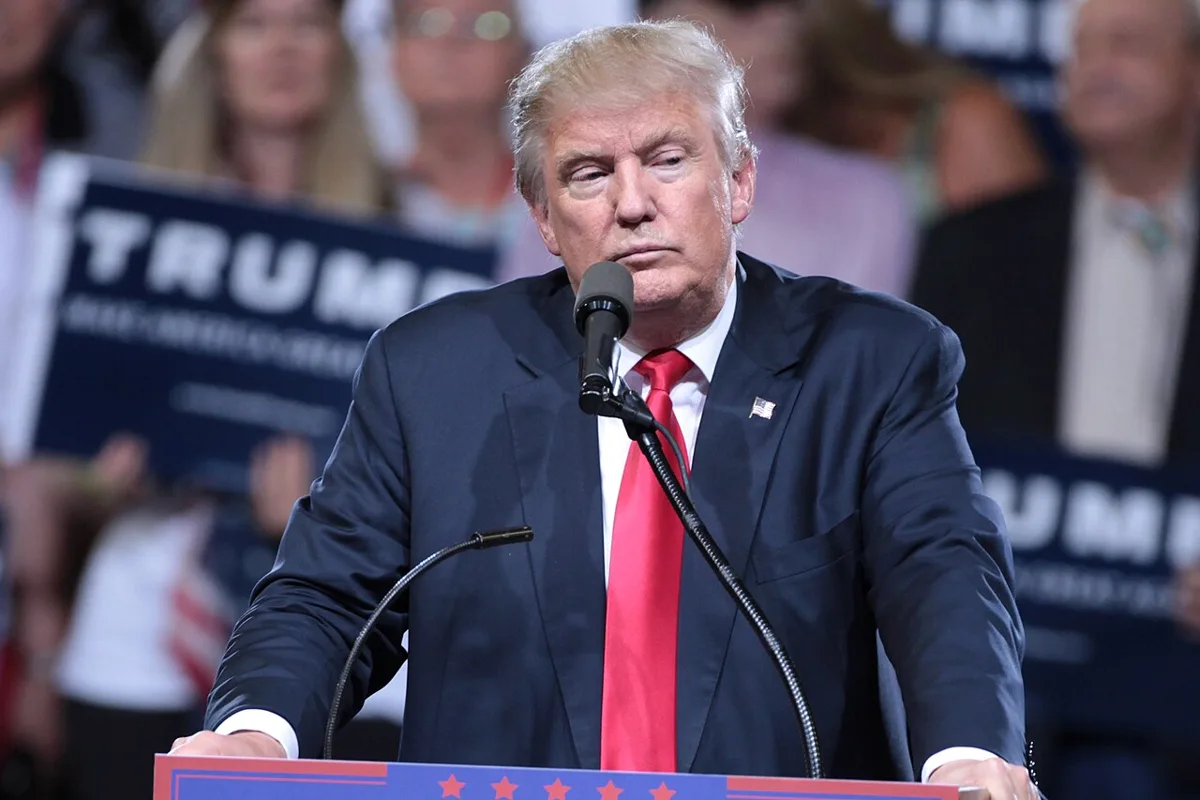
Donald Trump stood in front of the country during a prime-time White House address and cited a CIA report as proof that Venezuela manipulated its elections. The CIA report he cited says no such thing. In fact, it says the opposite.
What Trump Actually Said
During a Thursday prime-time address, Trump told viewers that declassified CIA documents prove the governments of Hugo Chavez and Nicolas Maduro devised plans to electronically manipulate Venezuelan election results between 2004 and 2020. He used this as a launching pad to push his broader argument that electronic voting systems are dangerously vulnerable, including, presumably, in the United States.
He also accused China of having the intention to manipulate electronic elections. The whole thing was framed as a dire national security warning, the kind of address designed to make your uncle forward it to the family group chat with seventeen exclamation points.
The problem, which is a fairly significant one, is that the CIA document Trump was citing does not support his claims. At all. And we are not talking about a subtle misreading here. We are talking about a president publicly describing a report as saying something it explicitly says it does not say.
What the CIA Report Actually Says
The CIA report in question was published on June 29 and covers roughly two decades of intelligence analysis on Venezuelan elections. According to teleSUR's reporting, drawing on sources including EFE and the Venezuelan research group Truth Mission, the report concluded that Venezuela "probably had some capability" to manipulate voting systems. That's the part Trump used.
Here is the part Trump did not mention: the same report states there is no evidence of electronic fraud in Venezuela. The CIA's own baseline assessment of the 2012 election, the report says, "remains that large-scale fraud did not occur." The report also found that the Bolivarian government "did not need to resort to significant fraud to win the December 2020 National Assembly elections."
The agency went further and concluded that Venezuela could not alter elections outside its own borders, and specifically could not manipulate U.S. elections. So the document Trump waved around as proof of a foreign election-manipulation threat explicitly rules out the scenario he was using it to illustrate. The CIA also acknowledged that reports about advanced manipulation techniques came from "limited sources."
The actual finding, if you want to be precise about it, is that Venezuelan electronic voting systems contain "vulnerabilities that could theoretically be exploited by sophisticated actors with insider access." Theoretically. Could. Not did. Not proven. Theoretical.
The Distance Between "Could Theoretically" and "Did"
This is not a minor distinction. "Could theoretically" describes a risk assessment. It is the kind of language intelligence analysts use when they are specifically trying not to assert something they cannot prove. Trump converted that careful hedge into a definitive historical claim of fraud, live, in front of a national audience.
Imagine a fire marshal telling you that a building's wiring has vulnerabilities that could theoretically cause a fire under certain conditions with the right combination of failures. Now imagine the mayor going on television to announce the building burned down. That is roughly the distance we are talking about here.
Truth Mission, a Venezuelan research group cited by teleSUR, put it bluntly: "The summary of the CIA assessment states it clearly: concerns about Venezuela's ability to manipulate elections did not translate into conclusive evidence of fraud. In other words, the United States has no proof that fraud occurred in Venezuela's elections. Everything else is propaganda."
Why This Matters Beyond Venezuela
You might be wondering why the president of the United States is giving prime-time speeches about Venezuelan elections in the first place. The context matters. Trump has spent years pushing the idea that electronic voting machines are compromised and that American elections cannot be trusted, a campaign that started the night he lost in 2020 and has never really stopped.
Using foreign election systems as a cautionary tale is a reliable rhetorical move. It seeds doubt about electronic voting in general, which then gets redirected toward American elections specifically. It does not require him to directly say American machines were hacked. He just needs people to absorb the general vibe that machines are hackable and foreigners are doing it.
The fact that the CIA document he specifically chose to cite for this argument actively undercuts the argument is either a colossal failure of staff preparation, a deliberate bet that nobody would read the actual report, or some combination of both. Given that we are talking about a president who has built an entire political identity around claiming elections are stolen, the bet that nobody checks the footnotes is probably not a reckless one.
The White House Has Said Nothing
At time of publication, there has been no correction, no clarification, and no acknowledgment from the White House that Trump's characterization of the CIA report was flatly inaccurate. This is, by now, a familiar pattern. The speech happened. The claim landed. It circulates. The correction, if it comes at all, gets a fraction of the attention.
CIA reports are not light reading, and Trump is counting on that. Most people who saw clips of the speech will not go hunting for a June 29 intelligence document to fact-check the president's summary of it. That asymmetry is the whole game.
The Dingo Take
Let's be straightforward about what happened here. The President of the United States, during a formal prime-time White House address, described a CIA report as proving something that the CIA report explicitly says did not happen. This is not spin. It is not creative interpretation. The same document he cited to claim Venezuela committed electronic election fraud contains the sentence that the CIA's assessment is that large-scale fraud did not occur. Those two things cannot both be true.
What makes this especially rich is the specific context. Trump has spent the better part of a decade telling Americans they cannot trust electronic voting. His entire post-2020 political existence is built on that premise. And when he finally waves around an actual government intelligence document to back that story up, he picked one that directly contradicts him. It would be funny if it were not a prime-time address to millions of people who will never read the underlying report.
The CIA did the work. The analysts hedged appropriately, used careful language, and arrived at a conclusion that was honest about what the evidence showed and what it did not. Then the president took that document, stripped out every qualification, flipped the conclusion, and told a national audience the opposite of what it says. That is not a communications strategy. That is just lying about what a document says while holding the document.




Comments