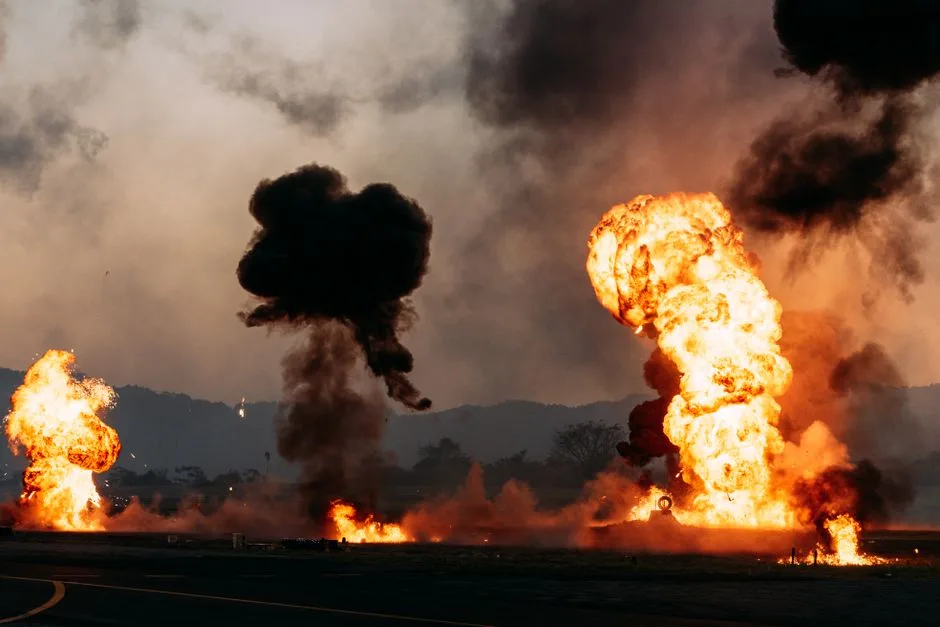
Ten consecutive nights. That's how long the United States military has now been bombing Iran, and it just launched another round. Iran, for its part, is shooting missiles at Jordan, sending drones over Kuwait, and its president has officially declared this a 'full-scale war' with the United States of America.
What Night 10 Actually Looks Like
The US military announced Monday that it had begun a new wave of strikes against Iran, specifically targeting the country's ability to threaten shipping through the Strait of Hormuz, according to BBC News. This is the tenth night in a row of American military action. Let that settle in for a second.
The strikes follow Trump's explicit promise that Iran would pay 'many times over' for the deaths of three American soldiers, two killed in Jordan and one in Iraq. The previous night's attacks hit Iranian military and communications infrastructure in multiple cities, including Tabriz, Chabahar, Konarak, and the port cities of Bandar Mahshahr and Bandar Imam Khomeini, per Iran's semi-official Tasnim news agency.
Iranian state media reported that two oil tankers exploded while attempting to transit the strait. Iran's Islamic Revolutionary Guard Corps claimed the vessels were using what it called an 'unsafe and hazardous southern route,' which is a remarkable way to describe a shipping lane your country has been mining and threatening. US Central Command disputed the IRGC's characterization of events.
Iran Is Shooting at Everyone Now
While absorbing American airstrikes at home, Iran has been busy shooting outward in every direction. Jordan's military said late Monday it had shot down three Iranian missiles as air raid sirens sounded across the country. Kuwait's armed forces confirmed they had intercepted Iranian drones. Bahrain reported that Iranian drones targeted its air navigation systems, though it said air traffic remained unaffected, BBC News reports.
Iran's President Masoud Pezeshkian went on record calling this a 'full-scale war' with the United States. That is a sitting head of state, using those exact words, about an ongoing active conflict. Whatever the phrase 'full-scale war' means to you, it probably does not involve ten nights of bombing and missiles raining down on multiple US-allied countries simultaneously.
This is the part where someone usually says the situation is 'escalating.' At this point, that word has ceased to carry any descriptive weight. We are past escalation. We are somewhere new.
The Ceasefire That Wasn't
Here is a detail that deserves more attention than it is getting. According to BBC News, Tehran confirmed that diplomatic messages are still being exchanged between the two sides through intermediaries, even as the conflict rages and a ceasefire has already collapsed.
So both countries are officially talking, unofficially bombing each other, and Iran is simultaneously firing on American allies in Jordan, Kuwait, and Bahrain. This is what passes for diplomacy right now. Both governments apparently believe they can bomb their way to a negotiating position while also keeping a back channel open through middlemen, which is either sophisticated statecraft or a complete disaster wearing statecraft's clothes. Possibly both.
The collapse of a ceasefire implies there was a ceasefire to collapse. It did not last. The strikes resumed. The missiles kept flying.
The Oil Angle Nobody Is Ignoring
Two oil tankers exploded trying to cross the Strait of Hormuz. Iranian state media reported the explosions. The IRGC framed it as the ships' own fault for using a dangerous route. US Central Command pushed back on that account, per BBC News, but has not elaborated publicly on what it believes actually happened.
The Strait of Hormuz is not some obscure waterway. Roughly 20 percent of the world's oil supply moves through it. Every day. When tankers start exploding there, oil markets notice. The global economy notices. Every country that heats homes or moves goods on trucks or flies aircraft notices, even if they are not paying attention to the military conflict itself.
Whatever is happening in the military dimension of this war, the economic dimension is already live and already spreading well beyond the immediate region.
Trump's Framing and What It Means
Trump has publicly tied the strikes to the deaths of three American service members, saying the previous night's attacks came 'in honour' of the soldiers killed in Jordan and Iraq, and vowing Iran would pay 'many times over.' That is language designed to signal to a domestic audience that this is retribution, not aggression. Strength, not war.
The problem with the 'many times over' framing is that it has no logical endpoint. How many times is many? How degraded does Iran's capability need to be before the ledger is settled? No one in the administration appears to have answered that question publicly, and ten nights of consecutive strikes suggests either the answer is 'a lot more' or there is no answer at all.
Meanwhile, the actual strategic objective, degrading Iran's ability to threaten Strait of Hormuz shipping, has not visibly been achieved, given that tankers are still exploding in the strait.
The Dingo Take
Ten nights. Let's be honest about what that number represents. This is not a targeted strike or a show of force or a proportional response. This is a sustained air campaign against a sovereign nation, the tenth consecutive night of which the US military announced with a press release like it was a product update. The word 'war' has been avoided with almost comedic discipline by official US sources, while Iran's own president is out here using it freely and firing missiles at three different countries.
The ceasefire collapsed. The diplomats are still texting through intermediaries, apparently. Oil tankers are on fire in one of the most important shipping lanes on earth. Jordan is intercepting missiles. Kuwait is shooting down drones. And Bahrain's air navigation systems were a target. If you had described this scenario two years ago, someone would have called it an overwrought Tom Clancy plot.
What is missing from all of this is any coherent public explanation of what 'winning' looks like, what the exit condition is, or what happens if ten nights of bombing does not in fact degrade Iran's capabilities enough to stop the tanker attacks. Those are not trick questions. They are the only questions that matter right now, and nobody in Washington is answering them.





Comments