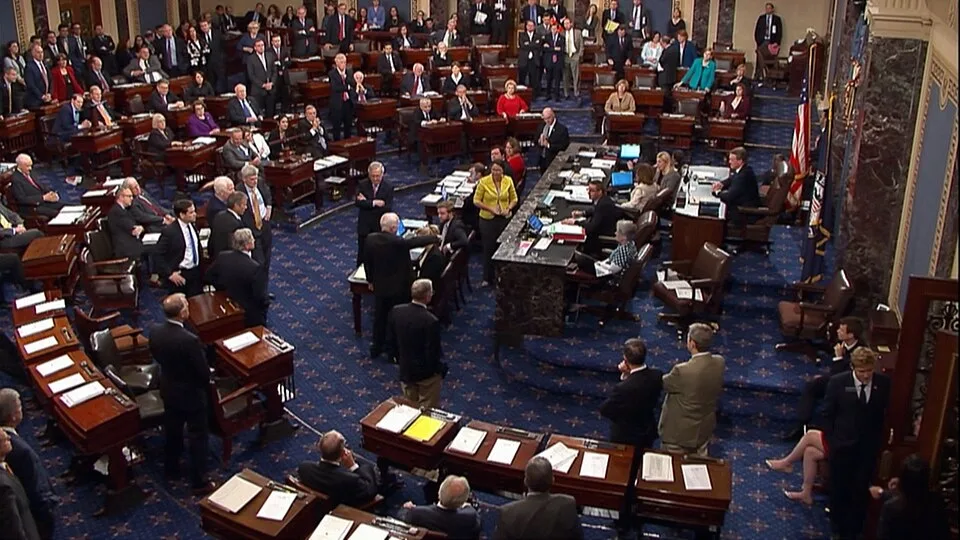
The United States is now on its 12th consecutive night of airstrikes against Iran, 18 Americans are dead, and the Senate just voted to keep going without ever formally authorizing any of it. Thursday's 49-47 vote to block a war powers resolution wasn't even close. One Republican broke ranks. One Democrat helped kill it. And somewhere in Washington, the Constitution wept quietly into its drink.
What Actually Happened on the Floor
CBS News reports the Senate voted 47 to 49 on a resolution led by Sen. Chris Van Hollen of Maryland that would have directed the president to remove U.S. Armed Forces from hostilities against Iran unless Congress explicitly authorized the fight through a declaration of war or a specific authorization for use of military force. That is, for the record, exactly what the Constitution already says Congress is supposed to do. The resolution failed anyway.
Susan Collins of Maine was the only Republican willing to cross the aisle. John Fetterman of Pennsylvania was the only Democrat willing to vote against his own party's effort to stop the war. Sens. Lisa Murkowski of Alaska and Rand Paul of Kentucky, who have previously supported similar measures, simply did not show up to vote. Two senators who have staked out positions on this exact issue before, and on the day it actually mattered, they were absent. Tremendous.
Meanwhile, the House Actually Did Something
Earlier the same day, the House managed to pass its own war powers resolution, 214 to 208, introduced by Democratic Rep. Pramila Jayapal of Washington. Four Republicans broke with their party to vote for it: Tom Barrett of Michigan, Brian Fitzpatrick of Pennsylvania, Warren Davidson of Ohio, and Thomas Massie of Kentucky, according to CBS News. Four. Out of the entire Republican caucus.
That the House passed anything at all is somewhat remarkable given its current composition. That it still probably goes nowhere is not remarkable at all. The Senate just demonstrated what happens to these resolutions, and the word that comes to mind is "nothing."
The War Powers Act Is Technically Still a Law, For What That's Worth
Here's a fun civics refresher. Under the War Powers Resolution of 1973, the president has to report to Congress within 48 hours of deploying troops without a declaration of war, and any unauthorized military engagement has a 60-day cap with a possible 30-day extension. That's the law. Congress passed it. Presidents have mostly ignored it for 50 years, but it is still, technically, on the books.
As CBS News reports, when the 60-day deadline approached earlier this year, the Trump administration declared it didn't apply because a ceasefire on April 7 had paused the clock. Then the president sent a letter to Congress on May 1 saying hostilities with Iran had "terminated." Then he formally notified Congress on July 7 that military action had restarted. So the war stopped, and then it started again, and now it's been 12 straight nights of airstrikes, and apparently none of this requires a single congressional vote to authorize. Just to be clear about what the rules are now.
The Senate Floor Arguments, Both of Them
Senate Minority Leader Chuck Schumer made the case for the resolution in terms that were direct, if not exactly optimistic. "Will our Republican colleagues join us?" he asked, according to CBS News. "Or are they just going to keep their heads in the sand? They know how bad this is, they're hearing it from one end of the country to the other." Schumer vowed Democrats would force more votes, again and again, until Republicans "see the light." The light, at current visibility, appears to be very far away.
GOP Sen. Tim Sheehy of Montana, a former Navy SEAL, delivered the counterargument with considerably more heat. He argued on the Senate floor that Iran started this fight 47 years ago with the 1979 hostage crisis, that no president before Trump had ever truly hit back, and that American troops are fighting a just war against a "murderous, savage adversary." It was a genuinely impassioned speech. It also did not address the constitutional question of whether Congress needs to authorize the war, which was the actual subject of the vote, but that's not really the point of a floor speech.
How We Got Here, and Where Here Is
This conflict started in February, according to CBS News, and Democrats have been running a series of procedural votes ever since to put Republicans on record and apply political pressure. In May, four Republicans joined Democrats to advance a similar measure led by Sen. Tim Kaine of Virginia. In June, the same four Republicans helped pass a separate House-passed concurrent resolution, a symbolic rebuke that didn't require the president's signature. That one actually looked like a moment.
Then the president met with Republican senators, GOP leadership applied pressure, and within 24 hours those same Republicans reversed course and killed Kaine's resolution when it came to a fuller vote. The Senate GOP has been remarkably consistent in eventually doing what the White House wants on this war, regardless of what individual members said before the meeting. Thursday's vote was the first since the ceasefire collapsed earlier this month. The death toll now stands at 18: three soldiers killed in an Iranian attack in Jordan last week, and one more service member who died in Iraq during a controlled explosion to destroy an Iranian drone, per CBS News.
The Dingo Take
Let's be honest about what's happening here. A war that started in February, that has now killed 18 Americans, that involves 12 consecutive nights of airstrikes on a foreign country's military infrastructure, is being conducted without a single congressional vote to authorize it. Not one. Congress has voted repeatedly on whether to stop it, and even those votes keep failing. The actual legal foundation for this war is the president's interpretation of his own powers, filtered through an administration that declared the War Powers Act didn't apply, then said the war was over, then restarted it. This is not a constitutional gray area. This is the gray area looking at you and shrugging.
The Senate had 49 votes to kill a resolution that would have forced the issue. That's not a majority of people who believe in this war's legal footing. That's a majority of people who are too afraid of the White House to say publicly what several of them have reportedly said privately. Murkowski and Paul didn't even show up. Fetterman voted with the Republicans. Collins was the lone Republican who crossed over. Forty-nine votes to keep fighting a war no one officially authorized, with no public accounting, no formal debate, no recorded declaration of intent from the people's representatives. Just airstrikes, and a body count, and floor speeches about 1979.
Schumer says Democrats will keep forcing votes until Republicans see the light. That's fine. Keep doing it. Put them on record every single time. But the record now shows that the Senate has had multiple chances to invoke the most basic constitutional check on executive military power, and it has declined every time. Eighteen dead Americans later, the institution responsible for declaring war is busy scheduling its next symbolic vote on whether to think about possibly considering asking the president to maybe stop.




Comments