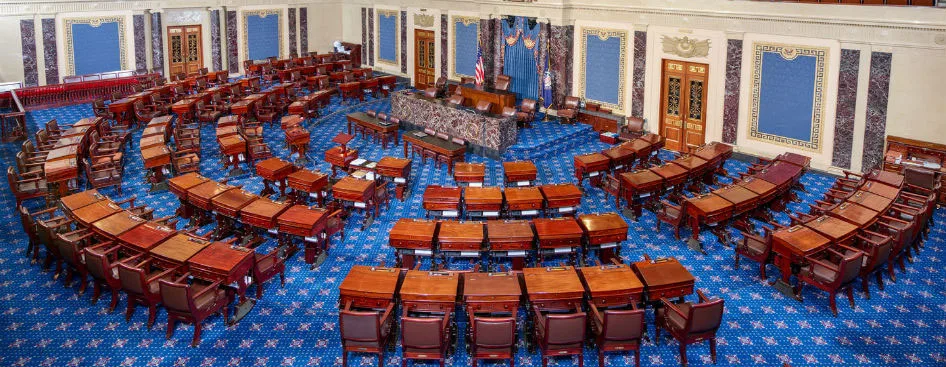
The United States Senate, that great deliberative body best known this year for partisan screaming matches and performative walkouts, may actually be about to do something. Democrats are signaling they're ready to vote as early as next week on a Russia sanctions package, according to people familiar with the matter who spoke to Axios. The catch, because there is always a catch, is that Trump demanded Iran get thrown into the bill at the last minute.
What's Actually in the Deal
Here's the basic shape of it. There's a Russia sanctions package, designed to put economic pressure on Moscow and ostensibly help end the war in Ukraine, that has been kicking around the Senate for a while. It was moving. Then, at the eleventh hour, President Trump decided it also needed to target Iran.
According to Axios, Democrats are now indicating to their Republican counterparts that they're prepared to swallow that demand and vote on the combined bill. That means Majority Leader John Thune of South Dakota and Minority Leader Chuck Schumer of New York have apparently found enough common ground to move legislation a few weeks before Election Day. Which, in this Senate, is roughly as rare as a solar eclipse that also plays saxophone.
Why This Is A Bigger Deal Than It Sounds
Let's be honest about the bar here. The Senate has spent most of 2026 in the kind of partisan combat that makes cable news producers rub their hands together and makes everyone else want to move to a cabin in the mountains with no WiFi. Thune and Schumer working together on anything substantive is not the norm. It's the exception.
The Ukraine angle matters too. The war has ground on, the debate over U.S. involvement has been a political football since 2022, and legislation that actually applies real economic pressure on Russia has been repeatedly stalled, watered down, or drowned in procedural quicksand. If this gets a vote and actually passes, it would be the most concrete legislative action Congress has taken to support Ukraine's position in some time.
So yes, by the standards of the current United States Senate, a bipartisan Russia-and-Iran sanctions vote counts as a genuine breakthrough. That's where we are.
Trump's Last-Minute Iran Detour
Now for the part that has Trump's fingerprints all over it. The Russia sanctions bill was moving along, and the President decided that wasn't enough. He wanted Iran included. This is, to be clear, a classic Trump move: take a thing that is mostly done, insert a new demand, and watch everyone scramble to figure out whether the new demand blows up the deal or whether they can paper over it fast enough.
In this case, it appears Democrats decided they could live with it. Axios reports they are prepared to vote on the combined package. Why? Hard to say for certain. Maybe they calculated that letting Trump claim a win on Iran was worth finally getting Russia sanctions passed. Maybe Schumer did the political math and decided this was the best deal on the table with Election Day approaching. Or maybe everyone involved just looked at the calendar and decided that something was better than nothing.
Either way, the Iran add-on is real, and it's now baked into what could become law.
The Election Day Factor
Axios flags something worth paying attention to: this would show that Thune and Schumer can get things done weeks before Election Day. That framing is interesting. Senate leaders don't suddenly discover bipartisan cooperation because they love democracy. They discover it because the calendar creates incentives.
Both parties have something to gain from showing voters they can govern. Republicans can point to sanctions on Russia and Iran as a foreign policy toughness win. Democrats can point to the Ukraine dimension and argue they forced some accountability for Putin's war. In an election environment, having a bill you both voted for is a lot more comfortable than having a bill one side blocked.
That's not cynical so much as it's just accurate. Sometimes the right outcome happens for impure reasons. We will take it.
The Dingo Take
Here is the thing about this story that is genuinely complicated. On the merits, sanctioning Russia harder is good. Applying economic pressure on a country actively waging a land war in Europe, killing tens of thousands of people, is a defensible and arguably overdue policy choice. Democrats voting yes on that is not capitulation, it's the correct call. And if Iran being included is the toll they had to pay, that's a political tradeoff worth evaluating on its own terms rather than reflexively cheering or booing based on who demanded it.
But let's not pretend the process here is anything other than chaotic. Trump threw in an Iran demand at the last minute because that is how he operates: impulsively, transactionally, and always angling for maximum personal credit. The fact that the Senate has adapted to governing around a president who treats legislation like a hostage negotiation is not something we should just normalize as fine, actually.
Still. Russia sanctions. Bipartisan vote. Before Election Day. In this Senate. If it happens, that is real. Don't let the perfect be the enemy of the barely functional. The bar is on the floor, but clearing it still counts.





Comments