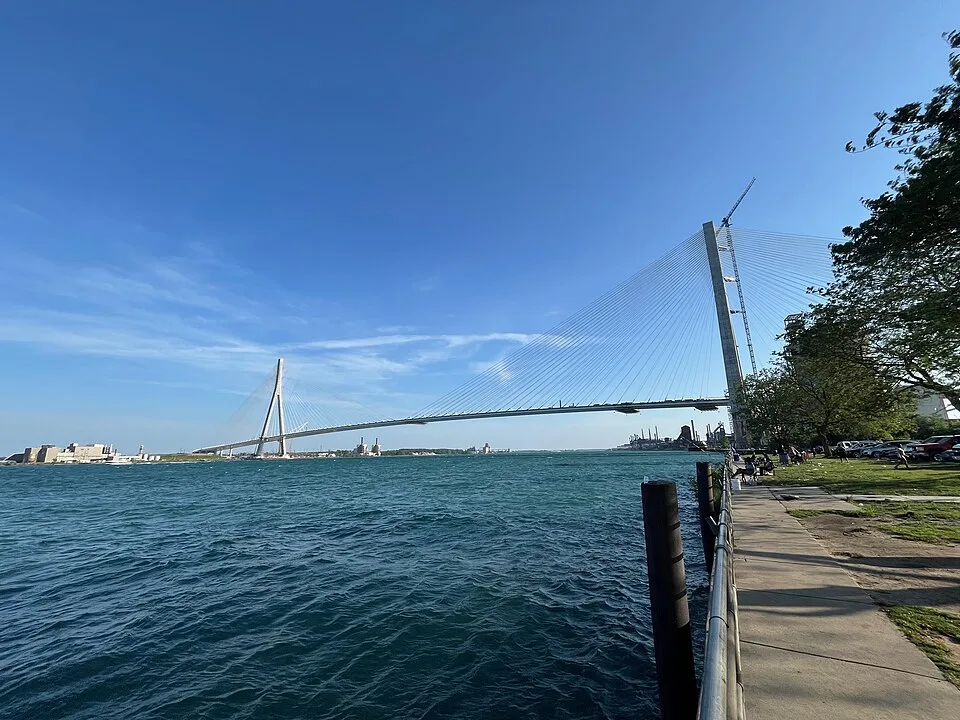
Canada spent $4.5 billion US dollars building a bridge to America, handed over half the revenue to make Trump happy, and then told American officials to stay home for the party. The opening ceremony for the Gordie Howe International Bridge happened Friday with Canadian flags, children playing street hockey, and zero American dignitaries, because sometimes you just have to eat a $4.5 billion snub and make the best of it.
The Most Expensive Solo Party in Canadian History
The Gordie Howe International Bridge connecting Windsor, Ontario and Detroit, Michigan was supposed to open with a joint celebration. Canadian and American officials were going to shake hands, make speeches, and pretend the relationship between these two countries isn't currently held together with duct tape and passive-aggression. That plan died when Trump threatened fresh tariffs on Canada, and Ottawa responded by disinviting their American counterparts entirely.
"Given the recent tariff action from the US, we felt that we should focus today on celebrating here in Canada," infrastructure minister Gregor Robertson said at the ceremony, according to BBC News. Trump, for his part, acknowledged the snub on social media and said it was "fine, considering they are paying substantial TARIFFS to the United States." The president of the United States, responding to being uninvited to a ribbon-cutting like a sulky teenager who didn't get picked for the team.
The bridge cost C$6.4 billion, which Canada paid in full. That's $4.5 billion US. Every cent of it Canadian. The entire reason Canada agreed to foot the bill alone, over a decade ago, was to get around US political resistance and actually get the thing built. So yes, Canada built America a bridge, and America's contribution so far has been threatening tariffs and demanding ownership of something they didn't pay for.
Trump Wanted a Cut of the Bridge He Didn't Build
Here is where the story gets special. Early this year, just before a planned ribbon-cutting, Trump announced he would block the bridge's opening unless Canada agreed to "share authority" and ownership. "We should own, perhaps, at least one half of this asset," he said. The asset that Canada built. With Canadian money. That Canada is about to pay back through tolls.
BBC News reports that billionaire Matthew Maroun, whose family owns the neighbouring Ambassador Bridge and who is also a Trump donor, met with Commerce Secretary Howard Lutnick just hours before Trump made those comments. The Ambassador Bridge is the busiest commercial border crossing in North America and one of the few that are privately owned. A new, publicly owned bridge right next door is obviously terrible for that business. Make of that timing what you will.
In June, Prime Minister Mark Carney announced Canada would delay the opening to allow for further negotiations. Then Ottawa agreed to split half of the bridge's toll revenues for the next 15 years with a US-controlled economic development fund. Trump called the new deal "MUCH BETTER" for America in a social media post. He was not wrong about that.
Carney's 'Elbows Up' Problem
The bridge is named after Gordie Howe, the legendary hockey player who happened to spend most of his career playing for the Detroit Red Wings, which is about as perfect a symbol of complicated cross-border identity as you're going to find. When Carney was campaigning for prime minister, he borrowed Howe's phrase "elbows up" to signal he'd take a combative approach to Trump's trade war. Canadians loved it. The merchandise practically sold itself.
Now Carney is getting hammered from multiple directions. Conservative MP Shuvaloy Majumdar told a news conference that the bridge situation proves Canada has been negotiating "with weakness," and that Canadians "deserve a government that is willing to fight for their existence and their country." That is a rough thing to say out loud at a press conference about a bridge, but here we are.
Collin Robertson, a former Canadian diplomat and fellow at the Canadian Global Affairs Institute, put it to the BBC more colorfully: "They renege on deals. They don't follow agreements. It's like dealing with pirates." He still thinks the revenue-sharing concession was necessary, given how critical the Windsor-Detroit crossing is to both economies. Over C$1 billion worth of goods crosses there every single day. But Robertson was also clear that Canada has given enough, and that further concessions "would be problematic and probably not in our interest."
Canada Is Cracking, and Trump Knows It
One of the things keeping Canada's negotiating position together has been a show of provincial unity. That is starting to fray. Ontario Premier Doug Ford praised Carney's handling of the bridge deal and called Trump a "bully," while also suggesting Canada use its energy and critical mineral exports as leverage. That's the tough-talk wing of Canadian politics.
But Alberta's Danielle Smith and Saskatchewan's Scott Moe are urging restraint, which in this context means urging Canada not to do anything that might upset the Trump administration. BBC News notes this reveals "cracks in Canada's united approach to the US." When your internal opposition is arguing for gentleness toward the guy calling your country a punching bag, your coalition has a problem.
Carney has also taken heat for a lack of clarity around the details of the new bridge revenue deal and exactly how the money will flow. He said Thursday that the original revenue-sharing agreement with Michigan remains in place, and the new White House deal runs "in parallel" to that. What that means in practice, in dollars, remains genuinely unclear. Canadians just handed over a bridge and aren't totally sure what they got in return.
The Dingo Take
Let's be precise about what happened here. Canada built a $4.5 billion bridge to help American trade, paid for it entirely themselves, and then watched Trump demand ownership of it based on nothing except the fact that one of his donors has a competing bridge nearby. Canada then agreed to give up half of the revenue it was counting on to recoup those costs. And then Trump threatened more tariffs anyway, so Canada told American officials to skip the party. That is the full arc of this story. It ends with Canada celebrating alone in the cold while children play street hockey.
The Gordie Howe comparison that keeps coming up is doing a lot of work. Yes, Howe played with his elbows up. He also, as Colin Robertson reminded BBC News, understood that "the objective is to get the puck in the net." But there is a third thing about Gordie Howe that nobody seems to be saying out loud: he was famous for being one of the most physically punishing players in the history of the sport. The elbows weren't a last resort. They were a message sent early and often so opponents understood the cost of taking liberties. Canada has been sending a very different kind of message.
The Gordie Howe Bridge is now open, which is genuinely good for both countries, billions of dollars in daily trade, supply chains, all of it. But the ceremony that marked its opening was a solo act, a nation celebrating infrastructure it built for a neighbor who repaid the favor with tariff threats and a demand for a cut. If there's a better physical monument to this particular moment in US-Canada relations, we haven't seen it.



Comments