The Department of Justice filed suit against Milwaukee on Thursday because the city had the audacity to require that law enforcement officers show their faces while policing the public. Yes, really. The Trump administration is now in federal court arguing that its agents have a constitutional right to wear masks while detaining American residents, and they've got a winning streak they'd like to extend.
The Lawsuit, Spelled Out Plainly
The Hill reports that the DOJ sued Milwaukee over a local ordinance banning law enforcement from wearing face coverings while on duty. The administration's legal argument is that the ban is unconstitutional as applied to federal agents, meaning that while Milwaukee can tell its own cops to show their faces, it cannot make that demand of ICE agents or whoever else the federal government sends rolling through town.
The DOJ's court filing pointed to what it called a "growing number" of courts siding with the administration on this exact question. That's not bluster. The Trump administration has already filed similar suits against California, Virginia, and Philadelphia, and according to The Hill, those challenges have gone well for the feds. Milwaukee is just the next city on the list.
Why Cities Are Banning the Masks in the First Place
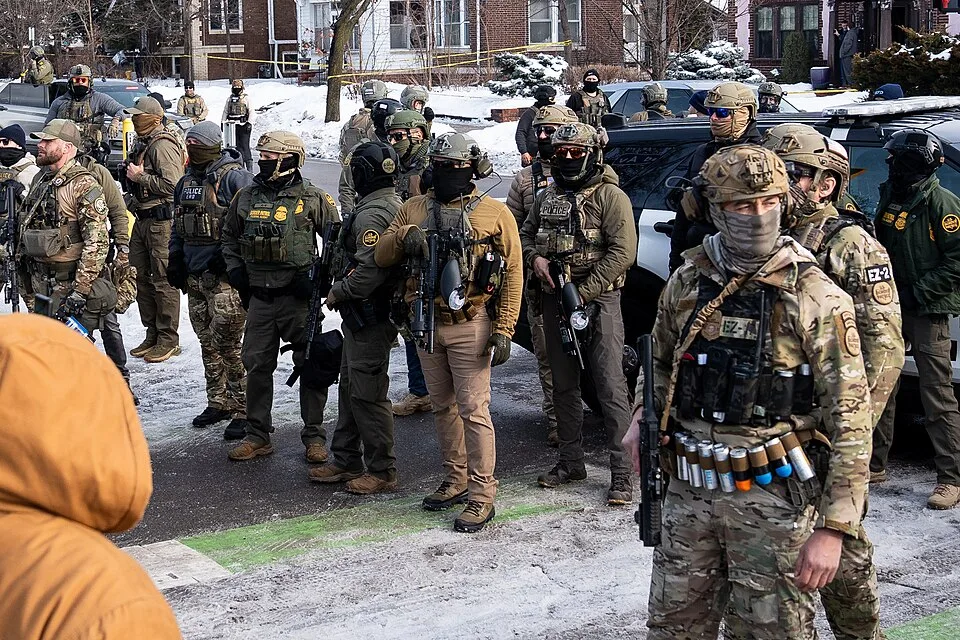
Let's be clear about what this is actually about. These local ordinances didn't materialize out of nowhere. They are a direct response to viral footage of unidentified federal agents in tactical gear, faces covered, grabbing people off streets with no identifying information, no visible badges, and no apparent interest in explaining themselves or their authority to anyone watching.
Cities like Milwaukee looked at that footage and said, reasonably, that law enforcement operating in their jurisdiction should be identifiable. That if you're going to arrest someone in public, the public should be able to see who you are. The Trump administration looked at that exact same reasoning and said: we'll see you in court.
The Administration's Legal Strategy Here Is Not Subtle
This is part of a deliberate, coordinated legal campaign. The DOJ isn't reacting to Milwaukee specifically. It is systematically targeting every jurisdiction that has tried to impose any local accountability on federal immigration enforcement. California, Virginia, Philadelphia, and now Milwaukee. They are building case law, one friendly ruling at a time, establishing the principle that federal agents operating on American soil answer to no local authority whatsoever.
That's a significant thing to be building toward. The argument isn't just about masks. It's about whether any city government has any meaningful say over how federal law enforcement conducts itself within city limits. The masks are the vehicle. The destination is something much broader.
What Happens If the Feds Keep Winning
The administration has already prevailed in similar cases, according to The Hill. If that trend continues through Milwaukee and whatever city comes next, you end up with a legal framework where federal agents can operate in any American city, faces covered, with no obligation to comply with local transparency or accountability rules.
Think about what that means practically. A resident gets detained. They can't identify the agent who grabbed them. Their lawyer can't identify the agent. A bystander who filmed it can't identify the agent. Local government can't demand identification. The federal government has, in that scenario, successfully created a class of law enforcement that is functionally anonymous while operating in broad daylight on American streets. That's not a hyperbolic slippery slope. That's just what the winning version of their legal argument produces.
Milwaukee's Options Are Slim
Milwaukee now has to decide whether to fight this in court or fold. Given the administration's track record in these specific cases, the city is not in a great legal position. Fighting costs money, takes time, and the precedents are stacking against local governments.
There's also the broader political pressure the Trump administration has shown it's willing to apply to cities that resist its enforcement priorities, whether through funding threats, public attacks, or just the grinding attrition of lawsuit after lawsuit. Milwaukee isn't a huge city with unlimited legal resources. The DOJ is counting on that math.
The Dingo Take
Here's what's remarkable about this moment: the Trump administration is openly litigating for the right of its agents to be unidentifiable while exercising state power over civilians, and it's winning. Not sneaking it through. Not hiding the argument. Filing lawsuits, in public, with press attention, saying outright that local governments cannot make federal law enforcement show their faces. That's the policy. They're proud of it.
The mask thing reads as minor until you think about why anonymity matters to anyone exercising power over other people. Accountability requires identification. If you cannot identify the person who detained you, you cannot file a complaint, name a defendant, or pursue any remedy. Anonymity for law enforcement isn't an operational quirk. It's the elimination of a check. That's the whole point.
Milwaukee will probably lose this one. Philadelphia lost. Virginia lost. California lost. And each loss makes the next city's fight harder, because now there's precedent. By the time anyone in Congress gets around to caring about this, the legal architecture will already be built. That's how this administration works. Slowly, methodically, and with way more patience for long-term institutional change than anyone covering the daily chaos ever gives them credit for.
Comments