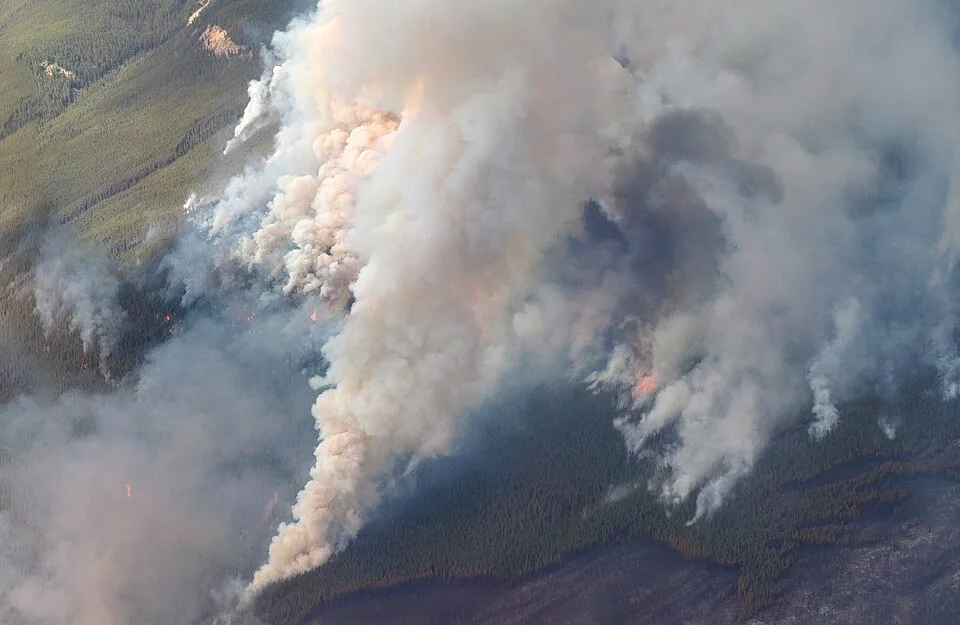
Donald Trump has accused Canada of 'poisoning' American air with wildfire smoke, suggested the country pay the US damages, and floated 50% tariffs on a nation that is currently watching its forests burn. Climate scientists would like a word.
The Accusation, In Full Absurd Detail
At the World Cup final over the weekend, Trump pulled aside Canadian Prime Minister Mark Carney to deliver one of the more surreal diplomatic messages in recent memory. According to The Guardian, Trump told Carney: 'You got to stop these fires from coming in and poisoning our air. If we can help them, we'll help them. But maybe they should pay us some damages or something, or we should do some tariffs.'
This is the President of the United States, at a soccer match, demanding that a neighboring country stop wildfires from crossing an invisible line in the sky, and suggesting monetary compensation if they fail to control atmospheric physics. Just sit with that for a moment.
Nearly 1,000 wildfires are burning across Canada right now. More than 8.1 million acres of mostly remote boreal forest have been consumed. Thousands of Canadians have been evacuated from their homes. And the American response, at the highest level of government, is: pay up, or face tariffs.
What Scientists Actually Said
The scientific community did not take this quietly. Michael Mann, a climate scientist at the University of Pennsylvania, gave The Guardian what might be the most perfectly constructed analogy in the history of climate communication: 'This is like crashing into the car in front of you because you were speeding and tailgating, and then demanding they pay for the damage to your headlights. It's victim-blaming by the assailant.'
Marshall Burke, an environmental policy expert at Stanford University, was equally direct. 'The main cause of worsening fires in Canada is not mismanagement,' Burke told The Guardian. 'Most Canadian forests are remote and haven't been managed at all, unlike the US, but instead a warming climate that has made large and extreme wildfires more common. These fires are not the result of Canadian action nor inaction, but instead largely the result of forces outside their control. So, punishment here would do nothing.'
Lori Daniels, an ecologist and wildfire expert at the University of British Columbia, called Trump's attacks 'unfounded, uninformed and even insensitive to people losing homes and firefighters putting their lives on the line.' She added that it's 'weak leadership to blame someone else when disasters are happening.'
The 'Raking' President Rides Again
You may remember that Trump has a theory about wildfires. It involves raking. In his view, forests catch fire because people don't clean them properly, and if we'd just get in there with some kind of enormous rake and tidy things up, the problem would largely go away. He has been saying versions of this for years.
Daniels, who actually studies these ecosystems for a living, explained patiently to The Guardian why this is not just wrong but physically impossible in Canada's case. The boreal forests are dominated by spruce and fir trees sitting on soils topped by spongy moss. In normal conditions, that moss is waterlogged. In the kind of extreme heat Canada has been experiencing thanks to a severe heat dome, that moss dries out and becomes fuel. Raking it would accelerate fires, not prevent them. The fires are also burning in areas so remote they lack roads or nearby firefighting resources. Canada's boreal forests cover roughly 1.2 billion acres.
'It would be physically impossible to do what Donald Trump has suggested, even with all the money and firefighters in the world,' Daniels told The Guardian. 'Some of the rhetoric from political leaders in the US is almost laughable.'
The Part Where the US Is Also on Fire
Here is a fact that tends to complicate the 'Canada is poisoning America' narrative: the United States is also on fire. The Guardian reports that huge blazes in Colorado and Utah have recently scorched 235,000 acres, forcing evacuations and killing Nicholas Dale, a Canadian pilot who died helping fight American fires.
Smoke from western US fires routinely drifts into Canada. This is how wind works. Neither country controls it. The air, infuriatingly for both Trump's worldview and his tariff strategy, does not respect borders.
The current blazes in Canada were worsened by a severe heat dome that expanded from the United States northward, according to The Guardian's reporting. Climate change more than doubled the likelihood of severe fire conditions during Canada's last major wildfire crisis in 2023, previous analysis found. The world is warming because of fossil fuel emissions, a process that, as The Guardian notes, Trump has actively sought to accelerate.
Congress Wants In on the Nonsense
It's not just Trump. Republican Senator Bernie Moreno of Ohio announced he will introduce legislation to sanction Canada for the 'atrocity' of not managing its forests properly, according to The Guardian. Sanctions. Against Canada. For having wildfires.
Hazy, unhealthy skies have hit New York, Washington DC, Detroit, and Toronto in recent weeks as smoke billows south. That's real, and it's a genuine public health crisis. Wildfire smoke triggers serious respiratory and heart problems, and The Guardian reports it has been eroding long-term air quality improvements that Americans had made over decades.
But the answer being offered by the US government is not to address the climate conditions driving these fires. It's to threaten tariffs and sanctions against the country that is currently losing its forests while its citizens evacuate their homes. That's the policy. That's the plan.
The Dingo Take
Let's be honest about what is happening here. Trump spent years calling climate science 'crap,' pulled the United States out of international climate agreements, and has made accelerating fossil fuel production a centerpiece of his presidency. The warming climate those choices contribute to is now driving catastrophic wildfire seasons across North America, filling American cities with hazardous smoke, and killing people. His response is to accuse the country that is most visibly on fire of attacking us.
This is not confusion. This is not ignorance, though there is plenty of that too. This is a deliberate strategy: find something to blame that isn't the actual cause, make it somebody else's fault, attach a tariff to it, and move on before anyone can do the math. It works, too, because 'Canada bad' is a much simpler message than 'decades of fossil fuel policy are catching up with us and we are out of easy options.'
Meanwhile, a Canadian pilot named Nicholas Dale died fighting fires in Colorado. Canada has sent firefighters to help the United States. The smoke doesn't care about tariffs. The boreal forest is not going to stop burning because a senator from Ohio is angry about it. And the heat dome that made all of this worse originated in the country that is now threatening sanctions. You cannot rake your way out of a warming planet, and you cannot tariff a wildfire into submission. But don't expect that to slow anyone down.




Comments