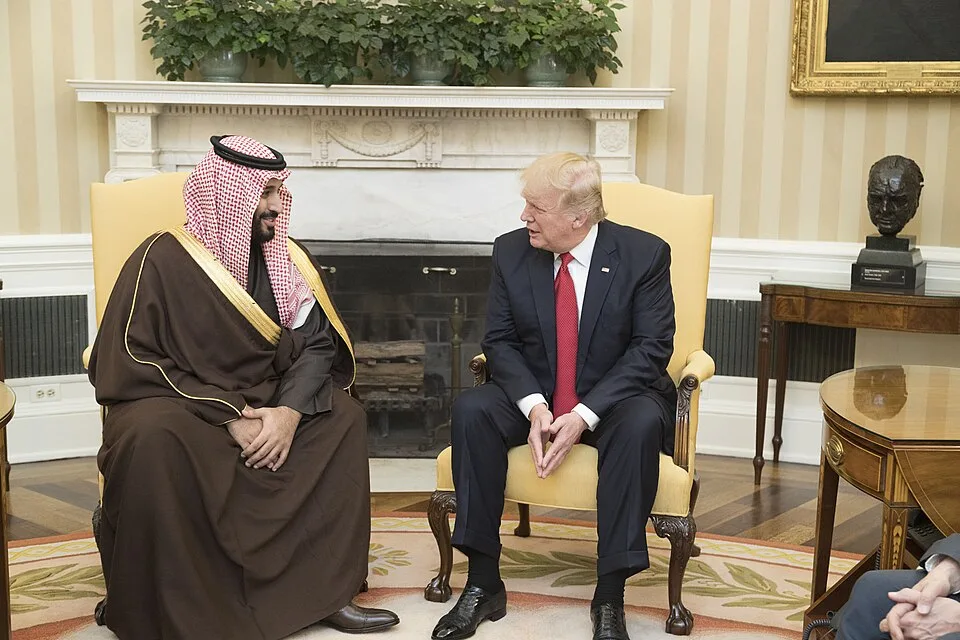
The Trump administration has signed a nuclear cooperation agreement with Saudi Arabia, giving the kingdom access to American nuclear technology and expertise to build out a civilian atomic energy program. This is the same administration that has spent the better part of two years threatening military action against Iran for doing roughly the same thing. Take a moment. Let that settle.
What the Deal Actually Says
The Department of Energy released details Wednesday on the agreement, which would provide U.S. technology and expertise to support Saudi Arabia's civilian nuclear energy program. The deal includes safeguards designed to prevent nuclear materials from being diverted toward weapons development.
That word 'safeguards' is doing a lot of heavy lifting here. The whole geopolitical debate unfolding in Congress right now hinges almost entirely on whether those safeguards are strict enough, and specifically whether Saudi Arabia will be required to meet the so-called 'gold standard' of nonproliferation commitments, which includes a firm pledge not to enrich uranium domestically. Spoiler: the current deal does not appear to include that pledge.
Fox News Digital reported on the sharply divided congressional reaction that followed the announcement, with Republicans broadly defending the agreement as a strategic necessity and Democrats warning it could light the fuse on a regional nuclear arms race.
The GOP Case: We Need Friends, So Deal With It
Republican supporters of the deal are leaning hard into the alliance argument. Rep. Tim Burchett of Tennessee put it about as bluntly as you can: 'I don't trust anybody as far as I can throw them, but we've got to develop allies.' Which is either refreshingly honest or deeply unsettling, depending on your tolerance for nuclear realpolitik.
Rep. Mark Alford of Mississippi was a bit more measured, telling Fox News he believes Congress should have a central role in reviewing any final agreement before it moves forward. He also made the regional partnership pitch, arguing that Saudi Arabia's ongoing internal reforms make it a credible partner against Iran. 'As we continue our conflict with Iran, we need partners in that region who are of the same mindset,' Alford said.
The argument has a certain logic to it, in the same way that arming one side of a bar fight has a certain logic to it. You're probably going to make the fight worse, but at least your guy will lose more slowly.
The Democratic Case: This Is How Arms Races Start
Democrats are not buying it, and they are saying so loudly. Rep. Jamie Raskin of Maryland called the deal 'outrageous.' Rep. Gregory Meeks of New York went further, warning that allowing Saudi Arabia to enrich uranium without airtight restrictions could trigger a cascade effect across the region.
'The president says what we're trying to do is to stop Iran from having a nuclear weapon, but if Saudi Arabia does not meet all the protocols, then it could cause an arms race where Egyptians or others in the area want a nuclear weapon,' Meeks told Fox News Digital. That is not a fringe concern. That is how nuclear proliferation actually works. One country gets a program, its neighbors panic, and suddenly everyone's shopping for centrifuges.
The timing also deserves scrutiny. The Trump administration is currently engaged in negotiations over Iran's nuclear ambitions while simultaneously handing Saudi Arabia, Iran's chief regional rival, a pathway to develop its own atomic capabilities. You could not design a more contradictory foreign policy posture if you tried.
Raskin Goes There on the Trump Family Money
Rep. Raskin did not stop at the policy arguments. He went directly at the financial relationship between the Trump family and the Saudi government, and the questions he raised are uncomfortable in a way that does not go away just because people would prefer they did.
'The Saudis enrich the Trumps, and the Trumps allow the Saudis to enrich uranium,' Raskin told Fox News Digital. 'And then we're going to have more nuclear weapons in the Middle East to set off another nuclear arms race there.' It is a pointed line, and the underlying facts about Saudi investment in Trump-affiliated businesses are well documented and publicly reported.
Whether that financial entanglement shaped this particular policy decision is something investigators and journalists will be working to answer. What is inarguable is that this administration has consistently received massive financial benefits from Riyadh while consistently delivering policy wins to Riyadh. Correlation is not causation. But at some point the correlation gets hard to ignore.
Congress Is in the Dark, Again
This should sound familiar. The Trump administration has developed a pattern of conducting major foreign policy moves and informing Congress somewhere between late and never. The Iran negotiations prompted demands from GOP lawmakers for a congressional vote after members complained they were being kept out of the loop entirely.
The Saudi nuclear agreement is now heading into that same territory. Rep. Alford's call for Congress to have 'a role' in reviewing the final agreement is notable precisely because it suggests the role of the legislative branch in a decision of this magnitude is, at present, unclear. A civilian nuclear cooperation deal with one of the most powerful countries in the Middle East, at a moment of acute regional tension, and Congress is asking to be included. Not demanding. Asking.
Fox News reports the agreement is expected to face significant congressional scrutiny in the coming months. That scrutiny would be considerably more meaningful if Congress had been in the room when the deal was being designed.
The Dingo Take
Here is the cleanest possible summary of what just happened. The Trump administration has spent years positioning itself as the only thing standing between the world and a nuclear-armed Iran. It has threatened war. It has imposed crippling sanctions. It has pointed at Iran's uranium enrichment as proof of existential danger. And then, this week, it signed a deal giving Saudi Arabia, Iran's most powerful enemy, a roadmap to build exactly that kind of program. The logic being offered is that Saudi Arabia is an ally and Iran is an adversary. Which is true. And also completely beside the point when we are talking about the spread of nuclear technology in the most combustible region on earth.
The Raskin quote is going to follow this deal around for a while, because it captures the core absurdity in a single sentence. 'The Saudis enrich the Trumps, and the Trumps allow the Saudis to enrich uranium.' You can argue about the motivations all you want. You can cite the safeguards. You can talk about regional alliances until you run out of breath. But the financial relationship between this administration and the Saudi government is not a conspiracy theory. It is a documented fact. And when documented facts line up this neatly with policy outcomes this convenient, the burden of proof falls on the people making the deal, not the people asking questions about it.
The arms race concern is not hypothetical. It is how the last several decades of Middle East policy have worked in practice. Countries watch their neighbors, they do the math, and they act accordingly. Egypt, Turkey, the UAE, all have their own nuclear ambitions and all have their own reasons to feel nervous about what Saudi Arabia might be building. The Trump administration is betting it can control an outcome in a region that has spent generations defying control. History suggests that is not a great bet. But the Trumps will be fine either way.




Comments