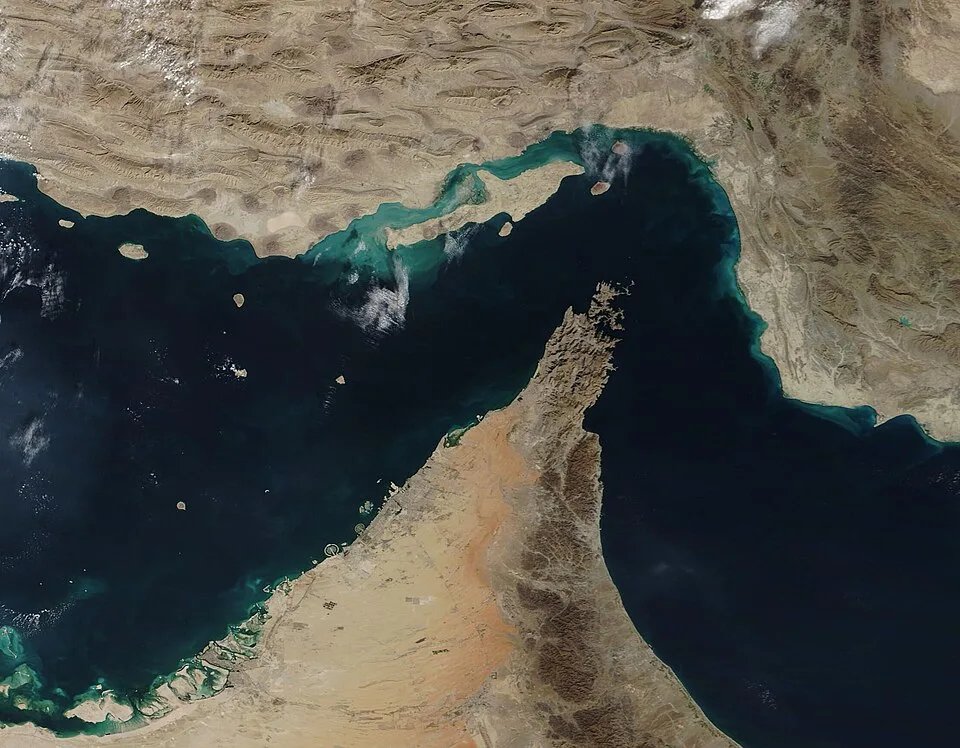
One hundred and fifty days into a hot war with Iran, the United States is claiming the Strait of Hormuz is open while Iran is literally firing warning shots at ships that try to use it. Both things are true at the same time. Welcome to the information environment of the Trump era, now with actual naval battles.
Six Ships, Six Warning Shots, Zero Open Straits
Iran's Revolutionary Guard Navy stopped six vessels Monday that tried to transit the Strait of Hormuz through a route not approved by Iranian authorities, according to CBS News. State television in Tehran reported the IRGC fired warning shots and turned all six ships back. On Saturday, they did the same thing to four more vessels.
This is the country that, according to President Trump and Defense Secretary Pete Hegseth, does not control the Strait of Hormuz. The U.S. controls it now, they say. Tell that to the ten ships that got turned around at gunpoint in the last three days.
Iran has effectively blockaded the strait since the war began in late February. Before the war, it was considered an international waterway. That was 150 days ago. A lot changes when two countries start bombing each other.
The Diplomacy That Isn't Diplomacy
Iran's Foreign Ministry came out Monday with an extremely careful statement. The ministry spokesman, Esmael Baqaei, told reporters in Tehran that Iran is not in direct negotiations with the United States. What it is doing, he said, is talking to Oman about "mechanisms regarding maritime traffic" in the strait.
"We currently have no negotiations with the United States," Baqaei said. "The negotiations that we are having are the same negotiations that we are conducting with Oman."
Now, an Iranian official separately told CBS News's Margaret Brennan on Sunday that those Iran-Oman talks were "constructive" and moving "in a positive direction." So the thing that is definitely not U.S.-Iran negotiations appears to be, functionally, U.S.-Iran negotiations conducted through Oman as a very thin diplomatic filter. This is how great powers talk when they are embarrassed to be seen talking.
'Locked and Loaded' with a Side of Diplomacy
U.S. Ambassador to the United Nations Mike Waltz went on "Face the Nation" Sunday and did the full both-sides-of-his-mouth routine. The pause in U.S. strikes is about "giving diplomacy some space," he said. Also, more military assets are "moving into the region" as we speak. Also, "the regime should believe the president when he says they're locked and loaded."
So to recap the official U.S. position: we are pausing bombing to give peace a chance, but we are also sending more weapons, and the president is locked and loaded. This is what passes for a coherent foreign policy message in 2026.
U.S. Central Command paused airstrikes Friday and Saturday after 13 straight days of bombing. Tehran paused its own strikes Sunday. The bombing halt is real. The diplomacy, conducted through Oman and wrapped in three layers of denial, also appears to be real. The question is whether either side has any idea what comes next.
The Human Cost Nobody's Leading With
Buried in the CBS News live blog, almost as an afterthought: more than 400 U.S. service members have been flown out of the Middle East for various types of treatment since Operation Epic Fury began on February 28, according to a U.S. official. Most cases were not combat-related, the official said.
So we are 150 days into a war called "Operation Epic Fury," over 400 American troops have needed medical evacuation, and the headline is about diplomatic semantics regarding Omani back-channels. The numbers are real. The war is real. The 400-plus Americans who have been medevacked out of the region are very, very real.
Israeli Prime Minister Benjamin Netanyahu added to the general weirdness Sunday by going on Fox News to say he supports Trump's pressure on Iran, and that during his upcoming Washington visit he plans mostly to listen to Trump rather than share intelligence, because "in many ways, it's his decision." That's a sentence Netanyahu said out loud about an American president.
What 150 Days Actually Looks Like
Operation Epic Fury kicked off February 28 as a joint U.S.-Israel campaign against Iran. Trump gave formal congressional notification on July 10 that hostilities had resumed on July 7, which is already a strange timeline worth sitting with. The U.S. also reimposed a naval blockade against Iran, with CBS News reporting Saturday that a dozen commercial ships had been redirected, two disabled, and two boarded.
Iran's position is that the interim deal it struck with the U.S. allows it to manage shipping in the strait for now. The U.S. position is that the strait is open and the U.S. controls it. Iran keeps shooting at ships that try to prove the American version correct. This is the situation at Day 150.
The global shipping industry, which depends on the Strait of Hormuz for roughly 20 percent of the world's oil traffic, is presumably not comforted by any of this.
The Dingo Take
Here is what is actually happening: both sides are exhausted, both sides are embarrassed, and neither side has achieved what it advertised. Iran still controls enough of the strait to turn ships around at gunpoint. The U.S. is conducting what is obviously indirect diplomacy while loudly insisting it is not doing diplomacy. Trump is simultaneously a "president of peace" giving talks a chance and a commander-in-chief who is "locked and loaded." These are not compatible descriptions of the same person in the same week, and yet here we are.
The Oman back-channel is not new. Oman has played this role before, most notably during the Obama-era nuclear negotiations that eventually became the Iran deal Trump scrapped in 2018. The fact that we are back in the same room, with the same mediator, after a war that has now run 150 days, should tell you something about how much was actually solved by blowing things up.
More than 400 American troops have needed medical attention. Shipping through one of the most important waterways on the planet is being controlled by a country we are technically at war with. The diplomatic solution being cobbled together through Oman right now is, at its core, a version of the kind of deal that people who called diplomacy weakness spent years mocking. Every day this war continues is a debt someone will eventually have to pay, and it won't be anyone currently appearing on Fox News to talk about how locked and loaded everything is.




Comments