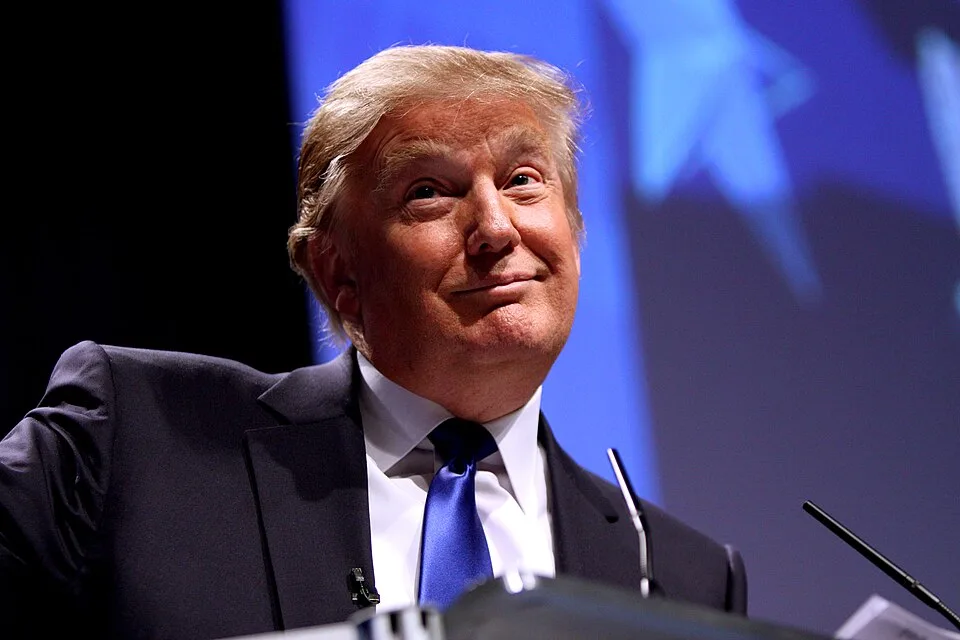
Donald Trump made more than a billion dollars in his first year back in office, struck a deal with his own government to stop the IRS from auditing his family, and openly told The New York Times that he doesn't bother limiting his business ventures because, as he put it, "nobody cared." He was, unfortunately, at least partially right. NPR sat in on focus groups with Pennsylvania swing voters earlier this month, and half of them basically said: yeah, so what.
The President Told You Himself Nobody Cares
Let's start with the quote, because it deserves to live in infamy. When The New York Times asked Trump in January why he made zero effort to separate himself from his family's business interests during his second term, his answer was not a denial or a deflection. It was a boast. "I found out that nobody cared," he said. "I prohibited my children from doing business in my first term, and I got absolutely no credit for it."
So the calculation was made, explicitly and out loud: restrain yourself, get nothing. Don't restrain yourself, get billions. This is not a man who stumbled into corruption. This is a man who ran the numbers.
And the numbers, by any historical standard, are staggering. Rep. Jamie Raskin, the top Democrat on the House Judiciary Committee, told NPR in May that Trump "made more than a billion dollars in his first year in office" and that "there's nothing remotely comparable to that in all of American history." The New Yorker has been tracking the tally. Good governance watchdog groups have catalogued the specific vehicles: a settlement that shields the Trump family from IRS audits, high-dollar stock trades in companies directly involved in administration policy, outside cryptocurrency ventures that have dramatically inflated his net worth. It is a buffet, and he has been eating.
Watergate Was a Cub Scout Prank, According to Both Sides
Here is the most telling detail of this entire political moment: Democrats and Republicans agree that Watergate looks like amateur hour by comparison, and they mean it as two very different things.
Raskin told NPR in May that "Watergate was like a Cub Scout prank compared to what we're living through." He meant it as an alarm. JD Vance said in June at the Richard Nixon Presidential Library, of all places, that if Watergate happened tomorrow it would be "like a 12-hour news story" and that the idea it could bring down a presidency is "crazy." He meant it as a victory lap.
Both of them are correct about the scale. Only one of them seems to think that's a problem. When the Vice President of the United States is standing at Nixon's library telling a crowd that Nixon's crimes were no big deal actually, you have entered genuinely new territory. This is not norm erosion. This is norm demolition, followed by a party on the rubble.
Voters Hate Corruption in the Abstract, Tolerate It Specifically
NPR observed two focus groups of Pennsylvania swing voters earlier this month, and the results are the kind of thing that should make Democratic strategists stare at the ceiling at 3 a.m. When asked about Trump's financial windfall since taking office, half the participants said they were troubled. The other half waved it off.
"When it comes to ethics, moral and financial, I think that just about every politician is corrupt," one participant named Todd A. told the group. "So the fact that he's a known huckster, I mean, we've known that for years about him." This is the trap Democrats have been unable to escape since 2017: Trump's corruption is so well-established, so baked into his public identity, that new revelations don't register as news. They register as confirmation of something voters already priced in.
Polling from the Brennan Center for Justice tells the bigger story. Nearly all voters, across party lines, say corruption is a serious problem: 90% of Republicans, 93% of Democrats and independents. Marina Pino, an attorney with the Brennan Center's Elections and Government Program, told NPR that Americans see corruption as "an embedded structural problem" tied to the perception that "the government is primarily working for the ultra wealthy and the well-connected." Eighty-eight percent of voters say corruption is responsible for big problems the government has failed to solve, like the high cost of living. They connect it to the price of groceries. They just can't always connect it to Trump specifically.
Democrats Have a Plan. It Has Real Limits.
Sen. Jon Ossoff, campaigning in Savannah in June, gave what NPR describes as a broader pitch than Democrats have typically made on this issue. "The Mar-a-Lago Mafia has taken American corruption to spectacular new heights," he told the crowd. "But corruption in America runs a lot deeper than Donald Trump." His framing was blunt: "American politics is coin operated. Money goes in, favors come out."
This is the strategic shift some Democrats are attempting: stop trying to make voters outraged specifically about Trump's portfolio and start making the case that the whole system is rigged, with Trump as the most extreme symptom rather than an isolated disease. The theory is that voters who have mentally filed Trump under "known huckster" might still be persuadable on systemic reform.
The practical ceiling here is significant. NPR reports that even if Democrats retake both chambers of Congress, Trump holds veto power over any legislation that reaches his desk. A Democratic congressional majority would mean investigations, public hearings, aggressive messaging. It would not mean signed anti-corruption legislation. Any Democrat telling voters they can legislate Trump's financial empire into compliance is selling something they cannot deliver, at least not before 2029.
The Dingo Take
The darkest joke buried in all of this is that Trump essentially told voters what he was going to do, watched them elect him anyway, and then confirmed to a reporter that this is exactly what he expected to happen. "Nobody cared" is not spin. It is a diagnosis. And the focus group results suggest it is, at minimum, partially accurate.
The Democrats' structural corruption argument is smarter than leading with Trump's crypto portfolio. Connecting a billion-dollar presidential payday to the cost of eggs is better politics than expecting swing voters in Pennsylvania to be freshly outraged by something they already assumed was happening. But there is a difference between a good argument and a winning one, and Democrats have been making very good arguments about Trump's corruption for nearly a decade now with mixed results at best.
What actually changes the math here is not a better message. It is what voters feel in their own lives by November. If the economy is grinding them down, if the cost of living is still crushing, if the administration's policy decisions keep looking like direct transfers of wealth from the public to Trump's business partners, the structural argument starts to land. If things feel okay, Todd A. from the focus group is going to shrug again. He has been very consistent about that.

Comments