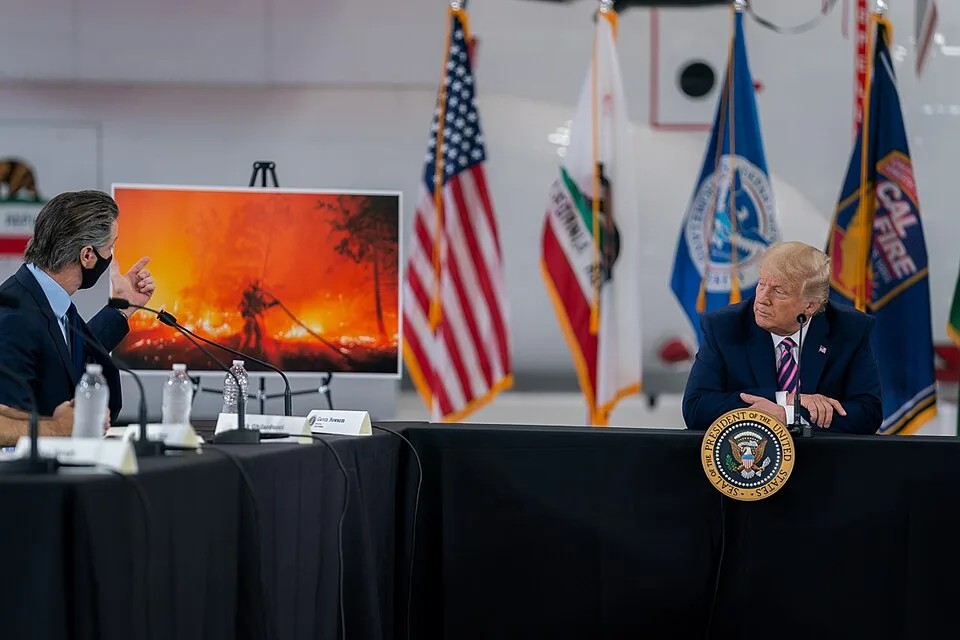
More than a million acres are burning across central and eastern Oregon, 34 major fires are raging simultaneously, and the National Interagency Fire Center has hit its highest preparedness level, which is the official government way of saying there are no backup resources left. This is happening roughly one year after the Trump administration's DOGE operation fired approximately 10,000 Forest Service and Bureau of Land Management employees, including wildfire prevention staff. Go ahead and sit with that for a second.
A Million Acres and Counting
Oregon's state climatologist Larry O'Neill told NPR, bluntly, that the state is "holding our breath right now that the weather conditions will moderate, though that's not looking likely." The fires are burning fast across public rangelands stretching from near Bend all the way to the Idaho border, driven by a lightning storm that brought essentially no rain and plenty of wind. Classic.
Thousands of people have already been forced to evacuate from small towns across central and eastern Oregon. Dense smoke has blanketed the entire region and triggered air quality advisories covering the Boise metro area, home to more than 700,000 people. Interstate 84, the main artery connecting eastern Oregon to the coast, has been shutting down with little to no warning. People are trapped. Ranchers are scrambling to move cattle out of the path of fires chewing through hundreds of square miles of rangeland.
And here is the part that should make everyone's head explode: officials are cautioning the public that it is "still early in the fire season." The high-altitude forests, which have not started burning yet, are also dangerously vulnerable heading into August and September because much of Oregon recorded its lowest snowpack on record this past winter. So this, right now, is not the worst of it.
The People Actually Losing Everything
Near the Coleman Creek Fire, which is threatening the tiny ranching town of Harper, NPR reporter Kirk Siegler spoke with Mary Thompson, a local resident whose fiancé is a rancher. She pointed out something that gets lost every single time fires like this happen: news coverage treats these rural blazes like there's nothing out there to burn. There is plenty out there to burn. It is people's entire lives.
"You almost cry," Thompson told NPR. The ranching community around Harper runs almost entirely on federal public grazing lands. When those lands burn, there is no grass left to feed the cattle. Ranchers will have to buy hay, which is expensive, and there will be no quick fix once the fires are out.
A couple named Terry and Kara Barnes got stranded in Harper trying to get home to western Oregon after cutting their camping trip short. "We've certainly never been trapped where we couldn't go home," Terry told NPR. Kara, a retired timber industry worker, asked the question rural Oregonians keep asking: why aren't we hitting these fires immediately when they start? It is a fair question. The answer, right now, is that there aren't enough people left to do it.
The Resources Are Gone. Completely.
The National Interagency Fire Center, which coordinates federal wildfire response across the country, has gone to its highest preparedness level. NPR reports this means that if another major fire ignites anywhere in the region, there will not be enough federal resources available to respond to it. The system is full. There is no bench.
Wildfire resources are currently stretched from Oregon all the way to Minnesota. This is not a localized problem. This is a nationwide firefighting capacity crisis happening in real time, in the middle of what Oregon's own climatologist says is shaping up to be a record-breaking season. The infrastructure designed to handle this is running on fumes.
DOGE Did This. We Can Say That Now.
NPR reports that the Western fires are burning in the direct aftermath of massive cuts to federal public lands agencies. The Trump administration's DOGE operation cut roughly 10,000 jobs at the Forest Service and the Bureau of Land Management since last year. Those cuts included wildfire prevention staff. Not wildfire suppression staff, though those are stretched too. Wildfire prevention staff. The people whose entire job was to stop fires before they became million-acre catastrophes.
This is not speculation. This is not a left-wing talking point. This is the sequencing of events: fire prevention workforce gutted in 2025, record-low snowpack recorded in winter 2026, fires ignite across one million acres of Oregon in July 2026 with no federal backup capacity remaining. You are welcome to draw your own conclusions, but the line between those dots is very short and very straight.
O'Neill, the state climatologist, told NPR that climate change is making all of this worse by pulling moisture out of the landscape faster every spring and summer. The combination of a hotter, drier climate and a deliberately hollowed-out federal workforce is not a mystery. It is a policy outcome.
No End In Sight
O'Neill told NPR that the same conditions hitting eastern Oregon are also hitting Western Europe right now, where June looked as dry as late August normally would. There is no reprieve in the immediate forecast, for weeks. That means the smoke advisories keep coming. The emergency evacuation texts keep coming. The "Go Now" alerts keep coming.
Catherine Randall was evacuated from the small town of Huntington on a school bus as the Tartar Fire closed in. She grabbed her computer and a couple of other things. That is the entirety of what she could take. That is what "Go Now" means. Weeks of this, and more weeks ahead, and a federal firefighting apparatus that by the government's own assessment has nothing left to give.
The Dingo Take
Ten thousand wildfire workers fired. Lowest snowpack on record. Highest federal preparedness level, meaning no reserves left. A million acres already burned and it is, officials keep reminding us, still early in the season. At what point does this stop being a tragedy and start being a crime? Because someone made the specific decision to fire the people whose job was preventing exactly this, and that someone is currently living in the White House.
The cruelest part of this story is not the politics. It is Mary Thompson standing at a roadblock on Highway 20, watching smoke cover the hills where her livelihood grazes, trying not to cry. It is Terry and Kara Barnes stranded at a gas station in a town most Americans have never heard of, stuck between fires on roads that closed without warning. These are the people who voted for smaller government and got it, good and hard, in the form of a wildfire response system with nothing left in the tank.
DOGE sold this as efficiency. Cutting the fat. Getting government out of people's way. What it actually cut was the thin line of trained federal workers standing between rural America and a fire season that Oregon's own climatologist is calling unprecedented. Efficient is one word for it. There are others.




Comments