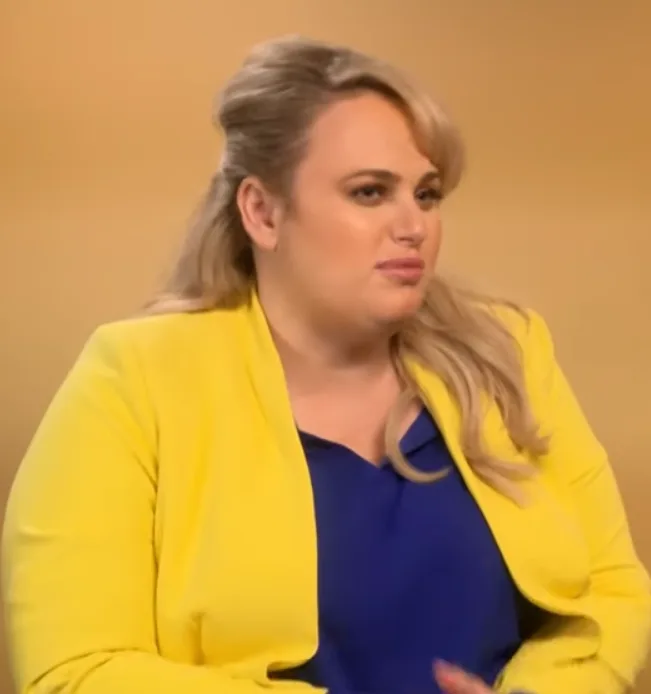
Rebel Wilson was shown metadata in an Australian courtroom indicating that her own production company, Camp Sugar, was listed as one of the authors of a website that called a film producer the "Indian Ghislaine Maxwell" and a "pimp" who gathered women "for the pleasure of the extremely wealthy." Her response, under oath, was: "I can't explain that." Cool. Great. See you in Los Angeles on October 5th.
Let's Back This Train Up
This whole saga starts with "The Deb," a film Wilson directed that appears to have been less of a creative experience and more of a hand grenade with a loose pin. In 2024, Wilson went full scorched earth on Instagram, accusing married producers Amanda Ghost and Gregor Cameron of embezzling funds from the production. She also accused Ghost of "inappropriate behavior" toward the film's young star, Charlotte MacInnes.
MacInnes denied it. Publicly, specifically, on the record. Wilson then suggested on social media that MacInnes was only denying the alleged misconduct to advance her own career. That particular move prompted MacInnes to sue Wilson for defamation in Australia. Ghost and Cameron, meanwhile, sued Wilson in Los Angeles, claiming she fabricated a MeToo story to leverage herself a screenwriting credit.
So to recap: Wilson accused the producers of financial crimes and sexual misconduct. The alleged victim denied it. Wilson accused the alleged victim of lying for personal gain. Now everyone is suing everyone. This is Hollywood, baby.
Australia Has Already Weighed In, Sort Of
Last week, according to Page Six, Justice Elizabeth Raper dismissed MacInnes' Australian defamation claim, ruling that Wilson's posts were not defamatory. In Australia, these cases are decided by a judge rather than a jury, and Wilson notched what looked like a win.
MacInnes immediately appealed. Her filing argues the court failed to adequately consider Wilson's alleged involvement in the smear websites, specifically the ones published at amandaghost.com and amandaghostsucks.com, which referred to MacInnes as a "hooker." So the Australian chapter is not closed. It's just been paused while the much larger, much uglier American version cranks up.
The LA case hits court on October 5th. And unlike the Australian proceeding, this one is expected to involve depositions, subpoenaed documents, and a cast of characters that extends well beyond Wilson herself.
The Websites Nobody Can Explain
Here is where this stops being a messy celebrity dispute and starts being something genuinely strange. Those smear sites, calling Ghost the "Indian Ghislaine Maxwell" and accusing her of being a "pimp" for the ultra-wealthy, are now the centerpiece of the LA case. In January, Judge Thomas Long approved a request from Ghost and Cameron's attorney to take depositions and subpoena documents related to who built them.
Page Six reports that legal filings make clear the attorney believes Wilson directed a trio of high-powered Hollywood operators to create the sites: attorney Bryan Freedman, TAG PR founder Melissa Nathan, and digital consultant Jed Wallace. Wilson, Nathan, and TAG PR are listed as defendants. Freedman says neither he nor Nathan nor Wallace built anything. Wilson denies any involvement.
Then the Australian court presented Wilson with metadata showing her Camp Sugar production company was among the listed authors of the sites. "I can't explain that" is not, historically, a phrase that reassures people of your innocence.
The Lively Connection Nobody Asked For
If those names Freedman, Nathan, and Wallace sound familiar, they should. Page Six notes that the same trio served as Justin Baldoni's representatives during his legal war with Blake Lively, and Lively's legal team targeted that exact axis, alleging they ran an untraceable smear campaign against her. A federal judge was apparently unimpressed. No similar smear websites targeting Lively ever materialized, which may explain some of the skepticism.
Lively eventually settled with Baldoni in an arrangement where, per Page Six, no money changed hands. Whether that outcome has any bearing on the Wilson case is unclear, but the attorney on the other side of both fights is the same person: Camille Vasquez, who you may remember as the lawyer who helped Johnny Depp beat Amber Heard in defamation court. She is now representing Ghost and Cameron, and she appears to be in considerably better shape here than Lively's team was.
Johnny Depp, for what it's worth, is a client of TAG PR. The same TAG PR that is a defendant in the case Vasquez is prosecuting. This industry is a ouroboros in a blazer.
Meanwhile, Vasquez Is Having a Mixed Week
Vasquez is not having uniformly good news across her caseload. Page Six reports that her client Danny Elfman, the celebrated Simpsons composer, has been taking hits in his legal battle against pianist Nomi Abadi, who accused him of sexual misconduct and is suing him for defamation over his denial in a Rolling Stone investigation.
In May, a California Court of Appeal ruled that Elfman cannot have Abadi's defamation suit dismissed. Last week, Elfman dropped his countersuit against her for fraudulent concealment. Abadi's attorney Deb Drooz told Page Six her client is "more than gratified that she will finally be able to tell her story to the trial court and ultimately to a jury."
Vasquez, for her part, told Page Six: "The truth is often stranger than fiction. We're confident the facts and the full record will speak for themselves." That's lawyer for "buckle up."
The Dingo Take
"I can't explain that" is doing a lot of heavy lifting as a legal defense strategy. Metadata linking your own production company to a website that calls someone the Indian Ghislaine Maxwell is not a small thing to be unable to explain. That is, in fact, exactly the kind of thing you very much want to be able to explain, ideally before you are sitting across from a judge in Los Angeles on October 5th.
What's remarkable about this case is how thoroughly it demonstrates that the MeToo framework, which was built to protect people with less power from people with more of it, can be weaponized in both directions. Wilson says she was defending a young woman from predatory producers. The producers say she invented the whole thing for a screenwriting credit. MacInnes, the young woman at the center of it, says nothing happened and got sued for saying so. Nobody here looks like the obvious hero, which is a sign you are probably looking at Hollywood operating as intended.
The October trial date is the one to watch. If Vasquez can demonstrate in court that Wilson's camp built those websites, this stops being a story about a defamation suit and becomes something considerably more serious. The metadata is already there. All someone has to do is explain it.



Comments