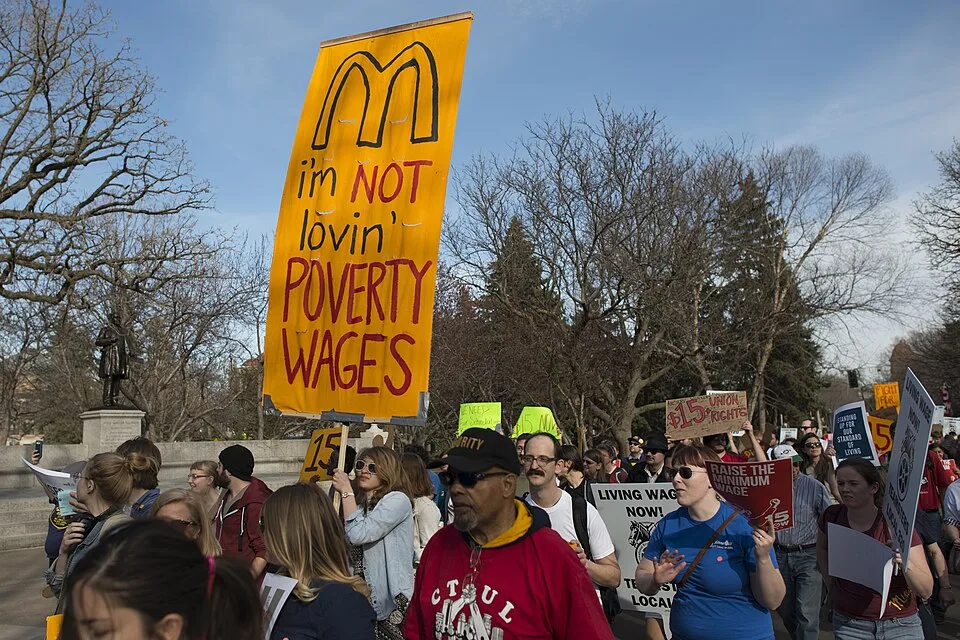
The federal minimum wage is $7.25 an hour. It has been $7.25 an hour since 2009, when George W. Bush was still president and the iPhone 3G was considered cutting-edge technology. California just announced it's going to $17.40, and Gavin Newsom is not being subtle about what that comparison is supposed to mean.
What California Actually Announced
Governor Gavin Newsom announced Friday that California's minimum wage will rise from $16.90 to $17.40 per hour starting January 1, 2027, according to The Guardian. That would make it the highest state minimum wage in the country, nudging ahead of Washington state, which is set to hit $17.13, and New York City's $17 rate in specific metro counties.
Since Newsom took office in 2019, the state minimum has climbed from $12. That's a 45% increase in seven years, for anyone keeping score. The announcement came packaged with a news release that was, let's say, not shy about picking a political fight.
Newsom Brought a Flamethrower to a Talking Points Fight
The governor's statement did not ease anyone gently into the comparison. "For years, Donald Trump and Republicans have blocked efforts to raise the federal minimum wage while handing tax breaks to billionaires and big corporations," Newsom said, according to The Guardian. He then added: "They think $7.25 an hour is enough. We don't."
This is Newsom doing what Newsom does, which is treat every gubernatorial announcement as a presidential audition tape. Whether that's a feature or a bug depends heavily on your feelings about Gavin Newsom. But the underlying point isn't wrong, and the numbers don't need a spin doctor to look damning.
Thirty states plus Washington DC have already set minimum wages above the federal floor, according to Department of Labor data cited by The Guardian. The federal number is so outdated at this point it functions less as a wage floor and more as a historical artifact, like a rotary phone that the government insists still works fine.
The Part Where $17.40 Is Still Not Enough
Here is where we pump the brakes on the victory lap, because the math is brutal. MIT researchers estimate that a working adult in a California family of two adults and two kids needs to earn $36.38 per hour just to cover basic necessities like food, childcare, healthcare, housing, and transportation, according to The Guardian.
Read that again. The new "highest in the nation" minimum wage is less than half of what researchers say a California working parent actually needs to get by. So yes, $17.40 is better than $7.25. It is also less than half of what the cost of living in this state actually demands. Newsom gets credit for moving in the right direction. He does not get credit for solving the problem.
Gas prices in California recently topped $6 per gallon, driven in part by the ongoing conflict with Iran that has pushed fuel costs up nationally, according to The Guardian. The state uses a specific low-emission gasoline blend that already runs pricier than the national average. The cost-of-living squeeze is real, and a 50-cent wage bump, however symbolically important, is not the thing that fixes it.
The Federal Minimum Wage Is a National Embarrassment
Let's dwell here for a moment, because it deserves it. The federal minimum wage of $7.25 was last raised in 2009. That was seventeen years ago. George W. Bush signed the bill that authorized it. Barack Obama tried to raise it. So did Biden. Congress blocked it every time, hiding behind studies about job losses while inflation quietly turned $7.25 into a sick joke.
For context, $7.25 in 2009 had roughly the same purchasing power as about $10.50 today, according to standard inflation calculations. Congress has not just failed to raise the minimum wage, it has allowed it to erode in real terms for nearly two decades while doing nothing. The people who benefited most from that inaction are not the workers.
The Dingo Take
You are supposed to look at $17.40 versus $7.25 and think the gap is a policy disagreement. It isn't. It's a choice about who the government thinks deserves to survive. One number reflects seventeen years of active Congressional inertia on behalf of low-wage employers. The other reflects a state doing what the federal government won't. That's the actual story, underneath all the Newsom grandstanding.
And Newsom is grandstanding, let's be clear about that. The man held a press conference to announce a 50-cent raise and turned it into a campaign commercial. His office knows as well as MIT's researchers do that $17.40 doesn't come close to what it actually costs to live in California. But calling out the federal government's seventeen-year freeze on the minimum wage is not grandstanding. That part is just accurate.
The midterms are coming, gas is over $6 a gallon, and working families are getting squeezed from every direction. Newsom picking this fight right now is not accidental. Neither is the fact that he has a point.




Comments