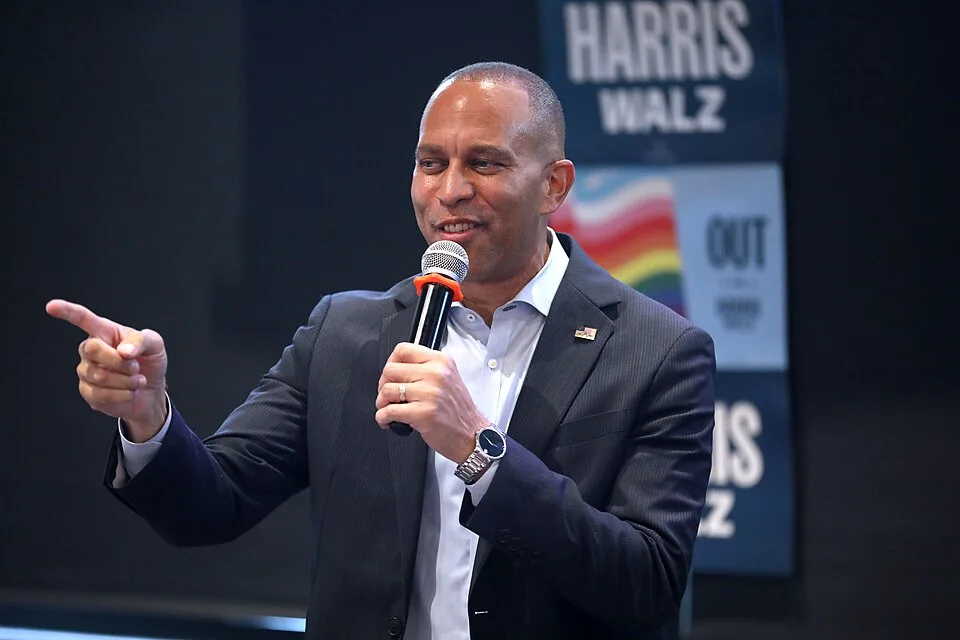
The Congressional Black Caucus is reportedly considering a new membership requirement for incoming Democrats: swear loyalty to Hakeem Jeffries for Speaker, or find somewhere else to sit at lunch. According to Axios, several Black Democrats who look almost certain to win in November have already declined to make that pledge. This is going to get messy before it gets better.
What the CBC Is Actually Proposing
Here's the deal. Axios reports that some members of the Congressional Black Caucus want to attach a condition to membership for newly elected Democrats coming in after the November elections. The condition: you commit to voting for House Minority Leader Hakeem Jeffries of New York when the Speaker vote comes around, or you don't get a seat at the CBC table.
This is not a minor procedural housekeeping item. The Speaker's race is the single most consequential vote a House member casts in any given Congress. Tying caucus membership to that vote is essentially asking incoming members to pre-surrender one of the biggest pieces of leverage they will ever have before they've even been sworn in.
The CBC has long been one of the most influential voting blocs in the House Democratic caucus. Membership carries real weight in terms of committee assignments, coalition politics, and legislative priorities. Using that as a bargaining chip to shore up Jeffries' speakership bid is a bold play. Whether it's a smart one is a different question entirely.
The Problem: Some Nominees Are Already Saying No
The reason this is news at all is because the plan has an obvious flaw. Axios reports that several Black Democrats who are all but guaranteed to win their November races have declined to commit to voting for Jeffries. That's the political equivalent of the CBC firing a shot across the bow and watching the incoming ships just keep sailing.
Who exactly is refusing hasn't been fully enumerated in the reporting yet, which means the actual scope of this standoff is still unclear. But even the existence of the dispute is a flashing yellow light for House Democratic leadership. If you can't get your own incoming members locked in before the election, the math on a Speaker vote starts looking considerably less comfortable.
Speaker votes require an absolute majority of the full House, not just the majority party. Democrats learned this the hard way watching Kevin McCarthy's 15-round humiliation in January 2023. They do not want their own version of that circus. The fact that some incoming members are already declining to commit suggests that at least a few of them are keeping their options open, for reasons that have not yet been made entirely public.
Two Nominees Trying to Thread the Needle
Axios also flags a couple of incoming nominees navigating the political geography here with varying degrees of finesse. Darializa Avila Chevalier, the Afro-Latino Democratic nominee in New York's 13th District, told Semafor she intends to seek membership in both the CBC and the Hispanic Caucus if she wins in November. She appears to be positioning herself as a bridge figure rather than a fault line.
Also in the mix is Pennsylvania state Rep. Chris Rabb, the nominee for a Philadelphia-area seat, though Axios' reporting on his specific position was cut off in the available sourcing. Rabb is a progressive with an independent streak, which probably tells you something about where he might land on a loyalty pledge question, though we're not going to put words in the man's mouth.
What both nominees illustrate is that the incoming class of Democrats is not a monolith, which is both the point and the problem. Diverse coalitions are messy. Managing one into a unified Speaker vote requires either genuine consensus or significant arm-twisting, and right now it looks like the CBC is reaching for the latter.
Why Jeffries Is Worth Fighting Over
Let's be fair to the CBC members pushing this. Hakeem Jeffries has been one of the more effective minority leaders the House Democrats have had in recent memory. He held his caucus together through a genuinely brutal session under a hostile Republican majority and an increasingly chaotic political environment. He's disciplined, media-savvy, and has managed to keep a fractious coalition from publicly eating itself more than once.
If Democrats flip the House in November, which remains a real possibility given the political environment, Jeffries becomes the frontrunner for Speaker. Locking in commitments now is rational politics. Uncertainty in a Speaker vote creates leverage for members who want to extract concessions, and a protracted Speaker fight would hand Republicans a gift-wrapped news cycle right at the moment Democrats would be trying to project competence and readiness to govern.
But there's a difference between building genuine support and trying to make loyalty a cover charge. Some of the holdouts may have real policy concerns about Jeffries' leadership direction. Some may simply want to preserve their own leverage. The CBC's proposed membership condition doesn't distinguish between the two, which means it risks alienating members it actually needs.
The Longer Game Here
The Speaker vote math is worth thinking through for a second. Even if Democrats win the House, their majority is likely to be slim. A slim majority means every single defection on a Speaker vote carries enormous weight. One or two members holding out can change the entire calculus, as the House Freedom Caucus demonstrated with McCarthy and as Matt Gaetz eventually proved in spectacular fashion.
The CBC's gambit makes sense as a way to prevent that kind of chaos, but it only works if the incoming members actually want CBC membership enough to accept the condition. If several of them shrug and say they'll sit with the Progressive Caucus or just caucus loosely, the leverage evaporates entirely.
What we're really watching here is House Democrats trying to solve a coordination problem before it becomes a crisis. Whether tying caucus membership to a Speaker pledge is the right tool for that problem is genuinely debatable. What isn't debatable is that they need to figure it out before November turns into a math problem they can't solve.
The Dingo Take
You are supposed to look at this story and see savvy institutional maneuvering by the CBC. And sure, on one level, that's what it is. But step back for a second. The Democratic Party just spent the better part of a decade getting torched for being too top-down, too leadership-driven, too focused on enforcing unity at the expense of actually representing the enormous diversity of interests under its tent. And the response to winning back some of that ground is to propose a loyalty oath to the club? Before the election is even over?
The incoming members who are refusing to commit aren't necessarily the villains here. They might have real reasons for keeping their options open, reasons that haven't been reported yet because it's August and the election is still three months away. Demanding pre-commitments on the single most powerful vote a House member casts is a significant ask, and 'because we said so' is not a great answer for politicians who just won competitive primaries by promising independent judgment.
If Jeffries is the right person to be Speaker, and he may well be, he should be able to make that case to incoming members on the merits. His record, his coalition management, his vision for what a Democratic House majority actually does with power. If the argument for Jeffries is strong enough to win a Speaker vote, it should be strong enough to not require a velvet rope at the CBC door. The fact that some members are already saying no before the pitch has even fully landed is a signal worth paying attention to.


Comments