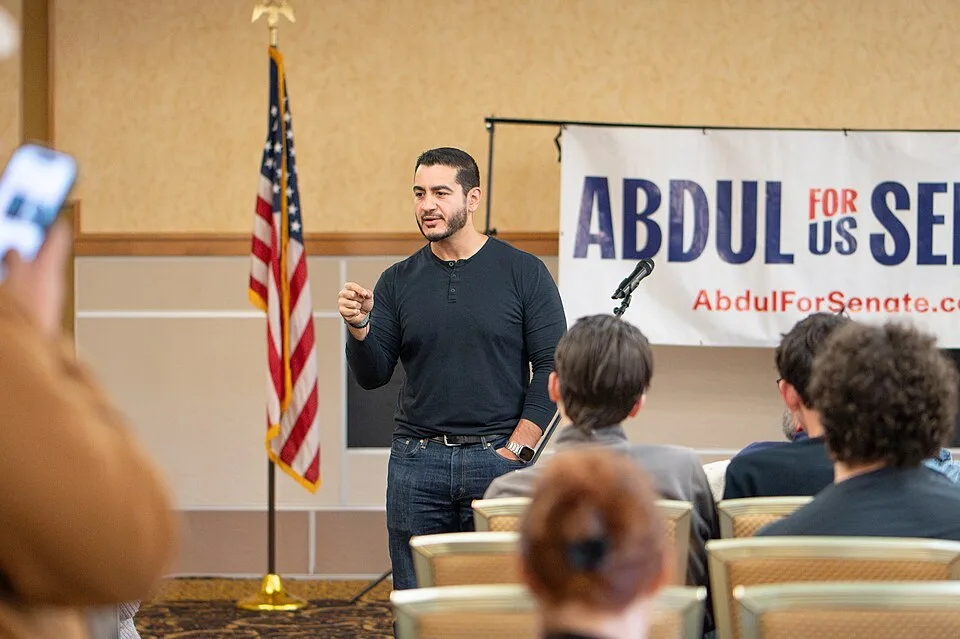
The Democratic Party is about to find out, in real time, whether running a Medicare-for-All anti-establishment candidate in a must-win Senate race is a bold political revolution or the most expensive therapy session in Michigan history. Abdul El-Sayed is leading polls in Michigan's Democratic Senate primary, and the party establishment is not handling it gracefully. The midterms are turning into a live stress test of the oldest argument in Democratic politics, and nobody actually knows how it ends.
The Stakes Are Not Small
Michigan is not a place where Democrats can afford to experiment casually. The current Democratic senator is retiring, and as NPR reports, if Democrats have any shot at retaking the Senate, they absolutely need to hold this seat. Full stop. No wiggle room.
And yet here they are, with primary polls showing El-Sayed, a former public health official, in the lead over four-term Rep. Haley Stevens, the establishment-approved candidate whose own polling apparently shows a stronger path in the general election. The party is staring down a choice between what its voters want right now and what its strategists think they need in November. Those two things are currently pointing in opposite directions.
This is not a symbolic protest vote in a deep-blue Brooklyn district where a progressive win changes nothing about November. Michigan is genuinely purple, genuinely contested, and genuinely decisive. The margin for error is, to put it gently, zero.
El-Sayed's Pitch and Why It's Working
El-Sayed's campaign slogan is about as subtle as a foghorn: "Money out of politics. Money in your pocket. Medicare for all." It is not a slogan designed to reassure nervous centrists. It is designed to make an exhausted, furious working-class voter feel seen, and according to the polls, it's doing exactly that.
This fits a broader pattern NPR has been tracking across the country this cycle. Far-left challengers have knocked off Democratic incumbents in deep-blue districts from New York to Colorado. The difference, and this is the part that has everyone in Washington chewing antacids, is that those races were in safe blue territory where losing the general was never a real risk. Michigan is the first major test of whether the insurgent energy translates outside the ideological comfort zone.
Adam Green, co-founder of the Progressive Change Campaign Committee, told NPR he thinks a Michigan win by El-Sayed would "send shockwaves across the Democratic party" and reshape who the party feels comfortable nominating for president in 2028. He's framing this as a chips-on-the-table moment. Which is a fun metaphor right up until the point where you remember that the table is the United States Senate.
The Establishment Is Nervous, and Also Not Wrong to Be
Neera Tanden at the Center for American Progress told NPR what every party operative is thinking but carefully word-salading around: progressive candidates beating incumbent Democrats in safe blue seats is one thing, but "can they beat Republicans" in swing states is, in her words, "heretofore untested." That is a polished way of saying they genuinely do not know if this works, and the consequences of being wrong are significant.
Haley Stevens, the four-term incumbent, is the candidate the establishment has lined up behind. She has the poll numbers showing a stronger general election performance. She does not, apparently, have the energy or the raw anger of the Democratic primary electorate behind her right now.
Democratic consultant Lis Smith, who has worked with Michigan candidates, put it bluntly to NPR: "Democratic voters are really rejecting people who reek of playing it safe." She acknowledged that some of the positions primary voters are rewarding could become liabilities in November, and that primary voters appear to have decided that's a tradeoff worth making. Which is either a sign of genuine political courage or a sign that people are too angry to do the math. Possibly both.
The Midwest Is the Whole Ballgame
It's not just Michigan. NPR reports that Democratic primaries this month in Michigan, Wisconsin, and Minnesota are all serving as testing grounds for whether the progressive insurgency can travel beyond the coastal enclaves where it first caught fire. The 7th Congressional District race in Michigan is a perfect microcosm: one of just 18 true toss-up districts in the country, currently held by Republicans, and now featuring a former U.S. ambassador to Ukraine, a retired Navy SEAL, and William Lawrence, a co-founder of the Sunshine Movement climate activist group.
Lawrence, whose campaign centers on the economy, opposition to AI data centers, and pulling back from foreign aid spending, told NPR that "the status quo is an electability risk." He thinks the conventional wisdom about moderation being the safe play is simply outdated. "What I hear is people are fed up," he said. "They're ready for change and they don't feel that either party has been representing their interests in DC."
Even former Republican Rep. Peter Meijer, who disagrees with the progressives on virtually everything substantive, told NPR they are "ascendant" and that everyone else is scrambling. When the moderate Republicans are shrugging and admitting the progressive wave is real, that's not nothing.
Nobody Actually Knows What Happens in November
Here is the uncomfortable truth that hangs over every piece of confident analysis being produced right now: the data on progressive electability in swing states is thin because it hasn't been tested at this scale before. Everyone is essentially projecting. The establishment thinks moderation wins general elections because that's the old playbook. The progressives think authentic populist anger beats cautious centrism because that's what the primary results keep showing. Both sides have evidence. Neither side has proof.
Smith told NPR, with refreshing candor, "When people are angry, sometimes they go with their heart over their head. And the reality is none of us know how it's going to play out in November." That is a Democratic consultant saying, on the record, that the party is operating partially on gut feeling during an election cycle where they desperately need to take back the House and hold the Senate.
The primaries vote. Then everyone waits. Then November either vindicates the insurgents or gives the establishment four years of very uncomfortable told-you-sos. There is genuinely no middle outcome here.
The Dingo Take
You are supposed to believe there is a clean, obvious answer to this argument. The establishment says: nominate the moderate, win the seat, govern, repeat. The progressives say: inspire people who've stopped showing up, expand the electorate, change what's possible. Both theories are internally coherent. Both have recent evidence in their favor. And both sides are making this argument at full volume inside a party that has approximately one Senate seat's worth of margin for error and a midterm map that was already going to be brutal.
What makes Michigan genuinely interesting, and genuinely nerve-wracking, is that El-Sayed winning the primary would not be an accident or a quirk of turnout. He's been in the lead. This is the Democratic primary electorate of a genuine swing state telling you something about what they want, and it's on the party to figure out whether that message translates in November or costs them a seat they cannot afford to lose. The answer is not available yet. The primary hasn't even happened.
Green called this a chips-on-the-table moment. He's right, but it cuts both ways. If progressive candidates win in these swing states, the argument about electability shifts permanently and 2028 looks very different. If they lose seats Democrats had a real shot at holding, the recriminations will be savage and the wounds will last. Either way, the Midwest is about to tell us something the political class has been arguing about for a decade. It will be loud, and it will be real, and there will be no one left to hide behind afterward.

Comments