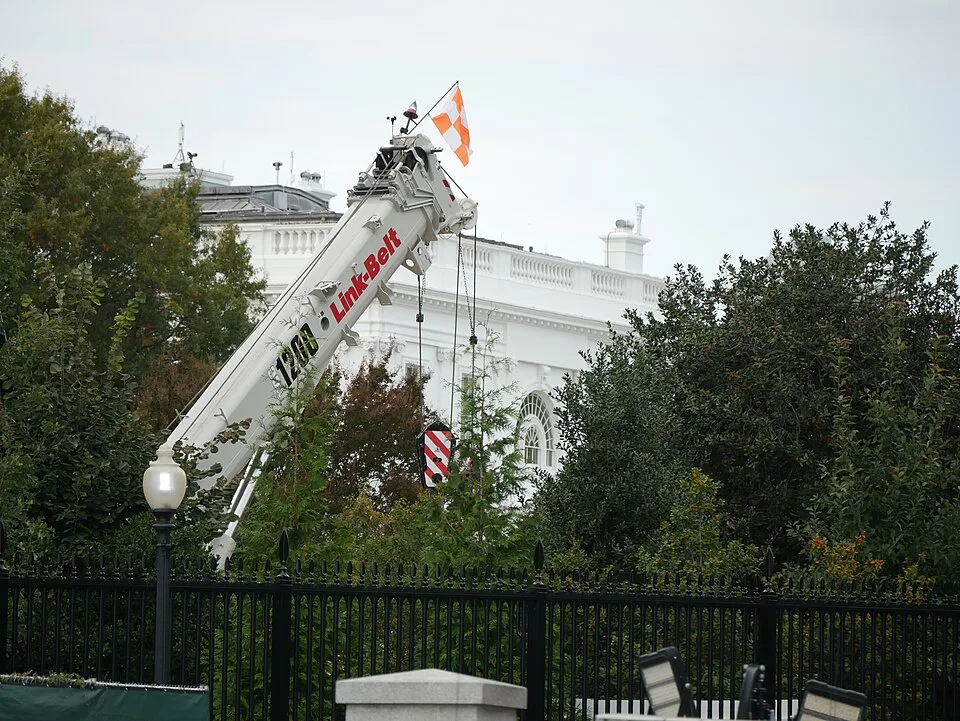
In October 2025, Donald Trump demolished a 120-year-old wing of the White House to make room for a $400 million ballroom. He did not ask Congress. He did not ask historians. He apparently did not ask anyone who has read the Constitution. On Friday, a federal appeals court told him, in exquisite legal language, that this is not how any of this works.
What the Court Actually Said
The U.S. Court of Appeals for the D.C. Circuit ruled 2-1 to uphold a preliminary injunction blocking above-ground construction on Trump's White House ballroom project. The ruling, written by Circuit Judges Patricia Millett and Brad Garcia, is not subtle about what happened here.
"We are aware of no instance in American history in which a President unilaterally and using privately collected funds demolished substantial portions of the White House that Congress authorized to be built and American taxpayers paid for. Until now," the court wrote. That's a sentence that goes directly into the historical record.
The court's core finding is straightforward: "Whether a massive ballroom should be constructed is for Congress to decide and is not a matter for Executive self-help." The phrase "Executive self-help" is doing a lot of heavy lifting there, and it should. It is a polite legal way of saying "you cannot just do whatever you want to a building you don't own."
The ruling also stayed itself for 14 days, giving the Trump administration time to appeal to the Supreme Court. Trump announced on Truth Social that he would "immediately" do exactly that.
The Demolition That Started This Whole Mess
To understand how we got here, you have to go back to October 2025, when the Trump administration bulldozed the White House East Wing over the course of three days. The East Wing was built in 1902. It took less than a long weekend to knock it down. No congressional authorization. No meaningful public consultation. Just gone.
This was not exactly what Trump had described when he first unveiled the project in July 2025. He said the ballroom would be built "near" the East Wing. Then the East Wing ceased to exist. As the BBC reports, the project has since ballooned in cost and scope, now carrying a $400 million price tag and a 90,000 square-foot footprint paid for through privately collected funds with no congressional oversight.
NBC News reports that U.S. District Judge Richard Leon, who has been presiding over the case with notable enthusiasm for punctuation, was not pleased when the administration tried to use a narrow security exception in his prior injunction to justify continuing the entire ballroom build. "It is, to say the least, incredible, if not disingenuous, that Defendants now argue that my Order does not stop ballroom construction because of the safety-and-security exception!" Leon wrote in April. The exclamation mark was his.
The National Security Argument, Examined
Trump's position throughout the litigation has been consistent: this isn't really about a ballroom, it's about national security. The underground portion of the project would house military facilities, bomb shelters, hospital infrastructure, and top-secret installations. Trump has said the complex is needed to protect against drones, ballistic missiles, and biohazards. After an assassination attempt at the White House Correspondents' dinner in April, he leaned into this framing even harder.
The appeals court didn't dismiss that argument out of hand. The ruling explicitly allows below-ground construction to continue, including bunkers, bomb shelters, and military and medical infrastructure. What it blocks is the 90,000 square-foot ballroom sitting on top of all that. The distinction matters: security infrastructure, fine. A grand entertaining space for "parties and State Visits," as Trump himself described it, requires Congress to sign off first.
The majority also pointed out something fairly damning about the administration's security concerns. According to NBC News, the court wrote that "any risk caused by the construction project and its multi-year timetable is overwhelmingly a problem of the Defendants' own creation." They knocked down the building. Then they told the world there was now an open pit and a vulnerability at 1600 Pennsylvania Avenue. Hard to then claim the courts are the national security threat.
The Dissent and the Money
The dissenting vote came from Neomi Rao, a Trump appointee, who argued that Judge Leon "abused his discretion in seizing control of construction at the President's home and office" and that the National Trust for Historic Preservation lacked standing to sue in the first place. Trump, predictably, highlighted her dissent in his social media post, calling the majority ruling "horrendous" and "politically motivated."
The money situation here is worth pausing on. Trump has repeatedly touted the ballroom as a gift to the American people, funded entirely by private donors. That framing is doing some work. The BBC reports that Republicans separately attempted to funnel $1 billion in taxpayer funds toward Secret Service security upgrades connected to the project, a plan that a budget watchdog rejected in May. So "privately funded" has some asterisks attached to it.
The National Trust for Historic Preservation, which filed the original lawsuit after the East Wing came down, called Friday's ruling a vindication. "The White House, a global landmark that symbolizes American identity and the ideals of democracy, belongs to the American people," said Brent Leggs, the organization's president.
Where This Goes Next
Trump said he will appeal immediately to the Supreme Court. The 14-day stay the appeals court granted exists specifically to make that possible. Whether the Supreme Court takes up the case, and how quickly, is the open question.
The appeals court was careful to note that its ruling doesn't mean the ballroom can never be built. It means it cannot be built right now, without Congress authorizing it first. That's a path that exists. It involves the legislative branch doing its constitutionally assigned job, which in this particular Congress, around this particular president, is not exactly a sure thing.
What has already happened cannot be undone. The East Wing, built in 1902, is rubble. The open pit remains. The project that NBC News describes as the most substantial structural change to the presidential residence in over 70 years has already permanently altered the most symbolically significant building in American democracy. The courts can stop the ballroom from going up. They cannot put the East Wing back.
The Dingo Take
"Each President is a temporary tenant, not the owner, of the White House." The court wrote that. In a ruling. About something that actually had to be litigated. Because the sitting president demolished part of the White House and dared anyone to stop him.
This is the through-line of the entire Trump era, rendered in its purest form. The rules, the laws, the constitutional structures that govern what the executive branch can and cannot do, those are for other people. Other presidents. People who didn't win. Trump knocked down a wing of the White House that Congress built and taxpayers paid for, over three days in October, without asking anyone, and then spent months arguing in federal court that he was allowed to do that. He wasn't. Two out of three judges agreed. He will now ask six out of nine judges, and we'll see.
The ballroom itself is almost a distraction at this point. The fight is about whether a president can unilaterally demolish and reconstruct the physical structure of a building owned by the American people because he wants to host grand parties and he has donors willing to pay for it. The courts have said no, twice, and the answer keeps being appealed. At some point, someone in this country has to be able to say no and have it mean something. We're still finding out if that's possible.




Comments