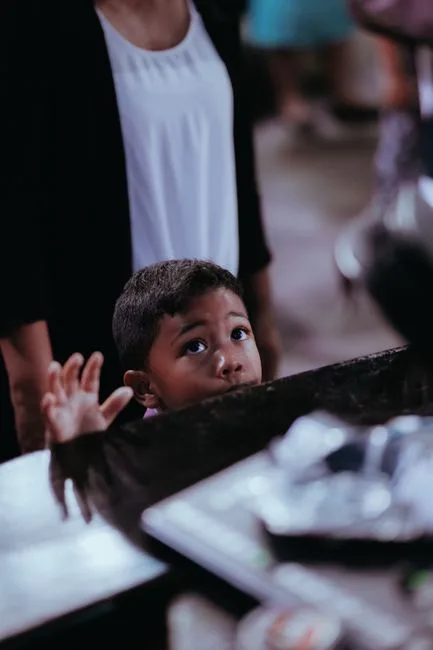
A federal immigration judge in suburban Virginia last week looked out at his courtroom and asked, "Where's the 7-year-old?" The clerk pointed to Moises, a small boy in a wrinkled white button-down shirt who had shown up, without a lawyer, to fight his own deportation. This is not a hypothetical about where the Trump administration's immigration agenda might lead. This is where it has already arrived.
The Boy in the Button-Down Shirt
Moises stood before Judge Paul McCloskey in a windowless courtroom in Annandale, Virginia, on Thursday. The U.S. government wants to deport him. His mother, who has not yet entered removal proceedings herself, could not be his legal representative. So Moises, age seven, showed up to make his own case.
McCloskey, to his credit, gave the boy a continuance until September 15 to find an attorney. He handed Moises and his mother a sheet listing pro bono legal services providers. He told the boy, in what Politico describes as "a soft but stern tone," to "prepare yourself to speak on your behalf."
Let that sentence sit with you for a moment. A federal judge told a seven-year-old to prepare to argue his own deportation case. Not because the system lacks rules protecting children. But because the Trump administration deliberately dismantled the infrastructure that was supposed to make those rules mean something.
How You Strand a Child in Immigration Court
Here is the mechanism, because the details matter. The federal government has long funded nonprofit legal services providers to represent unaccompanied minors in immigration proceedings. That funding flows through a central contract, held by an organization called the Acacia Center for Justice, which disbursed money to dozens of legal nonprofits doing the actual courtroom work.
The Trump administration stopped paying those nonprofits for months. Then, on July 31, it allowed the Acacia contract to expire entirely, according to Politico. The stated reason from the Department of Health and Human Services is that it wants better accounting of how the money is being spent. The nonprofits say complying would require turning over sensitive client information, which they are not legally or ethically able to do.
The result: organizations are broke. Kids in Need of Defense, one of the largest groups representing unaccompanied minors, is $27 million in debt, Politico reports. KIND has already had to withdraw from the Acacia subcontracting arrangement. Its attorney Sofia Lorenzo, who represented a middle schooler in McCloskey's courtroom last week, had to ask for extra time because KIND is furloughing staff at the end of the month.
A federal judge in Oakland ordered the government last week to release the Acacia funds by Friday at noon. HHS said in a court filing that Acacia would have access to the money "as early as Monday" for work dating back to December 2025. So the administration held out for eight months, got sued, lost, and called that a resolution. Incredible.
Nine Kids Without Lawyers, Two Days in Court
Moises was not the only child who showed up to McCloskey's courtroom without legal representation last week. Nine children in total appeared over two days without attorneys, according to Politico's reporter who sat in on the proceedings.
The contrast between those hearings and the ones involving lawyers was stark. When attorneys were present, McCloskey moved efficiently, taking motions, getting explanations of timelines, managing the docket. When a child without a lawyer came before him, everything slowed down so he could explain what rights the child even had. That is not a criticism of McCloskey. That is just what it looks like when a system designed for trained legal professionals is being used to process elementary school students.
One of the two pro bono providers listed on the sheet McCloskey handed to Moises is the Amica Center for Justice, which is itself one of the main plaintiffs in the lawsuit against the government to restore funding. In other words, the judge is handing children a list that includes the phone number of an organization actively suing the government that is trying to deport those same children. It would be darkly funny if it were not so thoroughly awful.
What the Administration Actually Believes
The White House, when Politico asked for comment, referred the question to HHS. HHS put out a statement saying its Office of Refugee Resettlement continues to "pursue all avenues to provide legal services for Unaccompanied Alien Children" and is "committed to ensuring every UAC has legal representation in immigration court."
The administration is, to use the technical term, lying. You do not demonstrate commitment to legal representation by allowing the contract that funds legal representation to expire. You do not pursue all avenues when you have been in a months-long funding standoff that a federal court had to forcibly resolve. These are not the actions of an administration that wants children represented. These are the actions of an administration that wants children deported and has simply discovered that defunding their lawyers is an efficient way to get there.
Wendy Young, president of Kids in Need of Defense, told Politico the administration is "turning a system that was designed for protection on its head to become one that's really focused on detention and deportation of children." That is about as clean a summary as you will find.
The Lawyers Who Are Left Are Drowning
The attorneys who did show up in McCloskey's courtroom last week were not in great shape either. Multiple lawyers told the judge they could not accept his proposed hearing dates because their caseloads had become unmanageable, with hearings stacked across multiple jurisdictions simultaneously, both in person and online, according to Politico.
McCloskey offered some flexibility on scheduling but denied most of the longer continuances the attorneys requested. The docket has to move. Cases pile up regardless of whether the people handling them have enough hours in the day or dollars in the budget.
This is what a funding squeeze looks like in practice. It is not an abstract budget line. It is a lawyer standing in court asking for more time because her organization is about to furlough its staff, while a judge tries to keep a backlogged system from completely seizing up, while a seven-year-old sits in a button-down shirt waiting to find out if he gets to stay in the country.
The Dingo Take
You are supposed to believe this is about fiscal accountability. That the Trump administration's months-long refusal to pay the nonprofits representing migrant children, culminating in an expired contract and mass layoffs at legal aid organizations, is really just a reasonable government demand for better bookkeeping. That Moises standing in a Virginia courtroom at age seven, without a lawyer, preparing to argue his own deportation case, is some kind of unfortunate administrative hiccup on the path to a more transparent grant management process. That is the ask.
It is not about bookkeeping. It is about outcomes. An unrepresented child in immigration court is almost certainly a deported child. The system is complex, the proceedings are adversarial, and the government has lawyers. The nonprofits that have spent years building the infrastructure to give kids a fighting chance are now in debt, cutting staff, and suing the federal government just to get paid for work they already did. That is not an accident of bureaucracy. That is a policy.
Moises has until September 15 to find an attorney. The organizations most likely to help him are broke. The administration that put him in this position issued a statement saying it is committed to his legal representation. And somewhere in a windowless courtroom in suburban Virginia, eight other children are waiting for their next hearing date, armed with a sheet of phone numbers and the advice of a federal judge to prepare to speak on their own behalf. This country is doing this on purpose.




Comments