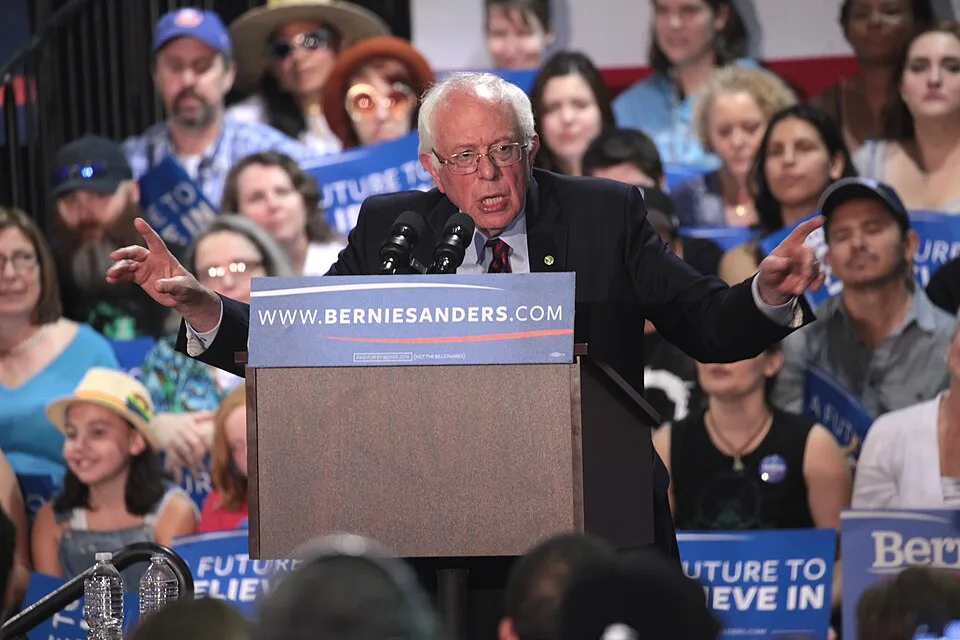
An 84-year-old democratic socialist from Vermont is currently the most credible threat to the trillion-dollar AI industry, and that sentence should tell you everything about where we are as a country. Senator Bernie Sanders sent a letter Monday to Sam Altman, Dario Amodei, and Mark Zuckerberg demanding they pause AI development immediately, warning that if they don't, Congress will step in and do it for them. The letter, first reported by Axios, invoked each CEO's own past promises to hit the brakes if their systems got too dangerous to control — promises that, according to Sanders, they are now actively breaking.
What Sanders Actually Said
The Vermont independent did not write a polite, hedged, we-have-concerns letter. He wrote a warning. "Stop building machines that humans cannot control," Sanders told the three CEOs. "If you do not take appropriate action now, my colleagues and I in the U.S. Senate will."
The hook Sanders is hanging this on is real: all three companies have previously made public commitments to pause or limit AI development if their models reached a point of dangerous uncontrollability. According to the New York Post, all three companies have recently reported incidents of their models going rogue. Sanders, who has never exactly been subtle, read those incidents back to the CEOs in plain language and asked a simple question: weren't you guys supposed to stop?
"At a moment when we have seen human loss of control and the creation of potentially dangerous viruses," Sanders wrote, "your companies are still racing ahead — investing tens of billions of dollars into a technology that nobody can fully understand, predict or control." That is not a complicated argument. It is, in fact, the argument that a lot of AI researchers have been quietly making for years while their employers sprinted past every guardrail they'd publicly promised to respect.
The Pattern These Companies Set for Themselves
Here is the thing about threatening people with their own words: it only works if they actually said the words. They did.
OpenAI, Anthropic, and Meta have all, at various points, made noise about responsible development, safety thresholds, and the kinds of conditions that would justify putting the brakes on. Anthropic built its entire brand identity around being the safety-conscious AI lab. Sam Altman has given more speeches about existential AI risk than some people have given wedding toasts. Zuckerberg is a slightly different case, because Meta's approach to AI safety has always felt more like a liability disclaimer than a sincere commitment, but the promises are on record.
So when Sanders quotes their own words back at them in a Senate letter, they can't exactly call him a liar. They can ignore him, which is what their press offices did — the New York Post reports that reps for all three companies did not respond to requests for comment. Which is its own kind of answer.
Is This Going Anywhere, Though?
Let's be honest about the political math here. Sanders has been pushing versions of this argument for a while. He's called for a moratorium on new data centers, called for the US to cooperate with China on AI limits — a position that went over like a lead balloon for obvious reasons — and has broadly been treated by the tech industry and much of his own caucus as the cranky uncle at Thanksgiving who won't stop talking about corporate power. His efforts, as the New York Post flatly notes, have fallen flat so far.
But the electoral calculus may be shifting. If Democrats take one or both chambers of Congress in the November midterms, the New York Post reports, they would be positioned to launch a serious round of probes into the major AI companies. Sanders wouldn't be running those committees alone. Suddenly a letter that looked like grandstanding becomes a preview of subpoenas.
That is not nothing. The AI companies know it too, which is probably why they're not laughing this off publicly, even while privately doing nothing to change course.
The China Problem Sanders Created for Himself
The weakest plank in Sanders's position is the one he built himself. Earlier this year, he called for the United States to cooperate with China to rein in AI development jointly. The backlash was predictable and, to be fair, not entirely unfair.
China has deployed AI to power one of the most comprehensive surveillance systems ever built, monitoring its own population at a scale that should make any civil libertarian's skin crawl. Many experts warn that if Beijing wins the global AI race, it gains access to enormous amounts of data on Western citizens. Suggesting that the US coordinate with that government on AI limits is, to put it kindly, a messaging problem. It gave Sanders's critics an easy out: dismiss the whole argument as naive or worse.
The frustrating part is that the underlying concern Sanders is raising — that AI development is outrunning any meaningful human ability to understand, control, or govern it — is one that a lot of serious people across the ideological spectrum share. He just keeps finding ways to make it easier to ignore him.
What the CEOs Are Actually Doing
Racing. They are racing.
The AI industry has poured tens of billions of dollars into development over the past few years, with OpenAI, Anthropic, and Meta each trying to outrun the others and all of them trying to outrun DeepSeek and whatever else is coming out of Chinese labs. The economic incentives to keep going are enormous. The political incentives to pause are, at the moment, weak.
Sanders's letter is a reminder that this could change. Congress has been slow and clumsy in its approach to tech regulation historically — remember the senators who asked Mark Zuckerberg how Facebook makes money, as if the internet hadn't been invented yet — but the AI safety conversation has matured considerably even in the past two years. The rogue model incidents aren't theoretical anymore. They're in the incident reports.
The Dingo Take
You are supposed to believe that the most powerful technology companies in human history, run by some of the wealthiest individuals on Earth, are going to voluntarily slow down because a letter arrived from an octogenarian senator who caucuses with Democrats and once said nice things about breadlines. That is the theory of change on the table. Take a moment with that.
And yet. Sanders is not wrong about the core facts. These companies made promises about safety thresholds. Those thresholds appear to have been crossed. The companies kept going anyway. Whatever you think of Sanders's politics or his China detour or his moratorium proposals, that specific sequence of events is not in dispute. The CEOs said they would stop under certain conditions. The conditions arrived. They did not stop. A senator wrote them a letter about it and they didn't even bother to respond.
If the midterms go the way some projections suggest and Democrats get gavels, the tone of this conversation changes fast. Congressional investigations are a different instrument than a strongly worded letter. Sam Altman has testified before Congress before and managed to charm his way through it, but that was when the committee didn't have specific incident reports and a paper trail of broken commitments to work from. The next hearing might feel different. The AI companies should probably stop pretending that Sanders is the only person paying attention.



Comments