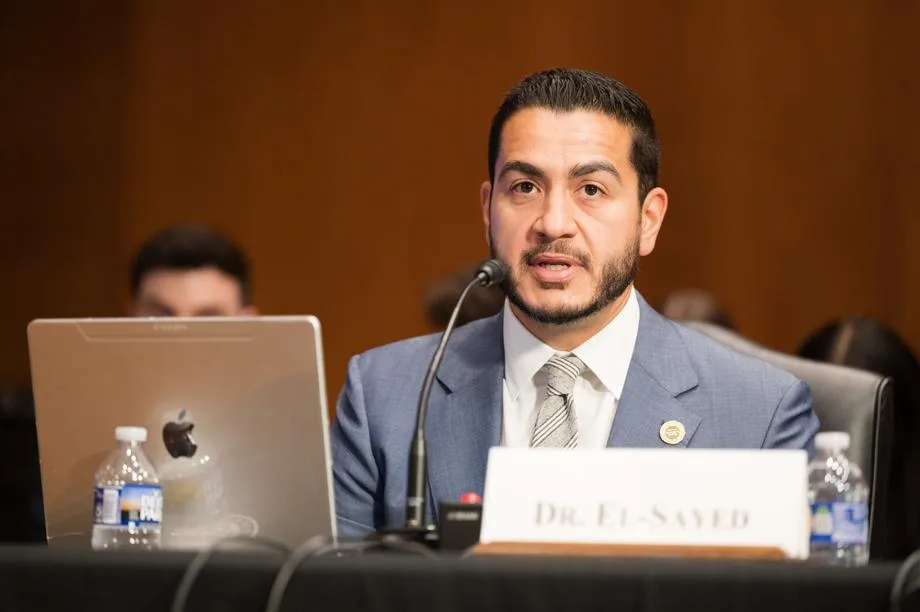
A Muslim son of immigrants just won the Democratic Senate primary in Michigan after being outspent nine to one by a coalition that included Chevron, Philip Morris, and a super PAC backed by AIPAC. The total bill to stop him ran past $60 million. It didn't work. Now the centrist wing of the Democratic Party is doing what it does best: gearing up to explain why winning is actually bad.
Sixty Million Dollars and a Loss to Show For It
Let's get the numbers straight, because they are genuinely staggering. According to The Guardian, the Michigan Senate Democratic primary between Abdul El-Sayed and establishment-backed Haley Stevens was the most expensive Democratic congressional primary ever run. Stevens pulled in over $60 million. Nearly half of that came from a single super PAC backed by the American Israel Public Affairs Committee.
Chevron. Philip Morris. AIPAC. That is the coalition that formed to stop one guy from winning a Senate primary. And they lost. In a swing state. A swing state that, The Guardian points out, is also on the list of presidential nomination states. So, you know. That matters.
El-Sayed ran on something that apparently terrified every major corporate interest group in America: the idea that voters should maybe get more out of their democracy than their democracy gets out of them. Wild concept. Radical, even. More on that framing in a moment.
The Guy Who Was Supposed to Be Unelectable
The playbook against El-Sayed was not subtle. As The Guardian describes, his opponents leaned hard on the "Israel has a right to exist" talking point, a rhetorical move designed to paint him as some kind of existential threat rather than a Senate candidate with opinions about military aid. El-Sayed's counter was simple and, frankly, pretty effective: "The question is quite secondary to whether they have a right to our tax dollars." That's not radicalism. That's a budget argument.
Trump, for his part, called El-Sayed a "full of shit" candidate who would bring "death, squalor, poverty" and "a life of hell." Which is rich coming from a man who has presided over more economic chaos, federal dysfunction, and general American misery than any president in living memory. But sure. The scary Muslim progressive is the threat here.
What El-Sayed represents, whether the establishment likes it or not, is a new archetype. The Guardian describes it as politicians who fuse the outsider experience of immigrants with a full-throated claim on American political life. Not assimilation as submission. Not standing aside. Actually running. Actually winning.
Zohran Was Supposed to Be a Fluke. Now What?
Remember when Zohran Mamdani won the New York City mayoral race and every centrist pundit rushed to explain why it meant nothing? Just New York. Just the city. Doesn't travel. Relax. The Guardian notes that this was the dismissive line from the Democratic establishment's comfort-seeking wing, and it held right up until El-Sayed won a Senate primary in Michigan.
Michigan is not New York City. Michigan went for Trump. Michigan has a significant Arab American and Muslim community that the Democratic Party has spent the last several years actively alienating through its positions on Gaza. And yet: El-Sayed won. Against $60 million. In a swing state. At what point does the establishment update its model?
The answer, if history is any guide, is never. Or at least not until the losses pile up high enough that denial becomes structurally impossible. The party has a remarkable capacity for learning exactly the wrong lessons from electoral data.
The Centrists Are Already Sharpening Their Knives
Here is where it gets darkly funny. A leading centrist organization called Third Way has already raised millions specifically to discredit democratic socialists, according to The Guardian, investing in social media campaigns and activist mobilization against candidates like El-Sayed. The group's leader was quoted saying, "We are preparing for the next war that is coming."
The next war. Against candidates in their own party who just beat a $60 million corporate-funded opposition. The logic here, if you want to call it that, is that progressive candidates are too risky to run nationally because Republicans will destroy them. Which, again, is a remarkable argument to make while sitting in the wreckage of multiple centrist Democratic campaigns against Donald Trump.
Third Way and its allies are genuinely more afraid of El-Sayed winning the 2028 presidential nomination than they are of Trump winning again. Sit with that. The threat they are mobilizing against is their own base's preferred politics succeeding.
What Actually Got El-Sayed Here
Strip away the symbolic framing and look at the mechanics. The Guardian's Nesrine Malik argues that El-Sayed's lack of establishment credentials, far from being a liability, functioned as a feature. Voters increasingly read the absence of corporate backing as proof of concept. No Chevron money means Chevron does not own you. In an era when voters are acutely aware that their democracy has been purchased wholesale by interest groups, "untainted" is a selling point.
The healthcare angle matters too. El-Sayed, a public health physician and former Michigan health director, ran in part on dismantling a system that is bankrupting ordinary Americans. That is not a niche concern. That is the number one financial anxiety for most American families. Framing it as radical requires a pretty specific definition of the word.
What the establishment calls inexperience, a growing chunk of the electorate calls not yet corrupted. That is a genuinely difficult thing to argue against when the experienced candidates keep losing to a former reality television host who tried to overturn an election.
The Dingo Take
You are supposed to believe that Abdul El-Sayed winning a Democratic Senate primary against $60 million in corporate opposition is the dangerous outcome here. That the threat to the Democratic Party's future is the guy who won, not the apparatus that spent an unprecedented fortune trying to stop him. That the lesson from Michigan is caution, not momentum. The centrist Democratic establishment has now fully inverted reality and is living comfortably inside the inversion.
The Third Way crowd's argument collapses the moment you say it out loud: progressive candidates are too risky to run because they might lose to Republicans. Meanwhile, the centrist candidates have lost to Republicans. Repeatedly. Spectacularly. At the presidential level, twice, against the same man. At some point "we can't risk losing" stops being a strategy and starts being a cope.
El-Sayed and Mamdani have identified something real: voters are furious, they know the system is rigged, and they will reward anyone who speaks to that clearly without sounding like a focus-grouped press release. The corporate money did not buy Michigan. The question for 2028 is whether the Democratic Party wants to actually contest power or just manage its own decline on its own preferred terms. Because the answer to that question is going to determine a lot more than one Senate seat.


Comments