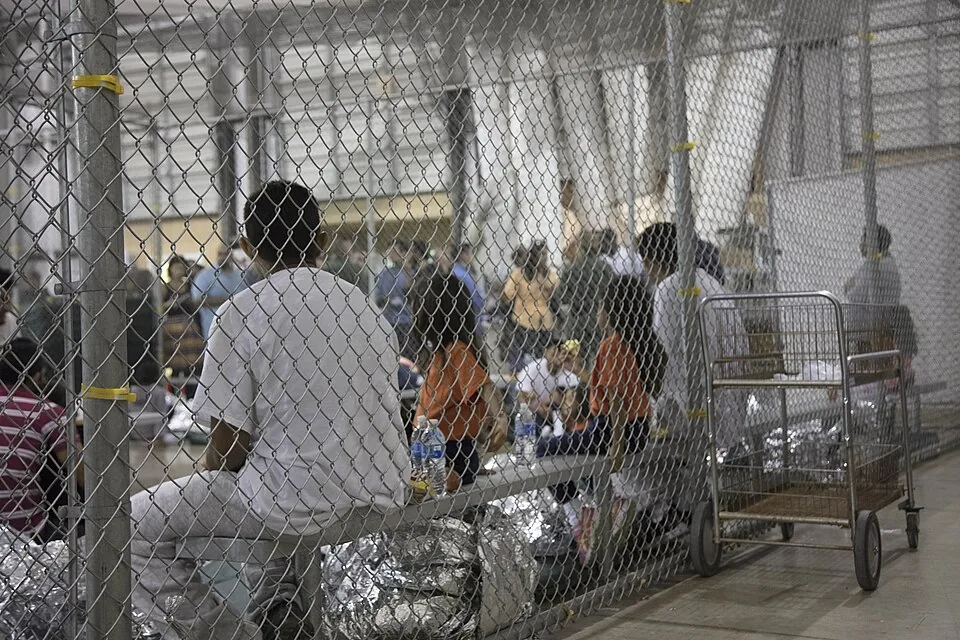
At this point it is less a legal debate and more a sustained judicial beatdown. A seventh federal appeals court has now ruled against the Trump administration's policy of locking up millions of long-term U.S. residents without a bond hearing, bringing the running tally of federal judges who have rejected the policy to 460, against just 54 who have sided with the government.
What ICE Actually Did Here
On July 8, 2025, as Politico reports, ICE adopted a sweeping new interpretation of a 1996 immigration statute. The law says people "seeking admission" to the U.S. must be held without bond while their cases are resolved. For thirty years, five administrations, Republicans and Democrats alike, read that to mean people who had recently crossed the border. Makes sense. That is, roughly, what the words mean.
Trump's ICE decided the phrase applied to anyone who had entered the country without authorization, regardless of whether they arrived last week or twenty years ago, regardless of whether they have a job, a family, a mortgage, and zero criminal history. Under this reading, ICE could scoop up a grandmother who came to the U.S. in 2003, hold her indefinitely, and offer no bond hearing at all. The policy ignited, in Politico's words, "a tsunami of emergency lawsuits" that has swamped federal courts for over a year.
The 1st Circuit Majority Was Not Impressed
The Boston-based 1st Circuit Court of Appeals ruled 2-1 against the administration this week. Judge Lara Montecalvo, a Biden appointee, wrote the majority opinion, joined by Clinton appointee Sandra Lynch. The dissent came from Trump appointee Joshua Dunlap, who argued the administration's reading was a defensible interpretation of convoluted law.
Montecalvo was not buying it. "Over three decades, five administrations implemented the disputed statutes just as we conclude today that their texts require," she wrote, per Politico. She went further: if this 1996 law had actually created "the largest increase in mandatory detention in this nation's history" as the government claims, Congress would not have just sat there watching five consecutive administrations implement it wrong. That is a polite, judicial way of saying: this argument is not serious.
Dunlap, in dissent, conceded the point almost cheerfully. "Little is to be gained by rehashing the arguments further," he wrote, "the debate will doubtless be resolved by the Supreme Court." At least everyone agrees on something.
The Scoreboard Is Ugly for the Administration
Let's put the 460-54 number in perspective. This is not a close legal question at the level of district and circuit courts. This is a rout. More than 460 federal judges have looked at the Trump administration's mandatory detention theory and concluded it misreads a 1996 statute. Fifty-four have agreed with the government. The win rate for the administration is roughly 10 percent.
The first two appeals courts to weigh in, the 5th Circuit out of Louisiana and the 8th Circuit out of Missouri, did side with the administration. That gave Trump's team some early momentum and probably contributed to the policy's aggressive rollout. But Politico reports that since those early wins, appeals courts based in New York, Georgia, Ohio, California, Colorado, Illinois, and now Boston have all rejected ICE's position. The momentum has fully reversed.
Real People, Not Just Numbers
Behind the legal abstractions is what Politico describes as "a trail of shattered families, strained courts, traumatized attorneys" and a year of chaos visited on communities across the country. These are people who, in many cases, have lived in the U.S. for decades. People with kids in American schools, jobs, leases, neighbors who know their names. Held without bond. No hearing. No chance to prove they pose no threat, because the administration decided the law didn't require one.
The 1996 statute, properly read, did allow for the detention of people living inside the country, but under a different legal framework that gave them access to bond hearings. That protection, which existed under Trump's own first term, is exactly what this policy stripped away. The administration's argument is not just legally aggressive. It is a fundamental rewrite of how the immigration system has worked for thirty years.
What Happens Next
The Supreme Court. That is what happens next. Politico reports that judges and attorneys on both sides fully expect the justices to take up the issue this fall, and the dissenting judge on this week's panel essentially invited them to. Given the circuit split, with the 5th and 8th backing the administration and seven other circuits rejecting it, the Court will almost certainly step in.
What the Court does with it is anyone's guess. The current Supreme Court has already shown it is willing to read immigration enforcement powers broadly and move fast when the administration asks nicely. Whether five justices will look at a 460-54 judicial consensus and say "actually the 54 were right" is the question everyone will spend the fall waiting to answer.
The Dingo Take
Four hundred and sixty judges versus fifty-four. In what universe is that a contested legal question? In this one, apparently, because the Supreme Court gets to blow up the consensus if it wants to, and based on recent form, it wants to fairly often. The Trump administration has essentially been losing in every courtroom in America for a year straight and is now betting the whole thing on six justices who have already bent immigration law in some creative directions. That is a strategy.
What gets buried in the legal back-and-forth is that this policy has already done enormous damage. The lawsuits took months to work through the courts. Families were separated. People were detained. The 460 judges who eventually said "no" did not undo any of that. The legal system moved at legal-system speed while ICE moved at ICE speed, and the gap between those two speeds is where the actual human cost lives.
And here is the thing that should make you genuinely angry: the administration's own first term did not do this. Five presidents, including Trump 1.0, looked at the same 1996 law and read it the same way everyone else did. This was not a long-standing legal dispute waiting to be resolved. It was a deliberate choice, made on July 8, 2025, to reinterpret a three-decade-old statute in the most expansive way possible, consequences be damned. The courts noticed. The question is whether the Supreme Court will.




Comments