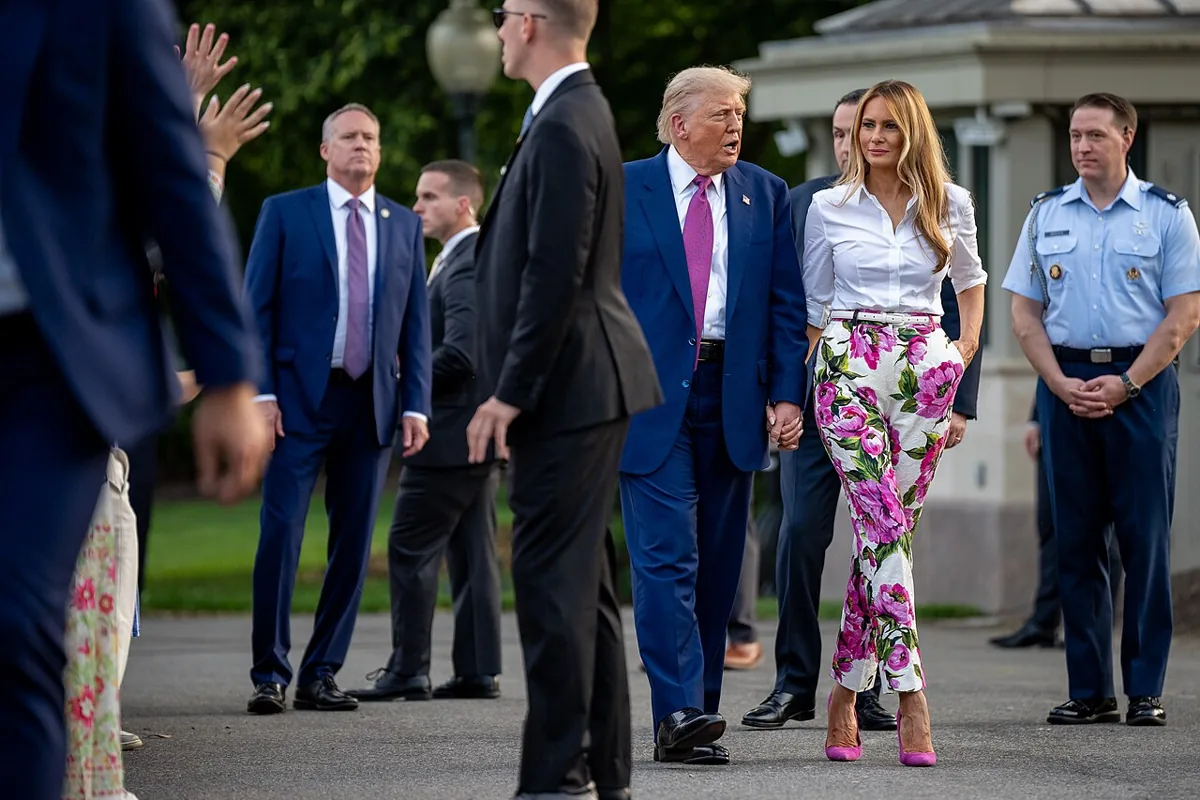
Donald Trump made $2.2 billion in personal revenue during his second presidential term's first year, according to financial disclosures reviewed by the Guardian. While he was doing that, roughly one million people who invested in his crypto scheme lost $3.8 billion. This is not a coincidence. This is the business model.
The Numbers Are Not Close
Let's put the math on the table before anything else. According to financial disclosure forms Trump filed in June and reviewed by the Guardian, he pulled in at least $1.4 billion from crypto ventures alone in 2025. Toss in Truth Social revenue, foreign hotel deals, and a few other monetization plays, and you clear $2.2 billion in a single year. One year. From one office he's technically only supposed to be managing on behalf of the public.
At the exact same time, the Guardian reports that approximately one million investors in Trump's crypto scheme watched their holdings crater, collectively losing $3.8 billion. So the president of the United States ran a financial product that transferred billions of dollars from ordinary investors into his own pocket. If a hedge fund manager did this, federal prosecutors would be building a case. When the president does it, his spokesperson calls it a 'very honest family.'
Pay to Play, and the Price List Is Right There
Truth Social, already a punchline as a social media platform, has apparently pivoted to a more straightforward business: selling access to the president's brain. This summer, the Guardian reports, Trump's Truth Social launched a product called Truth API, which gives wealthy buyers early access to Trump's posts for $100,000 a month. The posts that move markets. The posts from the guy who controls tariffs, sanctions, and federal contracts.
Senator Mark Warner of Virginia sent letters to six major Wall Street trade groups in July urging them to reject the product, warning against legitimizing an arrangement that, in his words, 'sells privileged access to market-moving presidential communications, especially for the president's personal financial benefit.' The trade groups have not exactly set the world on fire with their response. Because $100,000 a month for a thirty-second head start on whatever the president just posted is, from a pure return-on-investment standpoint, probably a bargain.
Larry Noble, former general counsel at the Federal Election Commission and now a law professor at American University, put it plainly to the Guardian: 'Whether you're a foreign country, a company or an individual who wants the government to approve a business deal, stop an investigation or just be a friend when you need a favor, the message is that this is a pay to play administration.'
The IRS Deal That a Judge Had to Throw Out
Then there is the IRS situation, which deserves its own entry in whatever legal textbook eventually gets written about this era. Trump used his Justice Department to settle a $10 billion lawsuit he had filed against the IRS over the leak of his tax returns. The settlement reportedly gives Trump and his family immunity from IRS audits of prior tax returns and could save him around $100 million. A judge later ruled the case had no jurisdiction because Trump controlled both sides of the lawsuit.
Former federal prosecutor Barbara McQuade, now a professor at the University of Michigan law school, told the Guardian: 'Trump used the court to legitimize what was essentially a gift to him at taxpayer expense.' Read that again. A federal judge found that the president manufactured a legal proceeding, against himself, to give himself a gift, and then tried to use the court system to make it look official. This is not subtle.
A $400 Million Plane and a Constitutional Shrug
The Emoluments Clause of the United States Constitution explicitly prohibits the president from accepting gifts from foreign governments without congressional approval. It is not a long clause. It is not an ambiguous clause. Qatar gave Donald Trump a $400 million plane anyway, and the Guardian reports that analysts are 'troubled' by how Trump has simply circumvented the prohibition. Troubled. The word doing all the heavy lifting in that sentence.
The foreign money doesn't stop at the plane. The Guardian also notes that wealthy foreign interests have backed Trump family hotel and golf deals abroad during his presidency. Beyond his personal cut, the monetization scheme extends to his sons, top advisers, billionaire allies, and major donors. It is, in the most literal sense, a family business. The family just happens to be running the country at the same time.
What the Historians Are Saying, and It's Not Great
Princeton historian Julian Zelizer told the Guardian that Trump 'didn't put up any firewall and smashed all guardrails that existed' in his second term. He called the precedent 'dangerous in general, as we are moving to a virtually unregulated era where there will be unending opportunities for corruption.' Historians tend to be careful with their language. 'Unending opportunities for corruption' is not careful language. That is a historian dropping the professional courtesy.
Noble went further: 'While Trump's second term is less than half over, it already looks like the most openly corrupt administration in our history.' A CNN poll from late July found that 66 percent of respondents said Trump does not put the good of the country over his personal gain. Only 34 percent said he does. Those 34 percent may want to reconsider their position in light of the $2.2 billion figure.
The Crypto Flip That Nobody Seems to Remember
Here is a detail worth sitting with. In 2021, Trump called cryptocurrency a 'scam' and 'a disaster waiting to happen.' That was his public position. Then the crypto industry poured millions of dollars into his 2024 campaign. Then Trump pledged to make the United States, in his words, 'the crypto capital of the world' with dramatically less regulation. Then he and his sons launched World Liberty Financial, a crypto venture, and Trump personally raked in $1.4 billion from crypto in 2025 alone.
Somewhere around one million investors followed him into that market and lost a combined $3.8 billion. The president, who once warned you that crypto was a scam, sold you a crypto product, made $1.4 billion, and watched you lose $3.8 billion. He still has not put his assets in a blind trust, despite repeated calls from ethics experts to do so. His explanation, offered to the New York Times in January, is that he has a 'very honest family.'
The Dingo Take
You are supposed to believe that a man who made $2.2 billion from the presidency in a single year, settled a lawsuit against himself using his own Justice Department, accepted a $400 million plane from a foreign government, and sold $100,000-a-month early access to his own posts is simply a successful businessman who happens to hold public office. That is the argument. That is what the 34 percent in the CNN poll have decided to accept.
The experts the Guardian spoke to are not fringe voices. They are a Princeton historian, a former FEC general counsel, and a former federal prosecutor. All three used the word 'corruption' without hedging. When legal scholars and historians start reaching for the same word at the same time, they are usually pointing at something real. The phrase 'most openly corrupt administration in our history' is not hyperbole from a political opponent. It is a considered judgment from people who have studied every administration this country has ever had.
What makes this different from ordinary political graft is the scale and the shamelessness. Trump is not hiding it. The Truth API product has a price sheet. The Qatar plane is sitting somewhere with a tail number. The financial disclosures are public record. He made $2.2 billion and filed the paperwork. The bet he is making, and so far winning, is that if you do it openly enough and loudly enough, enough people will either miss it entirely or decide it does not matter. Based on recent polling, that bet is covering the spread.




Comments