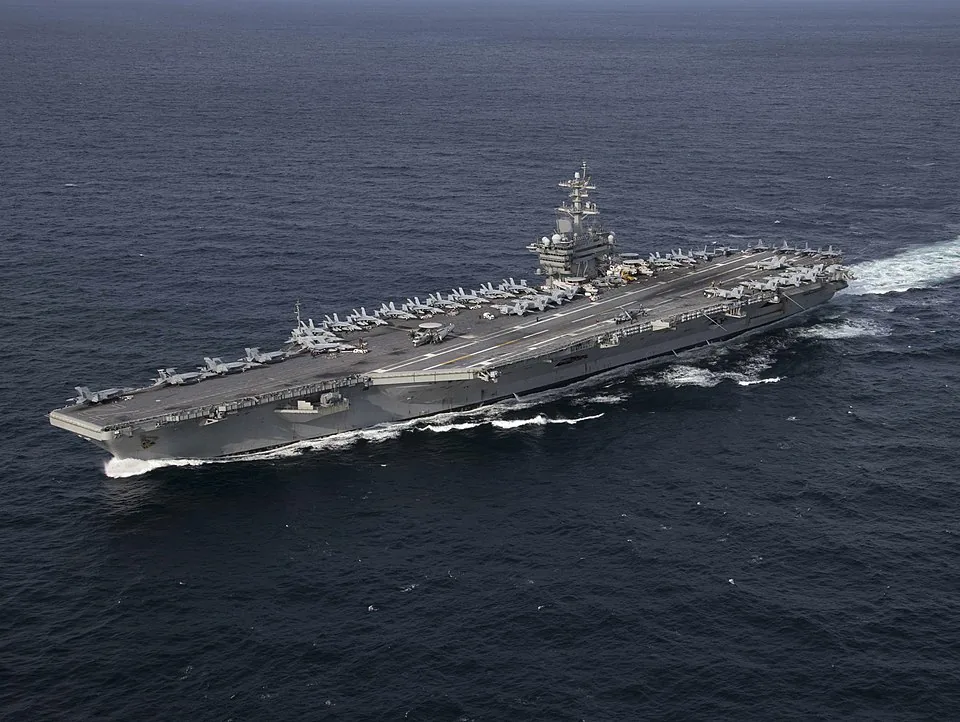
The USS Abraham Lincoln has been at sea for more than 260 consecutive days, a record, and according to sailors' families, the conditions aboard have gotten ugly. We're talking broken toilets, food shortages, and a crew of over 5,000 people running on fumes while the Pentagon insists everything is going great.
260 Days. Let That Number Sink In.
NPR reports the Lincoln has now been deployed longer than any carrier in recent memory, grinding through more than eight straight months at sea in support of U.S. and Israeli operations against Iran. For context, a standard carrier deployment runs roughly six to eight months. The Lincoln blew past that and kept going.
There are more than 5,000 sailors on that ship. Five thousand people, away from their families, working punishing hours, and, if the accounts coming out are accurate, doing it without enough food and with toilets that don't work. This is not a small boat with a skeleton crew. This is a floating city, and the city is apparently falling apart.
What Families Are Actually Saying
Senator Ruben Gallego, Democrat of Arizona and a Marine veteran who deployed to Iraq, went on NPR's Morning Edition to say he has been in direct contact with the spouse of an experienced sailor aboard the Lincoln. The picture she painted was not a Pentagon press release. Long hours, limited food, deteriorating morale, mounting stress. The kind of thing you'd expect when you keep 5,000 people at sea indefinitely with no clear end in sight.
Gallego did not mince words. "They're just kind of winging it right now," he said, taking direct aim at the Trump administration's planning. On the Pentagon's handling of the deployment more broadly, he added: "That's not proper leadership." Coming from a guy who has actually been in a war zone, that is not a throwaway line.
Democratic lawmakers are now formally pushing the Pentagon to investigate reports of food shortages, broken toilets, and inadequate mental health support. Gallego is among a group seeking permission to actually visit the carrier and see conditions for themselves.
The Resupply Problem Nobody Wants to Talk About
Here is where the story gets even messier. Steve Walsh of member station WHRO reports that Iran's attack on the U.S. Navy's main regional hub in Bahrain has directly complicated resupply efforts for ships in the region. So the same war the Lincoln is being used to fight has made it harder to keep the Lincoln stocked with basic necessities. That is a feedback loop of dysfunction that should be front-page news.
When your forward operating base gets hit and you lose your primary logistics hub, the ships depending on it don't just magically get resupplied through willpower and optimism. They go without. Sailors eat less. Equipment breaks and doesn't get fixed. Morale craters. This is not complicated military theory. It is cause and effect.
Pete Hegseth Says It's Fine
Defense Secretary Pete Hegseth has pushed back on reports of poor conditions aboard the Lincoln, according to NPR. The Navy has also stated it has seen no increase in suicidal ideation or suicide attempts aboard the ship. Which, okay. Let's accept that at face value for a moment.
The absence of a measurable spike in suicide attempts is, and we cannot stress this enough, an extremely low bar for how we should be measuring the welfare of 5,000 human beings deployed for a record-breaking stretch in a war zone. "Nobody has tried to kill themselves yet" is not a quality-of-life metric. It is a crisis threshold. The Pentagon is essentially arguing that because they haven't hit the very worst possible outcome, there is no problem worth investigating.
Gallego and other lawmakers want to visit the ship and verify conditions themselves. The Pentagon has not exactly rolled out the welcome mat.
What This Deployment Actually Looks Like
To be clear about the timeline: the Lincoln left port, has been at sea for over 260 days, has had its resupply chain disrupted by enemy action, has sailors reporting food shortages and broken basic infrastructure, and the official response from the top of the Defense Department is essentially "we disagree with your characterization."
The families of these sailors are not anonymous internet commenters. They are people watching their spouses and parents disappear into an open-ended deployment with no clear exit, reaching out to their elected representatives because they have nowhere else to go. That is what it looks like when the system is failing the people inside it.
The Dingo Take
You are supposed to believe that a carrier with broken toilets, food shortages, and 260-plus days at sea is operating within acceptable parameters because Pete Hegseth said so. Pete Hegseth, who arrived at the Pentagon with roughly the same qualifications for the job as a guy who's really good at Fantasy Football, wants you to trust his read on the mental and physical welfare of 5,000 sailors in a combat zone. Pass.
The Bahrain attack gutting the Navy's regional logistics hub is the detail that ties this whole disaster together. The administration launched and escalated a war, got a key supply hub blown up in the process, and then left the Lincoln out there to deal with the consequences while publicly denying anything is wrong. That is not a rough patch. That is a policy failure with human beings absorbing the cost.
Gallego and his colleagues are right to push for access, right to demand an investigation, and right to call this what it is. An experienced Marine veteran calling the Pentagon's handling "not proper leadership" is not a partisan attack. It is a professional assessment. The sailors on the Lincoln deserve better than a Defense Secretary telling the press it's all fine while their families are calling senators to beg for help.




Comments