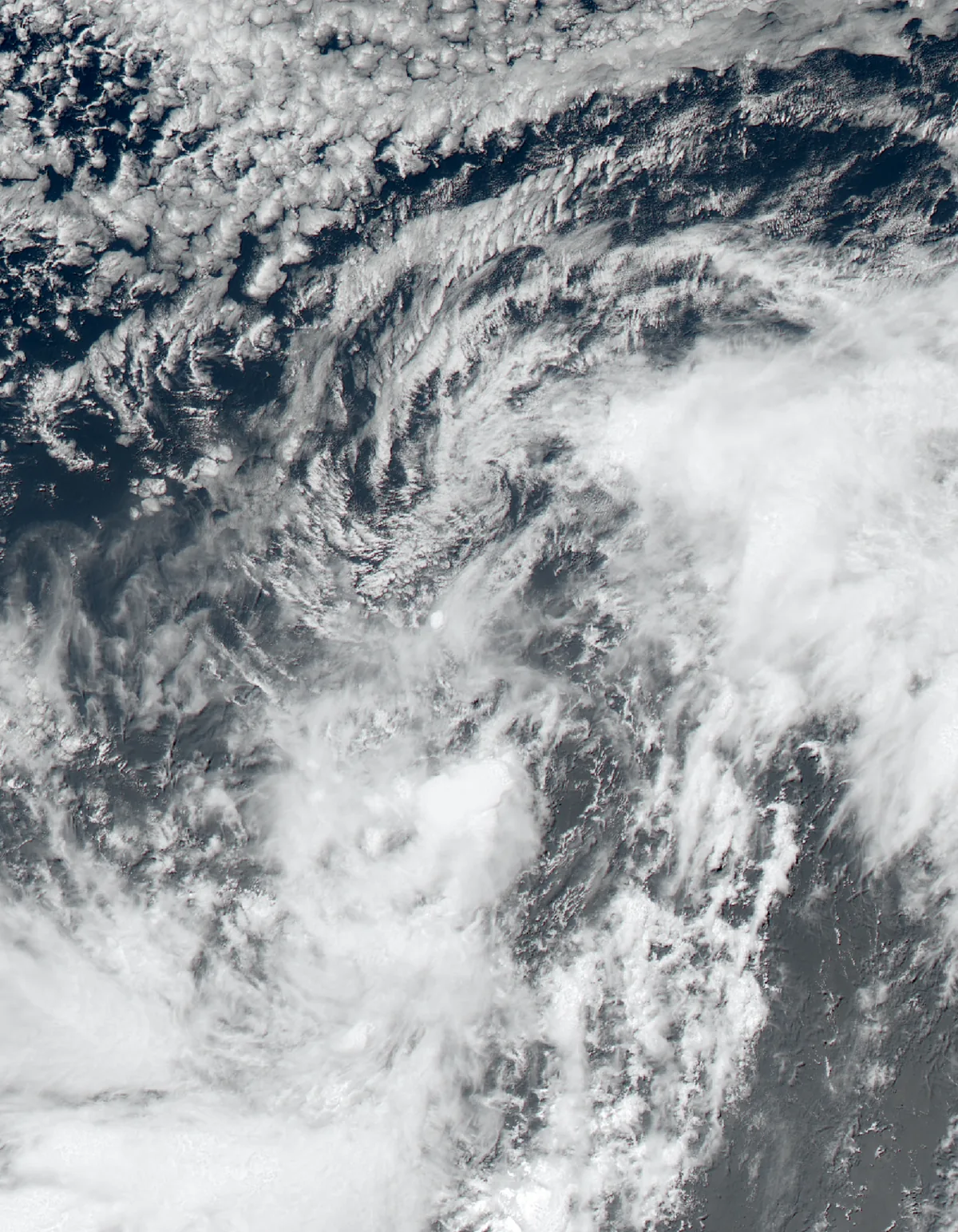
The last time a hurricane made landfall on Hawaii's Big Island, Abraham Lincoln was still alive. According to the New York Post, that 155-year streak is now genuinely in danger, as Hurricane Lala churns toward the southern end of the island with 75 mph sustained winds and the kind of rainfall totals that turn roads into rivers. Seventy-seven flights canceled, life-threatening floods projected, and the whole archipelago holding its breath.
What Lala Is Actually Bringing
Let's be precise about what we're looking at here. The New York Post reports that Lala is a Category 1 storm with maximum sustained winds of 75 mph, currently bearing down on the southern tip of the Big Island. Forecasters are warning of life-threatening flooding and mudslides. Some areas were already absorbing rain at a rate of 2 inches per hour as of Saturday.
Higher elevations could see up to 25 inches of total rainfall before this is over. Twenty-five inches. For context, New York City gets about 46 inches of rain in an entire year. Parts of Hawaii may get more than half that in the span of a single storm event. The ground only absorbs so much before it starts moving.
The flooding risk is the real threat here, not the wind speed. Category 1 storms get underestimated because people anchor to wind categories. But it is the water, the mudslides, the rivers jumping their banks, and the roads dissolving that kill people in storms like this. Officials on the ground know this, which is why they moved fast.
The 155-Year Number Deserves a Second
If Lala makes landfall on the Big Island, it would be the first hurricane to do so since 1871. That is not a typo. The New York Post flags this specifically, and it is worth sitting with. The Big Island has not taken a direct hurricane hit since Ulysses S. Grant was in the White House and the transcontinental railroad was two years old.
Hawaii does get tropical storms and near-misses. Hurricanes track toward the islands with some regularity and then wobble, weaken, or turn away. The ocean temperature, the trade winds, and plain dumb geography have historically conspired to protect the Big Island in particular. Lala, apparently, did not get that memo.
This does not mean the storm will definitely make landfall. Hurricanes are chaotic systems and forecasts at close range still carry real uncertainty. But the trajectory as of Saturday was direct enough that officials suspended all service into Hilo, the Big Island's main eastern city, and cut off flights into Kona after 2 p.m. That is not something airlines do for a storm they expect to miss.
The Flight Cancellations, Airport by Airport
The travel disruption hit the whole island chain, not just the Big Island. The New York Post reports that 59 inter-island flights and 18 transpacific flights were canceled on Saturday alone. Airlines also preemptively cut five more inter-island flights and three transpacific flights for Sunday, which tells you how much confidence crews had in conditions improving overnight.
The breakdown by airport: Hilo saw all service suspended entirely. Kona lost all flights after 2 p.m. Kahului on Maui and Lihue on Kauai both operated reduced schedules under Alaska Airlines and Hawaiian Airlines. Honolulu on Oahu ran close to a normal schedule, which makes sense given its distance from the storm's projected track. LAX departures to Kona, Maui, Kauai, and Honolulu were all caught in the cancellations.
Anyone who was already in Hawaii and planning to leave had a difficult Saturday. Anyone planning to arrive had a worse one. Officials issued the standard advisory to check flight status before heading to the airport, which is the aviation equivalent of "good luck out there."
Who Actually Gets Hurt When a Storm Like This Hits
The tourists stranded at LAX are an inconvenience story. The real story is what happens to people who live on the Big Island and cannot evacuate to somewhere drier. Hawaii's Big Island has some of the most geographically vulnerable communities in the United States: remote subdivisions in lava zones, rural roads that wash out under heavy rain, and agricultural workers in areas that sit directly in the path of mountain runoff.
The island has been through volcanic disasters in recent years, most notably the 2018 Kilauea eruption that destroyed entire neighborhoods in the lower East Rift Zone. Some of those communities were still rebuilding when this storm arrived. Layering a historic hurricane on top of communities already operating with frayed infrastructure is not an abstract concern. It is how disasters compound into catastrophes.
The New York Post does not have full damage reporting yet, which is appropriate since Lala was still approaching as of Saturday. But emergency management officials were clearly not treating this as routine, and the preemptive flight cuts for Sunday suggest nobody on the ground expected this to resolve quickly.
The Dingo Take
One hundred and fifty-five years is not an asterisk. It is the entire modern history of American professional baseball, both World Wars combined, and every presidency from Grant through Biden. The Big Island has survived all of it without a direct hurricane hit. Now a Category 1 storm with a very bad sense of timing is threatening to end that streak in 2026, and the honest answer is that the island's infrastructure, its emergency systems, and its most vulnerable residents are about to find out exactly how ready they were.
The flight cancellation numbers are going to be the hook for most coverage because they are concrete and they affect tourists with Twitter accounts. Seventy-seven canceled flights is a real story. But the 25 inches of projected rainfall on steep volcanic terrain, the mudslide warnings, the communities that are still recovering from the last disaster and now have to absorb this one, that is where attention should land and probably won't.
Hurricane season is doing what hurricane season does. The oceans are warmer than they used to be, the storms are carrying more water than they used to carry, and places that historically got a pass on direct hits are discovering that historical averages are not promises. Lala may still turn or weaken. But the fact that we are genuinely asking whether a hurricane will strike the Big Island for the first time since 1871 should be the kind of sentence that stops people cold. It probably won't. It should.



Comments