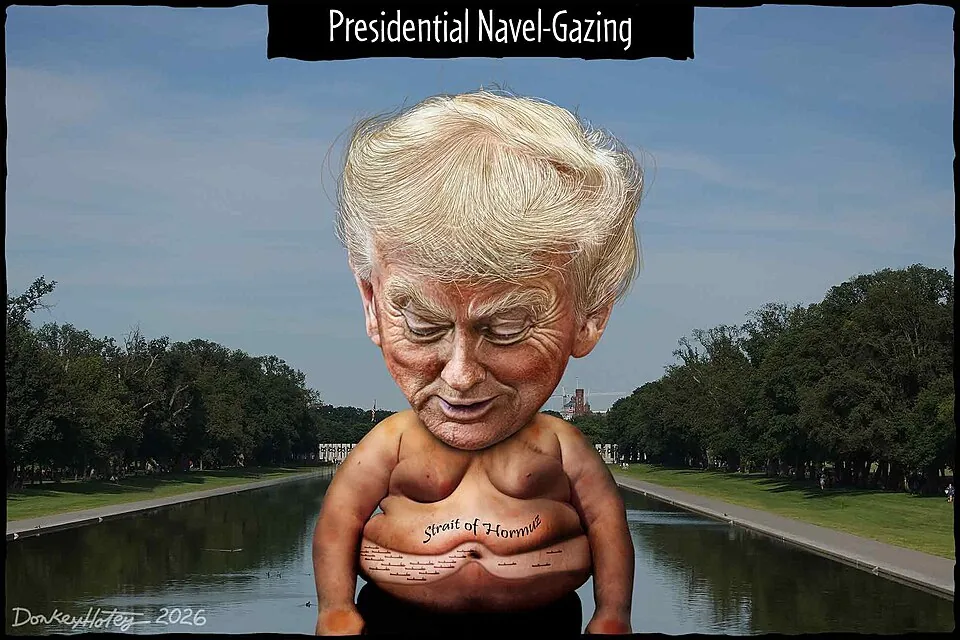
Standing in front of a crowd of law enforcement officers at a Nassau County police academy, Donald Trump announced that he would soon declare the Strait of Hormuz a territory of the United States. Iran's Deputy Foreign Minister got on X within hours to explain, with remarkable patience, how international waterways work.
The Speech That Launched a Thousand Confused Faces
Trump made the declaration on Friday, telling the Nassau County crowd that Iran was being "very badly defeated" and that once victory was secured, "pretty soon, I'll be declaring the Hormuz Strait a territory of the United States." He did not elaborate on the legal mechanism by which a sitting U.S. president claims a waterway on the other side of the planet. Presumably that detail is still being worked out.
He also urged Americans to accept "a tiny little bit more" at the pump as the cost of going to war with what he called "a very evil country." Crude oil futures rose $1 a barrel on Friday, and benchmark Brent futures were on track for a weekly rise of 6.0%, Reuters reported Saturday. So: slightly higher forever, and also we might own the Persian Gulf now.
Iran's Deputy FM Would Like to Offer a Rebuttal
Iran's Deputy Foreign Minister Kazem Gharibabadi did not take the news lying down. In a post on X early Saturday, he informed the American president that the crucial waterway "cannot be seized with a tweet, nor with an aircraft carrier, nor by issuing an order, nor through an election speech." That's a pretty thorough list. He covered basically every tool in the Trump toolkit.
"This strait will only be opened and closed under Iran's command," Gharibabadi added, "and as long as you do not accept the reality of defeat and stop indulging in delusions, Iran will continue to enforce the blockade." The phrase "indulging in delusions" is going to hit differently depending on which side of this war you're on. For about half of America, it's going to hit very accurately.
According to NBC News, the war itself launched on February 28. It is now mid-August. The 60-day negotiating window that Trump and Tehran agreed to in a memorandum of understanding back in mid-June expires on Monday, and Iran's Foreign Minister Abbas Araghchi told Shahrara News on Friday that there are currently "no negotiations taking place between Tehran and Washington." Sixty days. Zero negotiations. The clock is out.
The Strait Is Not Exactly Bustling Right Now
Before this war, the Strait of Hormuz handled roughly one-fifth of the world's oil supply. Today, it is functionally a shooting gallery. Ship-tracking firm Kpler found that only two vessels passed through the strait on Friday, with no crude oil shipments visible. In peacetime, 130 to 140 vessels transit it daily. Two.
Some ships have tried their luck by switching off their transponders and crossing undetected, NBC News reports, but Iran has continued firing on vessels attempting transit despite a U.S. blockade of Iranian ports. On Friday, a bulk carrier was struck in the hull by an unknown projectile, according to the United Kingdom Maritime Trade Operations Centre. The crew was safe, but no damage assessment had been completed and the environmental impact was unknown. Iran controls access to the strait with enough force to shoot ships in it. Trump wants to call it American territory. These two things are in tension.
JD Vance Is Handling Peace Talks, Somehow
Vice President JD Vance has been tasked with leading negotiations to end this war. On Thursday, he told Fox News that the number one goal of the conflict was to "keep oil and gas cheap for Americans all over our country," with preventing Iran from getting a nuclear weapon coming in at goal number two. Iran has repeatedly denied any desire to develop nuclear weapons, for whatever that's worth in this context.
This is worth sitting with for a second. The stated justifications for starting this war have shifted multiple times. NBC News reports that the Trump administration initially framed it as support for antigovernment protests inside Iran, then pivoted to ending Iran's nuclear program, then to toppling the Islamic regime entirely. Now Vance is saying cheap gas is the whole point. Meanwhile, gas prices are higher than before the war started and a two-carrier Navy is blockading Iranian ports while Iran blockades the strait and shoots at tankers. Cheap gas when, exactly?
Qatar and Pakistan are serving as mediators, exchanging messages between Washington and Tehran. But Iran's foreign minister was explicit: message-relaying "does not at all constitute negotiations." No decision has been made to resume direct talks.
Six Months In, and Nobody Has a Map to the Exit
The war is now nearly six months old. The 60-day peace window expires Monday. There are no active negotiations. Two ships crossed the world's most important oil strait on Friday. A British navy-affiliated organization is tracking projectile strikes on commercial vessels in international waters. And the American president is telling police officers in Long Island that he plans to annex a body of water that his military does not control.
Global oil markets have settled somewhat since the initial price spike when the war began, but prices remain significantly above pre-war levels and ticked upward again this week. The economic logic of this war, whatever it was, is not playing out the way the victory-lap speeches suggest. The humanitarian and environmental costs of a struck tanker with an unknown damage profile in a bottlenecked strait are not yet calculable.
The Dingo Take
You are supposed to believe the United States is winning this war. That is the official position. Iran is "very badly defeated." The speech said so, at a police academy graduation, on Long Island, in August. And yet: two ships crossed the Strait of Hormuz on Friday. A tanker got hit by a projectile. Iran's deputy foreign minister is publicly laughing at us on social media. The 60-day peace negotiation produced zero negotiations. These are not the metrics of a country that is very badly defeated.
What Trump described in Nassau County is not a foreign policy. It is a bumper sticker. "We're winning, gas prices are worth it, and also we're going to own that strait over there." The actual situation, as NBC News and Reuters have both documented this week, is a hot war with no exit ramp, a blockaded waterway handling two percent of its normal traffic, and a peace process that Iran's own foreign minister describes as nonexistent. JD Vance is the lead negotiator. Let that sentence breathe.
The Strait of Hormuz is not going to become U.S. territory. It cannot be claimed with a speech. Iran knows this. The shipping companies know this. The two vessels brave or desperate enough to transit it on Friday definitely know this. The question is whether anyone in the administration knows it, or whether the plan is just to keep saying "victory" until something changes. At some point, the gap between the speech and the reality gets wide enough that even the most committed believers start to notice the ships aren't moving.




Comments