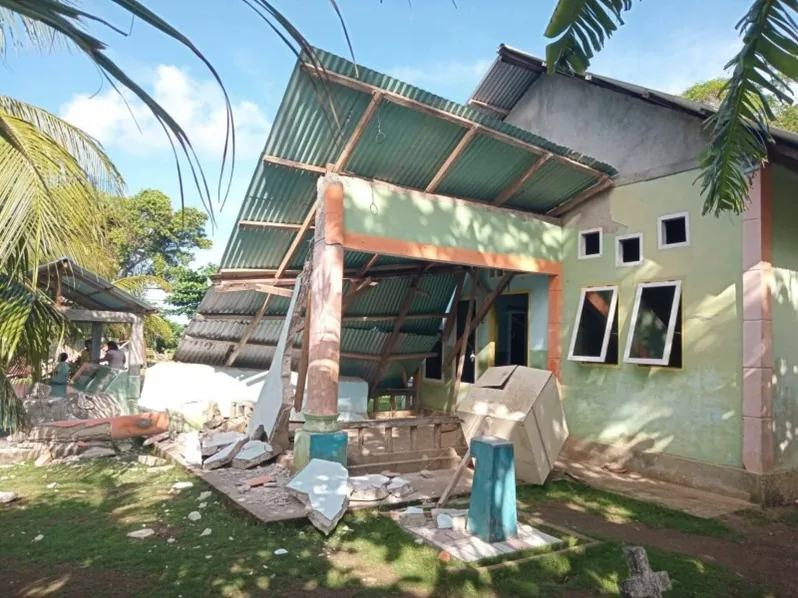
A 7.7-magnitude earthquake ripped through eastern Indonesia's Flores region early Saturday morning, killing at least 53 people, destroying more than 900 homes, and triggering a tsunami warning that sent coastal residents sprinting for higher ground. Then came the aftershocks. Nearly a thousand of them. Indonesia does not get to rest.
What Happened, and How Fast It Got Worse
The first quake hit at 5:58 a.m. local time Saturday, CBS News reports, with the U.S. Geological Survey placing the epicenter about 42 miles north-northwest of the city of Ende in East Nusa Tenggara province. Within minutes, a second earthquake, this one a 6.4-magnitude, struck western Sumatra island. Two major quakes. One country. One morning.
The tsunami warning that followed forced coastal communities to evacuate immediately. Authorities eventually lifted the alert after monitoring showed no significant sea-level changes, but the terror of that window, of watching the ocean and waiting, is not something you just shake off. Literally or otherwise.
Rescuers recovered at least 47 bodies on Saturday alone, mostly from the Sikka, Manggarai, and East Manggarai areas, according to CBS News. Six more were found Sunday, bringing the confirmed death toll to 53. More than 130 people were injured. Authorities said the number of dead would almost certainly climb.
Nearly 1,000 Aftershocks and Counting
By Sunday, Indonesia's National Disaster Management Agency had recorded at least 995 aftershocks, according to CBS News. Of those, only 46 were strong enough for residents to actually feel. The largest hit a magnitude of 6.2. That is, to be clear, a significant earthquake on its own. Here it is just an aftershock.
Abdul Muhari, the agency's chief for disaster prevention, confirmed the aftershock numbers. Thousands of displaced people spent Saturday night sleeping outdoors because going back inside a building after what they had just experienced was simply not an option anyone was willing to take. You cannot really blame them.
Villages Cut Off, Roads Gone, Power Out
The earthquake did not just kill people. It dismembered the infrastructure holding the region together. CBS News reports that landslides in Ende regency severed the Trans-Flores highway, a roughly 435-mile paved mountain road running the length of Flores Island from Labuan Bajo to Larantuka. That road is not a convenience. It is the artery.
East Nusa Tenggara Police Chief Rudi Darmoko said power outages across cities and villages have cut off information flow and complicated rescue efforts. "We are continuing to collect reports of damage and casualties, but there are communication disruptions," he said. When you cannot get information out of a disaster zone, the death toll you are reporting is almost always a floor, not a ceiling.
The head of the Search and Rescue Office in Maumere, Fathur Rahman, told reporters that landslides buried or cut off many remote villages across six regencies on Flores Island. The National Disaster Management Agency deployed a helicopter for logistics and evacuation support. One helicopter. For a province made up of dozens of islands with limited road access to begin with.
The Scale of the Destruction
More than 900 homes were destroyed and 450 more damaged across East Nusa Tenggara province, forcing roughly 5,000 people into temporary shelters, CBS News reports. In the Flores region alone, at least 241 homes were damaged. Over 100 public facilities, including schools, medical centers, and churches, were also destroyed.
Hospital footage broadcast on local television showed staff evacuating patients from buildings as a precaution, moving beds, IV stands, and oxygen cylinders outside to set up emergency treatment areas in the open air. These are not images from some chaotic, poorly managed response. This is what dealing with a 7.7-magnitude earthquake looks like everywhere, for everyone.
Yulian Juita Ekalia, a 37-year-old university lecturer living in Ruteng, more than 60 miles from the epicenter, described the experience to AFP: "It felt like we were on a trampoline; it was really scary. As I rushed to get outside, everything in the house fell down: the television, my son's trophies, the dish racks, suitcases on top of the wardrobes." She had never felt anything like it. Most people never do.
This Is Not a Fluke. This Is Indonesia.
Indonesia sits on the Ring of Fire, an arc of fault lines and volcanoes circling the Pacific Basin, and the country's more than 17,000 islands make it one of the most seismically active places on earth. This is not background color. It is the entire context.
The history here is brutal. In 1992, a powerful earthquake triggered a tsunami that killed about 2,500 people on Flores specifically, the same island hit Saturday. In 2018, a magnitude 7.5 quake and its tsunami killed more than 4,400 people. And in December 2004, a 9.1-magnitude earthquake off Sumatra triggered a tsunami that killed 230,000 people across a dozen countries. Indonesia has been living inside this threat for as long as there have been people living on these islands.
The Dingo Take
Fifty-three people are confirmed dead, and the rescuers trying to reach the remote villages where the real toll is hiding are doing it with one helicopter, severed roads, and no power. The death count being reported right now is what they have been able to verify with communication systems that are partially down, in a province that is a scattered chain of islands on a good day. Whatever the final number is, it will be higher than 53.
The tsunami warning piece deserves a beat of reflection too. Coastal residents evacuated. They ran. They did the right thing. And this time, the sea did not come. That is the best possible version of that scenario, and it still means thousands of people spent part of their morning genuinely believing they might be about to watch a wave take everything. After the earthquake had already taken the rest. The psychological damage of that is not something that gets tallied in disaster management reports.
International attention to disasters like this one tends to follow a depressingly predictable arc: a day or two of coverage, some fundraising links, and then the scroll moves on. The people of Flores Island will still be sleeping outside, waiting for aftershock number 996, long after that happens. Pay attention a little longer this time.



Comments