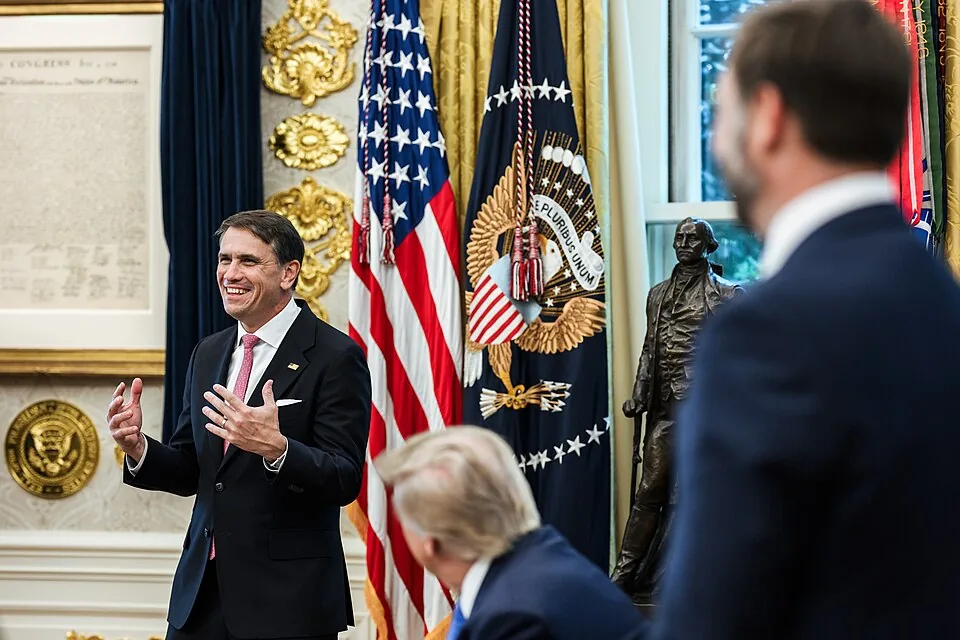
Todd Blanche, the attorney general of the United States, went on national television Sunday and said, with a straight face, that Donald Trump will 'never' ask him to do anything illegal. This is the same Todd Blanche who, before becoming the top law enforcement officer in the country, spent years as the personal attorney for a man a jury convicted of 34 felony counts. Just let that sit there for a second.
The Quote That Will Live in Infamy
Here is the exact sentence Blanche said to NBC News' Kristen Welker on Meet the Press: 'The president will never ask me to do something unethical or legal or illegal. He never has. He never will.' Read it again. He said 'unethical or legal.' As in, Trump would never ask him to do something legal. That garbled syntax aside, the confidence here is staggering.
This is a man who watched his former client get convicted in a Manhattan courtroom, watched him pay hush money to a porn star and try to cover it up through falsified business records, and came away thinking: yes, this is the guy whose ethical guardrails I want to stake my reputation on. And now he runs the Justice Department. America, baby.
Trump, for his part, appeared at a Nassau County speech Friday and told the crowd that Blanche 'has a shot at being the greatest ever, if he remains tough and strong.' According to NBC News, Blanche was in the audience when Trump said this. The 'tough and strong' qualifier is doing a lot of heavy lifting in that sentence.
30 States, 22 Losses, and One Possible Hail Mary to SCOTUS
The actual news driving the interview is this: the Justice Department has now lost 22 out of the 30 cases it has filed against states that refused to hand over their voter rolls. The cases stem from an executive order Trump signed demanding that states turn over voter data, including names, dates of birth, residential addresses, driver's license numbers, and the last four digits of Social Security numbers. The stated purpose, per the federal government, is investigating 'deficiencies' or 'anomalies,' including potential noncitizen voter registration.
Federal judges in Oregon, Michigan, and at least 20 other states have sided with the states. According to NBC News, some of those states pushing back are led by Republicans, including Idaho, Nevada, Utah, Georgia, and Vermont. Vermont's Republican Governor Phil Scott said last month that state leaders are simply better positioned to run elections than the federal government. Hard to argue with that.
Blanche told Welker that appealing all 22 losses to the Supreme Court is 'absolutely a possibility.' He framed it as a matter of patriotic duty. 'Election integrity is something that President Trump ran on, and the American people elected him,' he said. Which is technically true, but also describes roughly every position Trump has ever taken, and is not, on its own, a legal argument.
The Man Who Just Got Confirmed Wants You to Know He Has Integrity
Blanche was only confirmed to his post earlier this month, after months of serving as acting attorney general. NBC News reports the confirmation came after he brokered a deal with Republican Senators Thom Tillis and John Cornyn, who had serious reservations about a nearly $2 billion 'anti-weaponization' fund the DOJ had agreed to in a settlement with Trump over his lawsuit against the IRS. The fund would have allowed Americans to collect money from the Justice Department if they believed it had been weaponized against them.
Blanche killed the fund to get his confirmation through. On Sunday he told Welker: 'I've said repeatedly: It's dead.' So the mechanism that would have let ordinary citizens seek accountability from a potentially politicized DOJ is gone. The man who killed it is now in charge of the DOJ. Checks and balances are a rich tapestry of... wait, we don't use that word. A rich system of interconnected safeguards. You get the point.
House Minority Leader Hakeem Jeffries also appeared on Meet the Press and did not mince words, describing the Justice Department as 'a wholly owned subsidiary of the Trump cartel and Donald Trump's extreme agenda.' Blanche responded by promising that he and his prosecutors would act 'without fear or any sort of favor.' The words sound fine. The biography makes them land funny.
What Is Actually at Stake Here
Strip away the political theater and focus on what the DOJ is actually trying to do. The federal government wants comprehensive personal data on every registered voter in America, centralized in Washington, administered by an administration that has already demonstrated it views elections as a realm where it has unlimited grievances and limited patience for results it dislikes.
Elections in the United States have always been run at the state level. That is not a bureaucratic quirk; it is a feature, one that distributes power and makes large-scale federal manipulation structurally harder. The Trump administration is trying to change that architecture, and courts across the country, including courts in states run by Republican governors, keep telling them no.
If Blanche does take this to the Supreme Court, he will be asking a bench that already handed the president sweeping immunity from prosecution to now also hand him sweeping access to the data infrastructure of American democracy. That is a lot to ask. But then, this administration has never been shy about asking.
The Dingo Take
You are supposed to believe that the man Trump called 'maybe the greatest attorney general ever' is going to prosecute without fear or favor. The man Trump praised for being 'tough and strong.' The man Trump hand-picked after firing Pam Bondi in April. The man who spent years as Trump's personal defense attorney and watched the jury come back with 34 guilty verdicts and thought, you know what, I still want to work for this guy. You are supposed to look at all of that and feel reassured by a promise of integrity delivered on a Sunday morning talk show.
The voter roll cases are the story hiding inside the story. Twenty-two federal judges, in blue states and red states alike, have looked at this executive order and said no. Republican governors are in court fighting their own party's president over it. That is not routine partisan resistance. That is a broad, cross-ideological coalition of public officials saying this particular power grab goes too far. When Phil Scott of Vermont and the governor of Idaho are on the same side as California and New York, you are not looking at a culture war skirmish. You are looking at something structural.
Blanche says the DOJ won't stop. He says it's about fairness. He says Trump will never ask him to cross a line. November is three months away. The Supreme Court petition is coming. Pay attention to what happens next, because whoever controls the data infrastructure of American elections in 2026 is going to have a very strong opinion about 2028.



Comments