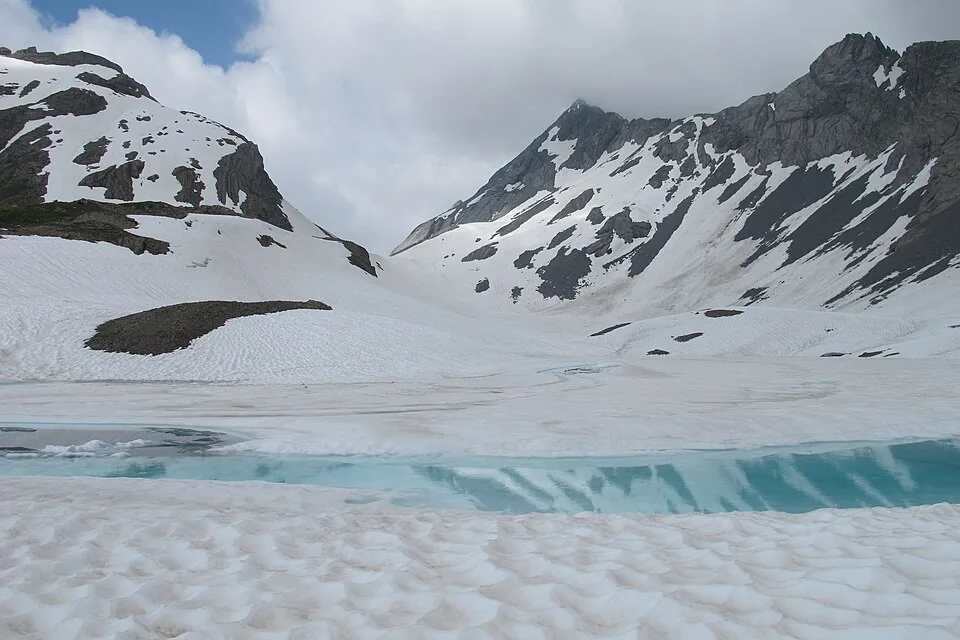
Two Belgian men went hiking in the Swiss Alps in 1992 and never came home. Thirty-four years later, a melting glacier handed them back. The climate crisis is doing a lot of things to this planet, but one of the stranger ones is that it keeps returning the dead.
What Actually Happened on That Glacier
On July 26, a hiker spotted two bodies on the Trift Glacier in southern Switzerland, near the Italian border. The regional police in Wallis canton confirmed Wednesday that DNA testing has formally identified the remains as two Belgian mountaineers, aged 39 and 41 when they vanished in the Weissmies region in 1992, according to CBS News.
The bodies were transported to the Institute of Forensic Medicine at Wallis Hospital in Sion for identification. A direct DNA comparison closed the case on a disappearance that had been sitting open for over three decades. Somewhere out there, families who have been waiting since George H.W. Bush was president finally got an answer.
Wallis police keep a running list of missing persons dating back to 1925, mostly from the high mountains and rivers of the region. They know this drill. They've been doing it for a century.
The Glacier Is Basically a Cold Case Archive at This Point
Here's what makes this story genuinely strange: this is not a one-off. It's not even unusual anymore. The Wallis police statement said the retreat of glaciers "repeatedly" reveals the remains of people who disappeared in the mountains decades ago. Repeatedly. That word is doing a lot of work.
CBS News laid out the timeline and it reads like a grim highlights reel. In 2025, the bones of a Swiss mountaineer who vanished in 1994 turned up on the Ober Gabelhorn. Also in 2025, a British researcher who disappeared in Antarctica in 1959 was found near a receding glacier on King George Island, and a man missing for 28 years was recovered from a melting glacier in Pakistan. In 2024, an American mountaineer showed up in Peru, 22 years after he disappeared. In 2023, a German climber who went missing in 1986 was pulled from a Swiss glacier.
Go back further: 2017 gave us a British climber lost in 1971, Italian hikers from the 1980s and 1990s recovered on Mont Blanc, and, most cinematically, a Swiss couple who went missing together in 1942 and were found frozen side by side 75 years later. The ice had them the whole time.
Why This Keeps Happening
Glaciers are not static. They move, compress, and preserve whatever falls into them. A body that disappears into a crevasse doesn't just sit there at the spot where it fell. It gets carried, slowly, downhill through the ice over decades. Eventually it reaches the glacier's terminus, the lower edge where the ice melts away, and gets deposited back into the world.
Climate change has dramatically accelerated that process. Glaciers that once took centuries to cycle through their mass are now retreating at rates that scientists describe in terms that used to be reserved for catastrophe. The Swiss Alps have lost roughly half their glacier volume since the mid-1800s, and the pace has been picking up sharply since the 1980s. What that means, as a direct and measurable consequence, is that the ice is giving up its secrets faster than it ever has before.
So when Wallis police say this happens "repeatedly," they mean it. And they mean it's happening more often now than it used to. The cold case unit of the future is going to need crampons.
The Part Nobody Talks About
Every one of these recoveries represents a family that spent decades not knowing. The Belgian men who disappeared in 1992 were in their late thirties and early forties. If they had children, those kids are now middle-aged. Parents who waited for news are likely gone themselves.
There's something both merciful and brutal about this particular form of closure. Thirty-four years is a long time to wonder. Getting an answer is something. But the mechanism delivering that answer, a planetary system destabilized by a century of industrial emissions, is the same one that is currently threatening to drown coastlines, collapse agricultural systems, and displace hundreds of millions of people.
The glacier is giving back what it took. It's just doing it for reasons that should terrify us.
The Dingo Take
You are supposed to look at a story like this and feel only the human interest angle. Two lost climbers, finally found, families finally at peace. And that part is real. It matters. But the mechanism here is not a curiosity or a silver lining. A warming planet is defrosting a century's worth of the missing, and we are treating each discovery as a standalone feel-good story rather than as evidence of a system coming apart at a scale that is very hard to look at directly.
Every body that a glacier returns is a data point. The ice that preserved these two Belgian men for 34 years is the same ice that, according to climate scientists, will be largely gone from the Alps within decades. When it's gone, it's gone. There are no more bodies coming back after that. There is no more water storage for the rivers those mountains feed. There are no more do-overs.
So yes, the families got closure. That is genuinely good. But the planet is running a clearance sale on frozen remains, and the reason it can afford to is because we spent a century making the world too hot to keep them. The glacier didn't decide to melt. We decided for it.



Comments