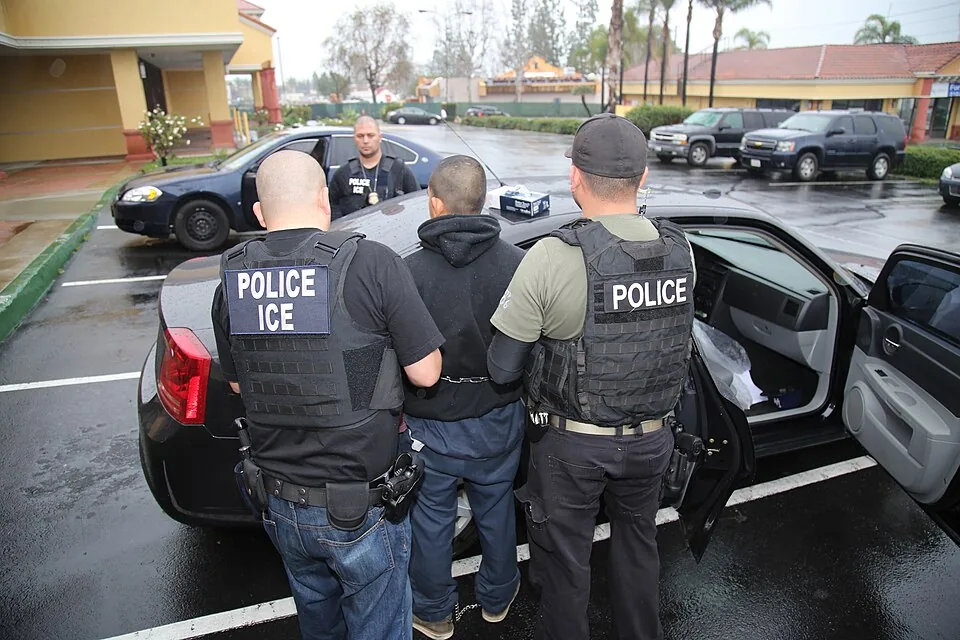
A 45-year-old man walked to a bus stop in Arlington, Virginia on August 11. He woke up hours later in a hospital with a brain bleed, two black eyes, and bruises covering his face, chest, hands, and back. ICE's response was to transfer him to their office, strap an ankle monitor to his leg, and hand him a court notice.
What Happened at That Bus Stop
According to The Guardian, José Mejía Hernández was on his way to catch a bus when two agents climbed out of an unmarked vehicle and started chasing him. He remembers being hit by what felt like a stun gun. After that, nothing. He came back to consciousness in a hospital bed.
A Department of Homeland Security spokesperson confirmed the arrest and said Mejía Hernández had 'attempted to flee, requiring ICE to use necessary force.' That is the entire explanation. What kind of force? No answer. Why was the force necessary? No answer. How did a man walking to a bus stop end up with a subarachnoid bleed? Silence.
The DHS did push back on one detail: they insist Mejía Hernández was never unconscious, that officers 'rendered aide' and that he was 'responsive' after the arrest. His lawyer, Margaret Hellerstein, says her client has no memory of anything between the stun gun and waking up in a hospital room. The photos of his face suggest this was not a gentle encounter.
The Injuries, in Plain Terms
The Guardian reviewed medical records and photos from after the arrest. Mejía Hernández had severe bruising across his face, two black eyes, and cuts and bruises on his hands, chest, and back. He was hospitalized for several days with ICE agents stationed beside him throughout.
A nurse told him he had suffered a brain bleed. He went back to the hospital on August 14 because he was feeling significantly worse. Medical records obtained by The Guardian show he was formally diagnosed with 'mild TBI' and a 'subarachnoid bleed,' with doctors noting 'head, face and neck injury' and 'trauma with continued pain.'
Doctors ordered an MRI. That's where the story gets a special kind of ugly.
The Ankle Monitor Catch-22
You cannot get an MRI with a metal ankle monitor on your leg. This is not complicated physics. Mejía Hernández's lawyers tried to get the monitor removed so he could complete the scan his doctors had ordered. ICE said no, he needed paperwork first. Paperwork specifying the exact date and time of the MRI.
So he had to go back to the ICE office, wait for hours, get the monitor removed, do the scan, and then have it reattached. The DHS framed this in their statement as proof they were not 'denying him' medical care. The man with a traumatic brain injury had to spend hours in a government office waiting room to prove he had a doctor's appointment before he could access the scan his doctors had ordered.
He eventually got the MRI done, several days after doctors had requested it. His lawyer told The Guardian that ICE's bureaucratic requirements directly delayed medically necessary care.
What His Lawyer Is Actually Saying
Hellerstein was direct with The Guardian in a way the DHS was not. 'Is ICE's narrative that it is acceptable and appropriate to beat a person in the head until he has a brain bleed and traumatic brain injury just because he was trying to escape?' she said. 'He was not a danger and they are not claiming he was a danger. All they are claiming is that he was trying to get away.'
She has a point worth sitting with. The DHS's own statement does not allege that Mejía Hernández threatened agents, attacked anyone, or was armed. The entire justification for whatever force was used is that he tried to run. Running from police is not typically considered a capital offense, or even a reason to leave someone with brain trauma.
'He has been treated as less than human,' Hellerstein said. 'It's just unconscionable how unimportant this man's life is to these people.' The DHS did not respond to questions about whether agents beat him, or how he got the injuries visible in the photographs.
The Pattern Virginia Officials Are Describing
The Guardian reports that photos of Mejía Hernández's injuries spread widely on social media, prompting responses from local officials. Virginia Democratic Congressman Don Beyer said his office had received reports of multiple ICE encounters in northern Virginia over the past ten days involving 'unjustified violence or apparently warrantless detention.'
Beyer described a pattern of agents stopping people on the street, demanding ID, and 'responding with violence when their orders are questioned, regardless of whether those orders violate individuals' rights.' He also pointed to a recent video of an ICE agent drawing a gun on a US citizen who was filming him in Falls Church, Virginia. ICE called that person an 'anti-ICE agitator.'
Arlington's top prosecutor, Parisa Dehghani-Tafti, said she was 'deeply disturbed' by reports of the injuries and had reached out to local police and state officials. The DHS's parting shot in their statement to The Guardian: 'We take allegations regarding misconduct seriously and cherish the public's trust.' Sure.
The Dingo Take
The DHS said they 'cherish the public's trust.' They said it in a statement where they refused to answer questions about how a man ended up with a brain bleed, two black eyes, and bruises head to toe after their agents chased him to a bus stop. They disputed that he was unconscious. They did not dispute the medical records. They did not explain the bruises. They offered paperwork requirements and press release boilerplate and called it accountability.
This is the architecture of impunity: deny the most dramatic claim, say nothing about the documented evidence, blame the victim's behavior for requiring 'necessary force,' and then stick an ankle monitor on the man while he's still in the hospital. The genius of it, if you can call it that, is that by the time anyone gets around to asking real questions, there are six more cases behind this one. Congressman Beyer is not describing an isolated incident. He is describing a pattern, in one county, in ten days.
José Mejía Hernández walked to a bus stop. He now has a traumatic brain injury and a court date. The agents who left him that way have not been named, have not been suspended, and have not been charged with anything. The DHS says they hold themselves accountable. They do not appear to have started yet.


Comments