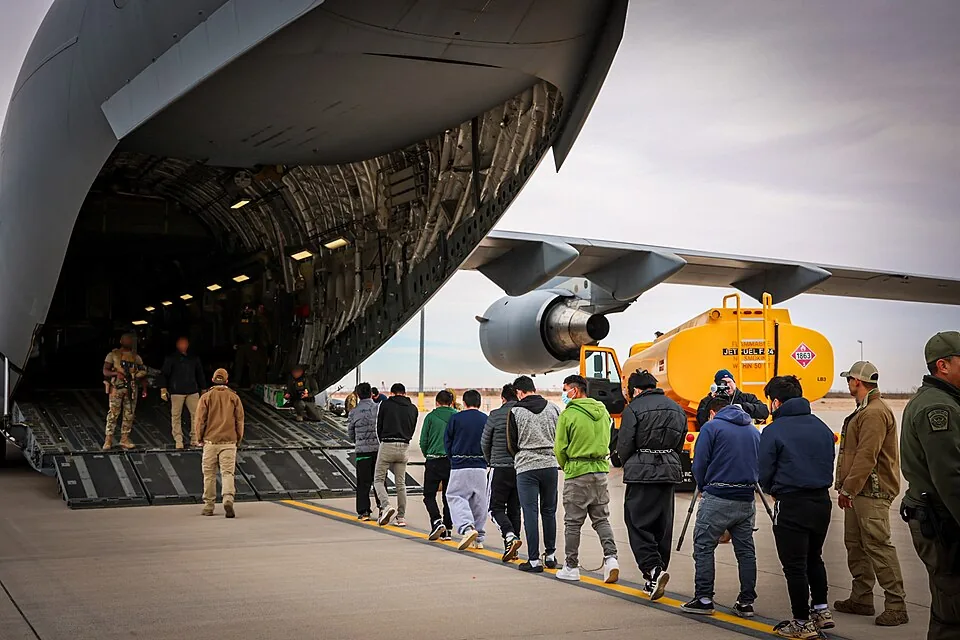
While Donald Trump was posting on social media telling people to evacuate Tehran, his immigration agency was quietly letting the Iranian government decide which Iranians got put on deportation flights back to Iran. Emails obtained by the National Iranian American Council and made public Tuesday show ICE officials amending deportation manifests at the direct request of the Iranian Embassy, sometimes days before flights departed. This is not a metaphor. This literally happened.
An Enemy Government Had Input on American Deportation Lists
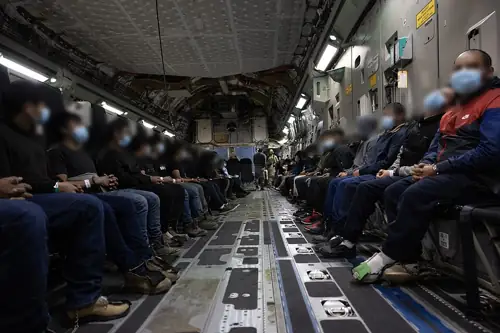
The emails, exchanged between U.S. immigration officials and obtained by the National Iranian American Council, cover three deportation flights to Iran in September and December 2025 and January 2026. CBS News reports that more than 100 Iranians were removed across those three flights, and the paper trail of how those flights came together is stunning.
"Per request from the Iran Embassy I added a few cases," one unnamed ICE official wrote in late August 2025, about a month before the first flight. Less than two weeks later, someone with the same job title made another change to the deportation list after meeting with the "Director at the Iranian Embassy." The official wrote, "Iran has requested that I amend the previous manifest and expedite the removal process."
Three days before the September flight departed U.S. soil, an ICE official noted the Iranian Embassy was still pushing to add three more people. Iranian officials were still making requests the day of the flight, though one official noted those last-minute additions were denied. The key word there being "last-minute" — the earlier requests, it appears, were not.
They Were Planning Deportations While the Bombs Were Still Falling
Here is where this story goes from bad to jaw-dropping. The U.S. and Israel fought a 12-day conflict with Iran between June 13 and June 24, 2025. According to CBS News, on June 16 — three days into active hostilities — Trump posted on social media urging people to "immediately evacuate Tehran." Days after that post, former acting ICE director Todd Lyons sent an email calling the repatriation of Iranian immigrants a "priority" and addressed it to the agency's head of removal operations, Marcos Charles.
An unnamed ICE official pushed back, warning that "removal will prove difficult" because Iranian airspace was closed, Iran wasn't issuing travel documents, and Iranians were, you know, fleeing the country their government was actively bombing. Charles was not moved by any of this. He told staff to make a plan to deport 58 Iranians with final removal orders, writing, "We need a plan forward ASAP." Another official, name redacted, urged colleagues to "identify a solution for this White House priority."
A White House priority. Deporting people to a country the U.S. was in the middle of bombing was, explicitly, a White House priority.
At Least One Person Was Deported Who Wasn't Even on the List
The operational chaos baked into this program is its own story. CBS News reports that at least one person was put on a deportation flight who was not included on the final approved manifest. "An Iranian not included on the final manifest we sent to the Qatari MOI was boarded on the flight," an unnamed U.S. official wrote. Another official responded: "I have no idea how the case/person got through on the plane."
So to review: the Iranian government was adding people to the list, someone who wasn't on any list ended up on a plane anyway, and the officials running this operation had no idea how it happened. The New York Times had previously reported that asylum-seekers were among those deported, and that some were removed against their will. The emails don't clarify whether the people Iran requested for deportation had agreed to go home or were simply handed over.
Qatar Was the Middleman, and ICE Was Meeting Regularly with Iranian Officials
The flights were chartered through Doha, with Qatari officials sometimes passing messages between U.S. and Iranian counterparts. But CBS News reports the emails also reference direct, apparently regular contact between ICE officials and the "Iranian delegation" and "Director at the Iranian Embassy." This was not a one-time back-channel conversation. This was a working relationship.
The emails also show ICE officials arranging for Iranian officials to meet with people detained in the U.S. for unspecified reasons. Iranian asylum-seekers testified about similar meetings in a separate, unrelated lawsuit. What those meetings were about, and whether detainees had any idea who they were meeting with, is not addressed in the emails.
The Department of Homeland Security, CBS News notes, did not respond to a request for comment.
What Human Rights Groups Are Saying
Jamal Abdi, president of the National Iranian American Council, told CBS News that the emails directly contradict the Trump administration's stated rationale for the conflict with Iran. "It demonstrates that the top priority here was to kick out as many people as possible by whatever means necessary," Abdi said. The organization's policy director, Ryan Costello, called the documents "an operation that demands answers from the highest levels of government."
That framing matters. The Trump administration spent the summer of 2025 telling Americans that military action against Iran was about liberating the Iranian people from a repressive regime. These emails describe that same administration coordinating deportation logistics with that same regime, letting Iranian officials shape who gets sent back, while bombs were still dropping on Tehran.
Iranian officials confirmed in September 2025 that as many as 400 Iranians could ultimately be returned under the agreement with the Trump administration, CBS News reports. The U.S. has not characterized the arrangement as a formal deal.
The Dingo Take
You are supposed to believe that the Trump administration went to war with Iran to protect ordinary Iranians from a brutal theocratic government. That was the pitch. That was the justification for a military conflict that killed people on both sides and sent shockwaves through an already destabilized region. And while that justification was still warm, ICE was on email chains with Iranian Embassy officials, taking their input on deportation lists, scheduling meetings between detained asylum-seekers and Iranian government representatives, and labeling the whole operation a "White House priority."
This is not a bureaucratic mix-up. The emails are specific, detailed, and damning. A foreign government whose relationship with the United States is, to put it gently, adversarial was given influence over which of its own citizens got handed back to it. Some of those people may have been dissidents. Some were asylum-seekers. At least one person was put on a plane with no explanation for how they got there. The country receiving them has a documented history of imprisoning and torturing people who ran afoul of the government. None of this was a secret inside ICE. It was just not supposed to become your problem.
The fact that the Department of Homeland Security had nothing to say when CBS News called is its own answer. There is no version of this story where the silence is reassuring.



Comments