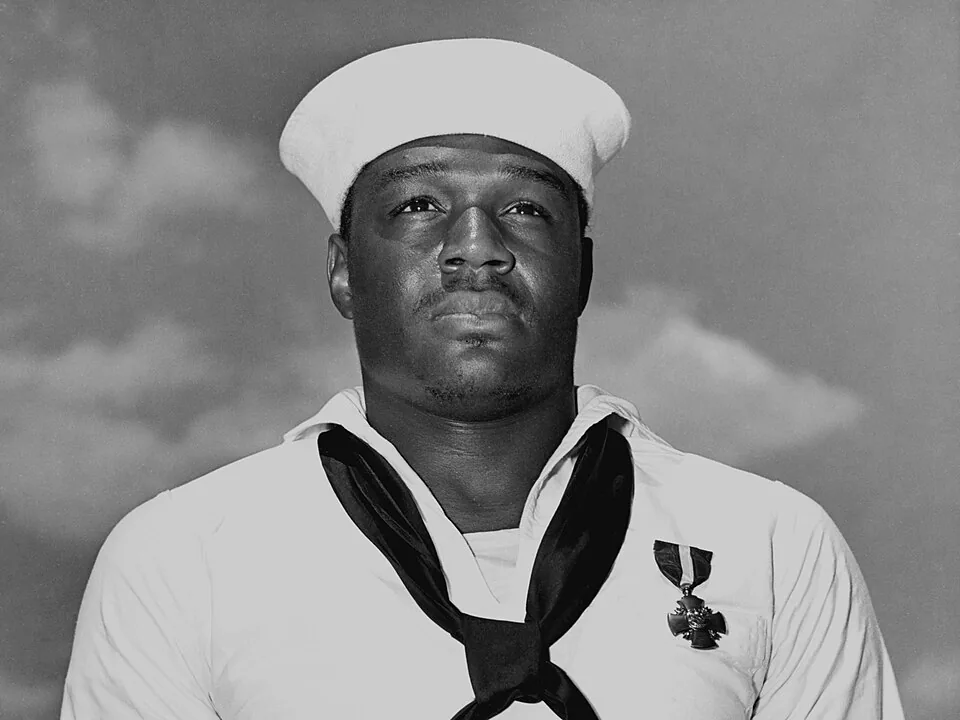
The United States Navy is discussing stripping the name of Doris Miller, a Black WWII hero who manned an anti-aircraft gun at Pearl Harbor while people were actively dying around him, off a future aircraft carrier so it can be named after Donald Trump instead. This is a real thing that is happening in the real world in the year 2026. Two U.S. officials confirmed the discussions to NBC News.
Who Doris Miller Actually Was
Let's make sure we are all clear on what is being proposed here, because the specific details matter enormously.
Doris Miller was a mess attendant in the U.S. Navy. That means he was a cook, one of the few roles the segregated Navy allowed Black sailors to hold. On December 7, 1941, when Japanese planes started dropping bombs on Pearl Harbor, Miller did not go find a safe place to wait it out. He dragged wounded sailors to safety. Then he grabbed an anti-aircraft gun he had never been trained on and, according to historical accounts, shot down at least one Japanese plane.
For this, Miller became the first Black service member to receive the Navy Cross, the Navy's second-highest honor. He was celebrated. He was used in recruiting posters. He died in combat in 1943. It took until 2020, during Trump's first term, for the Navy to finally announce that a carrier would bear his name. The USS Doris Miller would have been the first aircraft carrier ever named for a Black sailor and the first named for an enlisted sailor. Both of those milestones, apparently, are now negotiable.
The Discussions Have Been Going On For Months
NBC News reports that two U.S. officials confirmed the name-change discussions have been ongoing for several months. CNN was first to report it. The Navy did not respond to a request for comment, which, honestly, tracks.
Ship-naming authority sits with the Navy secretary, but defense secretaries are historically involved when it comes to aircraft carriers. That means this decision runs through Defense Secretary Pete Hegseth and acting Navy Secretary Hung Cao. The same Pete Hegseth who arrived at the Pentagon with approximately zero relevant experience and a genuinely impressive collection of controversial opinions. The same administration that has been systematically scrubbing diversity-related names, programs, and initiatives from the military since day one of Trump's second term.
The ship itself is still under construction. It's the fourth Ford-class carrier, and according to NBC News, it could be among the first to carry the Trump-ordered steam catapult system, replacing the electromagnetic catapults the Navy had been developing. So the vessel may already be getting reshaped in Trump's image below deck. Apparently that wasn't enough.
The Medal of Honor Dodge
Here is the part that is almost impressive in its cynicism. NBC News reports that Miller is now being considered for a posthumous Medal of Honor, but that the White House has not approved it. Destroyers are commonly named after Medal of Honor recipients. Aircraft carriers are traditionally named after presidents.
Read that slowly. The implicit logic being floated here is that if Miller gets the Medal of Honor, the Navy can put his name on a smaller ship, and a carrier gets freed up for Trump. It's a lateral promotion that results in a demotion. It's a consolation prize dressed up as an honor. Give the dead Black war hero a slightly bigger medal so a living president can have the bigger boat.
Whether that is the actual plan or just how it lands when you put the facts in a row is, at this point, a distinction without much of a difference.
The Pattern Is the Point
This does not exist in a vacuum. The Trump administration has spent the better part of two years ordering the military to remove what it calls "DEI" elements from the armed forces. Bases have been renamed. Programs have been cut. Portraits have come down. The military's entire approach to demographic data collection and diversity recruitment has been dismantled.
Naming the carrier after Miller was itself a corrective act, an acknowledgment that the Navy had for decades failed to honor the contributions of Black sailors in any meaningful way. Miller's story was always slightly awkward for the institution, because it illustrated that the segregated Navy was forcing Black men into support roles while those same men were demonstrably capable of combat heroism when given the chance. The carrier was supposed to be a reckoning, however belated, with that history.
Stripping his name to put Trump's on it is not just tasteless. It's a statement about whose sacrifice counts and whose legacy is expendable when it becomes politically inconvenient.
The Dingo Take
You are supposed to look at this and see a routine bureaucratic discussion about ship-naming conventions. A president's name on a carrier is traditional, after all. Carriers get named after presidents. This is just how it works. Nothing to get worked up about.
Except Doris Miller was already chosen. The announcement was made during Trump's own first term. The name was set. This isn't filling a blank slate; it's erasure. A Black enlisted sailor who performed an act of extraordinary courage in a Navy that wouldn't let him hold a combat role is being bumped so a man who received five draft deferments during Vietnam can have his name on the side of a $13 billion warship. And the possible sweetener, a posthumous Medal of Honor that would conveniently justify moving Miller to a smaller vessel, is the kind of maneuver that would get a slow clap from Machiavelli.
The Navy hasn't commented. Hegseth's Pentagon rarely explains itself before it acts. The carrier is still under construction, which means there is still time for enough people to make enough noise that this particular piece of historical revision doesn't get quietly signed off on in a conference room somewhere in the Pentagon. Miller earned his place on that ship. He earned it on the morning of December 7, 1941, in the middle of a burning harbor, with a gun he wasn't supposed to know how to use. That should count for something. The fact that it apparently needs to be argued for, in 2026, is its own kind of answer.




Comments