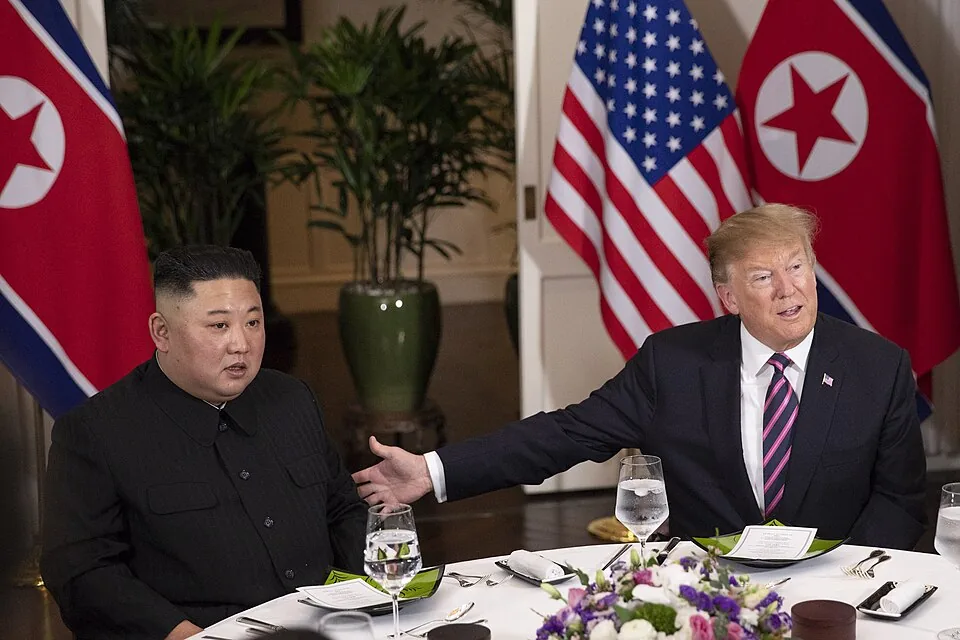
Donald Trump, the man who stores classified documents next to his golf shoes, just casually told the world the exact number of nuclear warheads North Korea possesses. He said 57. He said it like he was reading off a receipt. No U.S. official has ever publicly put a specific number on North Korea's arsenal before, and Trump offered zero explanation for where that figure came from.
The Number Nobody Was Supposed to Say Out Loud
According to Fox News, Trump made the disclosure Wednesday while defending his personal relationship with Kim Jong Un, arguing that getting along with a nuclear-armed dictator is, quote, "a good thing." He was not wrong that it's better than the alternative. He was also not explaining why he knows Kim's exact warhead count.
Public estimates from serious analysts have generally placed North Korea's assembled stockpile somewhere between 50 and 60 warheads. The Federation of American Scientists put the number at roughly 50 assembled warheads in 2024, while estimating Pyongyang has enough fissile material to build as many as 90. The Stockholm International Peace Research Institute landed at about 60. So Trump's figure of 57 is in the ballpark, which raises an obvious question: is this a classified intelligence assessment he just read into the public record, or is he triangulating between two think tank estimates and presenting it as a briefing?
Neither answer is particularly reassuring.
The Context Makes It Worse, Actually
Trump did not drop this number in a vacuum. He made the comment the same week he ordered Defense Secretary Pete Hegseth to substantially scale back the annual U.S.-South Korea Ulchi Freedom Shield military exercises, which have long served as a deterrent signal to Pyongyang. Fox News reports that U.S. and South Korean militaries announced they would shorten the drills and end them Friday.
So in the span of a few days, Trump cut joint military exercises with a key ally and told the world how many nuclear weapons the country those exercises are meant to deter currently has. Kim Jong Un, meanwhile, ordered his country to ramp up production of, and this is a direct quote, "weapon-grade nuclear materials" on Tuesday. Kim's sister Kim Yo Jong dismissed the reduction in drills as insufficient, saying Washington's policy toward North Korea remains hostile. So North Korea is not even acknowledging the concession. They are just banking it and asking for more.
This is, to use a technical diplomatic term, a bad trade.
The Summit That Has Not Happened Yet Is Already Costing Something
Trump told reporters he expects to meet Kim later this year, possibly during a planned November trip to Asia, though Fox News notes no summit has actually been announced. He also said Kim is "a very powerful player" and blamed previous administrations for letting North Korea develop nuclear weapons in the first place.
That last point is not entirely unfair as a historical observation. Multiple administrations, both parties, failed to stop North Korea's program. But Trump met Kim three times during his first term and walked away with nothing except photo opportunities and a brief moratorium on missile tests that Kim ended the moment it suited him. The negotiations collapsed in 2019 without any agreement to curb the nuclear program. What is different now, beyond the fact that North Korea has more warheads than it did in 2019, is not clear.
For Scale, Because Scale Matters Here
North Korea's 57 warheads sound almost modest until you think about what 57 nuclear weapons can do to a region. Russia has roughly 4,400 warheads in its military stockpile. The United States has about 3,700. China has 620. France has 290. The United Kingdom has 225. India has 190. Pakistan has 170. Israel has around 90, according to January estimates from the Stockholm International Peace Research Institute.
North Korea sits at the bottom of that list and still represents an existential threat to South Korea, Japan, and depending on delivery capability, the continental United States. The number 57 is not small. It is 57 reasons why scaling back military exercises and scheduling golf-buddy summits without preconditions is a strategic choice that requires more justification than "I get along with him."
The Dingo Take
You are supposed to believe that a president casually disclosing what appears to be a classified intelligence figure about a hostile nuclear state's exact weapons count is normal statecraft. It is not normal. It is either a deliberate leak of sensitive intelligence with no announced purpose, or it is a man confusing a think tank estimate for a briefing and announcing it to the cameras either way. Pick whichever explanation you prefer. Both are alarming.
The real story here is not the number 57. The real story is the pattern it sits inside. Trump is cutting military exercises, angling for a summit, calling a nuclear-armed dictator "fine" as long as America has a "smart president," and offering concessions before a single negotiation has begun. Kim Yo Jong looked at the drill reductions and said it was not enough. North Korea is simultaneously ramping up weapons material production. These are not the signals of a country preparing to deal. They are the signals of a country that has learned Trump will give things away for the promise of a meeting.
Trump pulled this same playbook in his first term and got three photo ops and zero denuclearization. North Korea has used the intervening years to build more bombs. Whatever 57 means, it is a bigger number than it was the last time Trump was sure he had this handled.




Comments