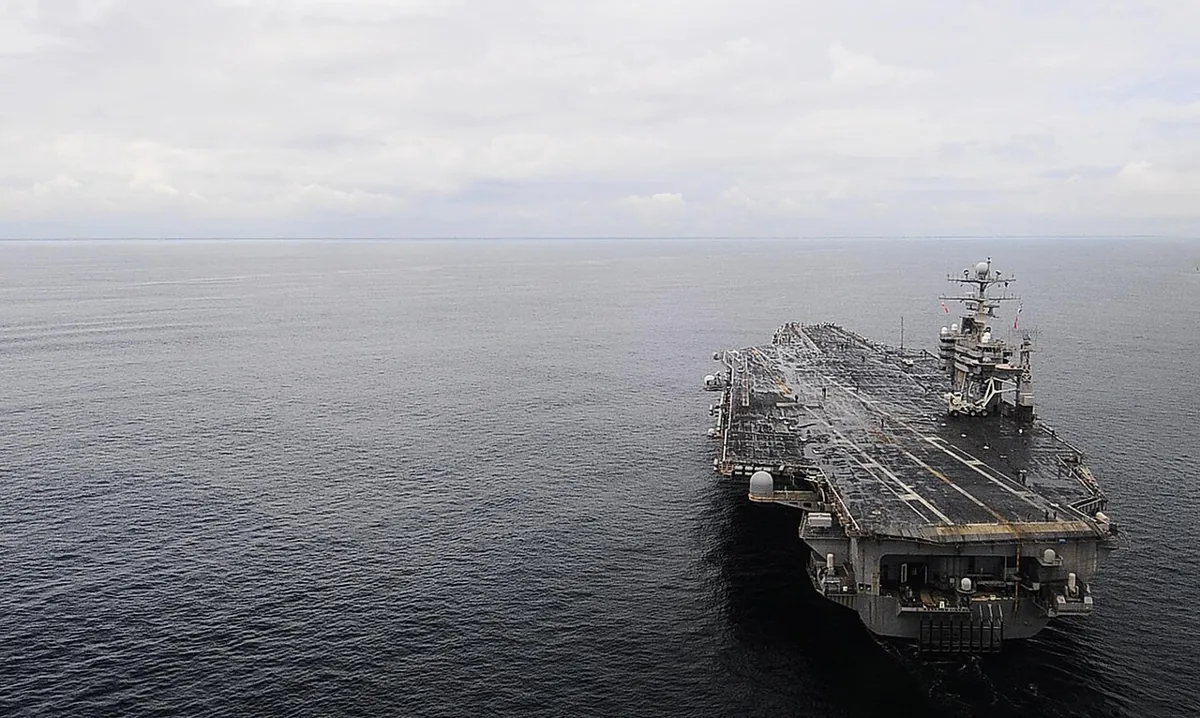
Five thousand sailors and Marines who spent nine months at sea, more than 200 of those days without a single port stop, with food shortages and crew members reportedly jumping overboard, are finally heading home. Last week, Donald Trump looked into a camera and said their deployment had been "not nearly long enough." The USS Abraham Lincoln left the Middle East this week, according to NBC News and CBS News, and is expected back in San Diego in roughly three weeks.
Nine Months, No Ports, No Problem (According to Everyone Who Wasn't There)
The Lincoln departed San Diego on November 21. The original plan called for a deployment ending in May, which would have clocked in at a standard six to seven months. Then the U.S. and Israel launched strikes on Iran in late February, the war expanded, and the Lincoln stayed. And stayed. And stayed.
NBC News reports the ship has been at sea for more than 250 days total and hasn't docked at a port since December. That's over 200 consecutive days at sea. For context, aircraft carriers typically make regular port stops throughout a deployment specifically to resupply food and give the crew a moment to exist on land like human beings. The Lincoln skipped all of that.
The ship has served as a launch point for thousands of aircraft sorties supporting strikes in the Iran war, according to CBS News. So not a quiet nine months. Not a calm stretch of open water. Active combat operations, stretched supplies, and no shore leave, for the better part of a year.
What Families Were Actually Saying
Family members of crew aboard the Lincoln have been sounding alarms for weeks. NBC News reports they described grim conditions: lack of food, lack of supplies, and serious concern about deteriorating mental health. Multiple sailors have reportedly attempted to jump overboard.
CBS News notes that family concerns, as reported by Military Times and Stars and Stripes, had already reached Capitol Hill before this week's homecoming announcement. Jefferson Kelley, whose son Jackson is on his first-ever deployment aboard the Lincoln, told CBS News last week that he'd get on a helicopter that night if it meant bringing his kid home.
The Navy, for its part, told CBS News it hasn't seen a confirmed increase in reported suicide attempts or suicidal ideation on board. It is, however, investigating an August 3 incident in which a sailor fell overboard and was recovered. So that's something they are actively looking into, which is not the vibe you want from a statement meant to reassure people.
The Official Response Was a Masterclass in Missing the Point
CENTCOM Commander Admiral Brad Cooper flew out to visit the Lincoln over the weekend and penned an op-ed in the Wall Street Journal announcing the crew's return home. "I delivered the words every deployed sailor and Marine longs to hear," Cooper wrote. Good. Great. But also buried in that same op-ed: a full-throated dismissal of the concerns that families had been raising for months.
"Issues related to food, hot water and other concerns raised months ago were addressed by leadership and resolved," Cooper wrote, adding that the crew "continues to fire on all cylinders." He also posted on social media that the Lincoln "currently has among the lowest number of cases related to mental health" of the Navy's 11 active carriers. A comparison that, depending on how you read it, could mean things are fine or could mean the rest of the fleet is also struggling and the Lincoln is simply slightly less bad.
Acting Secretary of the Navy Hung Cao called media coverage of the conditions "dishonest," according to CBS News. Defense Secretary Pete Hegseth said reports had been "completely misrepresented." And then there was Trump, who told reporters Friday that the deployment was "not nearly long enough." Five thousand people. Nine months. Sailors going overboard. Not long enough.
Now Someone Else's Turn
With the Lincoln finally pointed toward San Diego, the Japan-based USS George Washington has arrived in the Middle East to take over, according to U.S. Central Command. The rotation continues. The war continues.
The George Washington's crew is now beginning whatever version of this deployment they're in for. Whether the lessons of the Lincoln, the food shortages, the port stops, the mental health monitoring, factor into how this next stretch is managed remains to be seen. Based on how leadership has characterized the last nine months, the answer to that question is not obviously yes.
The Dingo Take
The President of the United States, when presented with a situation in which 5,000 members of the military had been at sea for nine months, hadn't touched land since December, were reportedly running low on food, and multiple crew members had gone overboard, looked at all of that and said it wasn't long enough. That is the sentence. That is what happened.
And the machine around him performed accordingly. The admiral wrote a Wall Street Journal op-ed. The acting Navy secretary blamed the press. Hegseth said it was misrepresented. Not one of them addressed the central, obvious question: why was a carrier with 5,000 people aboard kept at sea for over 200 consecutive days without a port stop during an active war, well past its original end date, while the administration publicly waved away every warning sign families raised?
These sailors are going home. That part is real and it matters. But the fact that it took this long, and that every official instinct along the way was to manage the story rather than the conditions, is worth sitting with. The Lincoln's crew delivered, by any measure, an extraordinary deployment under genuinely brutal circumstances. They deserved better than to have the Commander in Chief suggest, publicly, that they should have stayed longer.





Comments