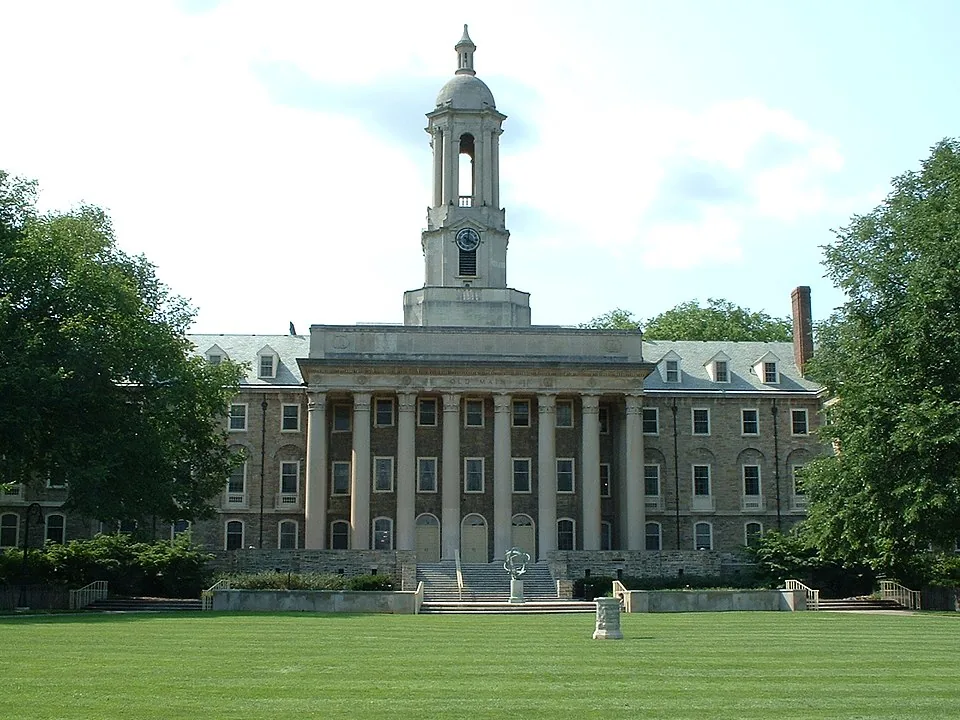
Forget the keg stands and the blindfolds. At Penn State's Delta Upsilon fraternity, prosecutors say pledges earned their letters by cutting and bagging cocaine. Thirteen current and former students were charged this week in what Pennsylvania's attorney general called an 'upper-level trafficking organisation' — one that allegedly started with frat brothers selling to each other and ended with a supply chain worthy of a mid-tier crime drama.
The Ringleader Who Lived by a Moral Code
Meet Agostino Abbatiello, 24, the man prosecutors say ran the whole operation. According to the BBC, he graduated from a prestigious Catholic all-boys school on Long Island where he described himself as a 'life coach' and embraced his school's motto of doing 'the right thing at the right time because it is the right thing to do, regardless of who is watching.'
Regardless of who is watching. That's a fun one in retrospect.
Abbatiello was a member of Sigma Chi at Penn State. According to the criminal complaint obtained by the BBC, a Sigma Chi brother named Lars Zeepvat had already cultivated a cocaine source in Pennsylvania, and Abbatiello initially tapped that connection. When it dried up, Abbatiello allegedly went back to his hometown in New York and found a supplier willing to move product in much larger quantities.
That, according to the complaint, is when things escalated. Zeepvat told prosecutors he noticed 'a shift in Abbatiello' and it became clear he was 'now selling drugs for profit, rather than sourcing it for himself and a few friends.' Abbatiello then allegedly asked Zeepvat if he 'wanted to make money and help him distribute cocaine.' Zeepvat, it appears, said yes.
The Pledge Program Nobody Put in the Brochure
Here is where it gets genuinely dark. By late 2023, according to the criminal complaint the BBC obtained, 'several of the pledges at the Delta Upsilon fraternity were used to package the drugs into half gram bags for sale.' Pennsylvania Attorney General Dave Sunday described this as 'a pattern of events that showed cutting and bagging cocaine was, for some pledges, an indoctrination into the Delta Upsilon and Sigma Chi fraternities.'
Let that settle. These kids showed up to college, decided they wanted to join a fraternity for the networking and the parties and the sense of belonging, and allegedly got handed a razor blade and a pile of cocaine as their welcome-to-the-brotherhood moment.
Two Delta Upsilon members, Mohammed Huraibi and Thomas Robinson, are accused of partnering in the cocaine business in 2023 and making increasingly large purchases from Abbatiello. By fall of 2024, the BBC reports, Robinson and Abbatiello were actively recruiting more help, pulling in friends and fraternity brothers for packaging, delivery and distribution. What started as frat brothers selling to each other had become, in Sunday's words, a serious regional trafficking operation.
Venmo, Snapchat, and the World's Most Traceable Drug Ring
For a group that managed to build what prosecutors are calling an upper-level trafficking network, the operational security was, to be generous, not great. The BBC reports that the suspects used apps like Snapchat and Venmo, and that usernames tied to their actual names ultimately helped bring them down.
A confidential informant told police that a man going by 'T-Rob' was selling cocaine out of the Delta Upsilon house and collecting payments on Venmo under the username 'Tom-Robinson,' according to court documents obtained by NBC News. Police traced that back to the Penn State student in roughly the amount of time it would take you to Google someone.
Detectives had an informant make multiple controlled cocaine buys from Robinson before raiding his room at the fraternity house in December 2024. CBS News reports that when officers arrived, Robinson thought it was a prank and didn't comply with orders, so police used a stun gun on him. They found a 220-gram bag of marijuana, pill bottles, drug paraphernalia, a handgun in a safe, and a magazine with ammunition. Robinson then pointed investigators straight to Abbatiello, and the rest, as the BBC put it, 'unravelled.'
The Charges and the Fallout
Abbatiello faces multiple felony counts including illegal drug possession with intent to deliver and conspiracy, the BBC reports. He turned himself in to Pennsylvania police, and his lawyer did not respond to requests for comment. Thirteen current and former Penn State students are charged in connection with the enterprise. Lawyers for Zeepvat and Huraibi also did not respond to comment requests.
Penn State's vice-president for student affairs, Andrea Dowhower, issued a statement calling the allegations horrifying. 'Criminal activity, including hazing, such as this has no place at our institution, and we will co-operate with law enforcement in any way we can,' she said. Attorney General Sunday was blunter about the scale of what investigators found. 'There was nothing junior or childlike about this type of conduct,' he said. 'This was an upper-level trafficking organisation for this region in Pennsylvania.'
The Dingo Take
You are supposed to believe that fraternities, as institutions, have a hazing problem that universities are working hard to address. What this case illustrates is that 'hazing' is doing a lot of heavy lifting as a category when it has to cover both 'forced to chug a beer' and 'forced to bag cocaine for a drug trafficking operation.' These are not the same thing. One is a stupid and occasionally deadly college tradition. The other is a felony conspiracy that prosecutors say operated as a regional supply chain. The word 'hazing' should not be in the same sentence as both of those things.
The part that should keep Penn State's administration up at night is not just that this happened, but how long it took to catch. This allegedly ran from 2023 into late 2024, grew from a small friend group into a multi-person operation with dedicated packagers, drivers, and distributors, and got busted not through any institutional awareness but because someone was accepting drug money on Venmo under his own name. The school's systems caught exactly none of this. A payment app did.
And then there is the pledge angle, which is the part nobody should let slide. These were kids trying to join a college club. Whatever they were told they were signing up for, it was not this. Prosecutors say some of them were handed drugs to process as part of their initiation. If that is proven true, it is not a campus misconduct issue. It is a recruitment-into-criminal-enterprise issue, and it deserves to be treated exactly that way.



Comments