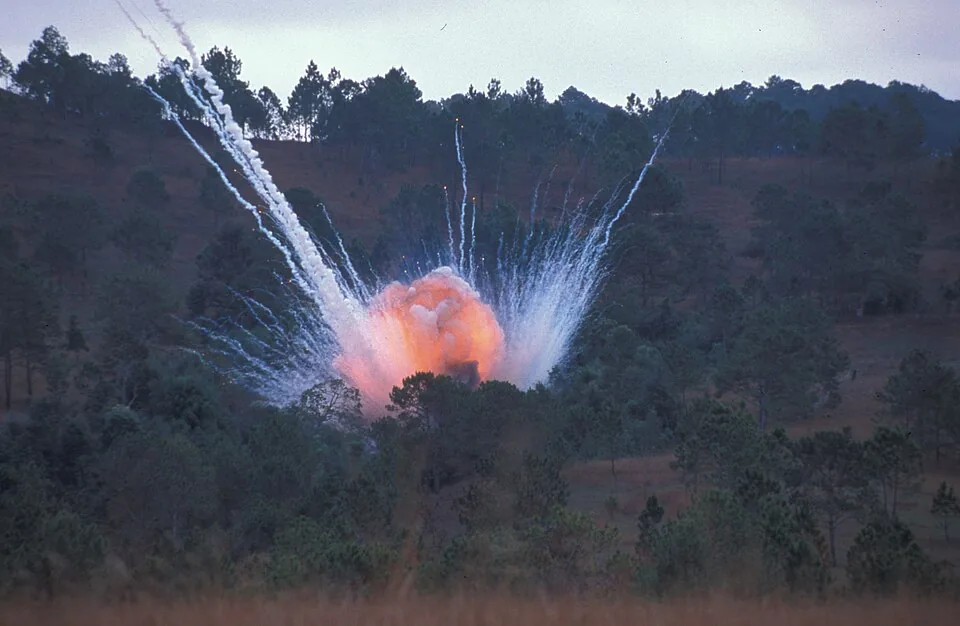
A wildfire outside Bordeaux uncovered around 400 shells of World War II-era ammunition this month, some of which exploded, and one of which went through a house. Europe is currently on fire, and the fire is shooting back. This is not a metaphor.
Bombs Nobody Knew Were There
In the village of Le Porge, France, the mayor described the sounds coming from the forest during the blaze as "the sound of war." He was not being poetic. According to CBS News, roughly 400 shells and pieces of ammunition, both German and French, were found after a massive wildfire tore through the area near Bordeaux earlier this month. Mortar shells. High-explosive anti-tank rounds. Buried since the 1940s. Suddenly very much above ground and in the mood to do damage.
Fire commander Thomas Mimiague confirmed that blasts heard during the fire were likely shells cooking off in the heat. Mayor Martial Zaninetti told French outlet France Info that the town had no idea there were ammunition depots buried under their land. "They exploded," he said, in the kind of matter-of-fact statement that should probably disturb more people than it currently does. One munition punched through a house. Over 180 homes in the area were destroyed by the fire itself, before you even start counting the ordnance problem.
Belgium Is Living With 200 Tons of This Every Single Year
Here is a number that deserves a moment of silence: Belgium's Explosive Ordnance Disposal and Destruction Service responds to more than 3,000 calls per year and disposes of 200 to 250 tons of war munitions annually. Every year. As CBS News reports, farmers in Ypres, the town synonymous with the worst trench warfare of World War I, have a name for what happens when they till their fields in spring. They call it "the iron harvest." Because that is what comes up.
In the eastern Belgian province of Liege, Governor Hervé Jamar confirmed that emergency services were adapting their wildfire response to account for munitions buried in active fire zones after "sporadic detonations" were heard. Local media published photos of a firefighter holding a rusted bomb like it was a piece of litter he found on a hiking trail. Because in Belgium, that is basically what it is.
Local historian Bernard Collard, who is authorized to scan former battlefields with a metal detector, put it simply to CBS News: "You are not sure where the explosives are." He has personally found mortar shells, machine guns, helmets, and once, a human skeleton. His father detonated a bomb in a quarry. This is just what growing up near the High Fens looks like. The peat-bog forest that straddles the Belgian-German border, site of the Battle of the Bulge, is currently smoldering under a huge blaze.
Climate Change as Bomb Disposal Problem
The specific cruelty of this situation is that the wildfire season itself was made worse by climate change, and the wildfires are now activating unexploded ordnance that climate change is also disturbing through drought and shrinking rivers. It is a feedback loop of historical violence.
A World Weather Attribution study from last month found that this summer's European fires were supercharged by heavy January rains that caused excessive vegetation growth, which then became tinder when summer heat and drought conditions arrived. Sarah Njeri, a peace and conflict scholar at the School of Oriental and African Studies in London, told CBS News that climate change "is now doing the work of unburying and reactivating what was previously stable." She described Europe's "climatic luck" as running out.
Christina Greene, a researcher at the University of Arizona who co-wrote an article on this exact risk with Njeri, told CBS News that "the legacy of war keeps creeping up" because of climate change. It is not just fire doing this. Drought shrank the Danube enough that Slovakia had to pull two naval mines out of the river and bury them for a controlled demolition. Budapest closed the Margaret Bridge after a WWII bomb appeared at its base in receding water. The Rhine dried up and Germany found another one. The continent is, essentially, a very old crime scene that the weather keeps digging up.
This Is Not a New Problem, Just a Newly Dangerous One
To be clear, unexploded ordnance turning up in Europe is not new. CBS News reports that a 1,000-pound Allied aerial bomb was pulled from a construction site in Belgrade, Serbia, as recently as December. In August 2025, thousands of people in Dresden had to evacuate their homes after a bomb turned up. Paris's Gare du Nord, one of the busiest train stations in the world, had to halt all traffic in March 2025 after a bomb was found near the tracks.
What is new is that wildfires strip away the controlled conditions that make finding these things manageable. The standard procedure involves careful handling, controlled demolition, professionals with equipment and time. Wildfire removes all of that from the equation. The heat detonates the shells on its own schedule, in its own direction, without warning. Firefighters already have one extremely dangerous job. The prospect of the ground exploding beneath them is, to use the technical term, a lot.
The Dingo Take
Eighty years after the end of World War II, the war is still capable of blowing a hole in a house in rural France. Sit with that for a second. The shells are still there. The mines are still there. The booby traps are still there, rusting in peat bogs and riverbeds and under farmland all across a continent that has been trying, with varying success, to move on. The ground never forgot. Climate change just started reminding everyone else.
What makes this story genuinely maddening is how many layers of failure it represents simultaneously. The climate failure that is making fire seasons worse. The geopolitical failure of wars that salted entire regions with weapons meant to kill people, dropped and buried and then simply left. The infrastructure failure of countries that have known for decades that this ordnance exists but cannot possibly dig up all of it. All three of those failures are now combining in real time, in forests that are on fire, with consequences that a firefighter holding a rusty bomb in a photo published by Belgian local media cannot fully control.
Njeri is right that Europe's climatic luck is running out. But this is not just a European problem to marvel at from a distance. This is what it looks like when the chickens of a century of industrialized war and a century of industrial carbon emissions come home to roost at exactly the same time. The ground is full of things we put there and tried to forget about. Turns out, forgetting something does not make it inert.




Comments