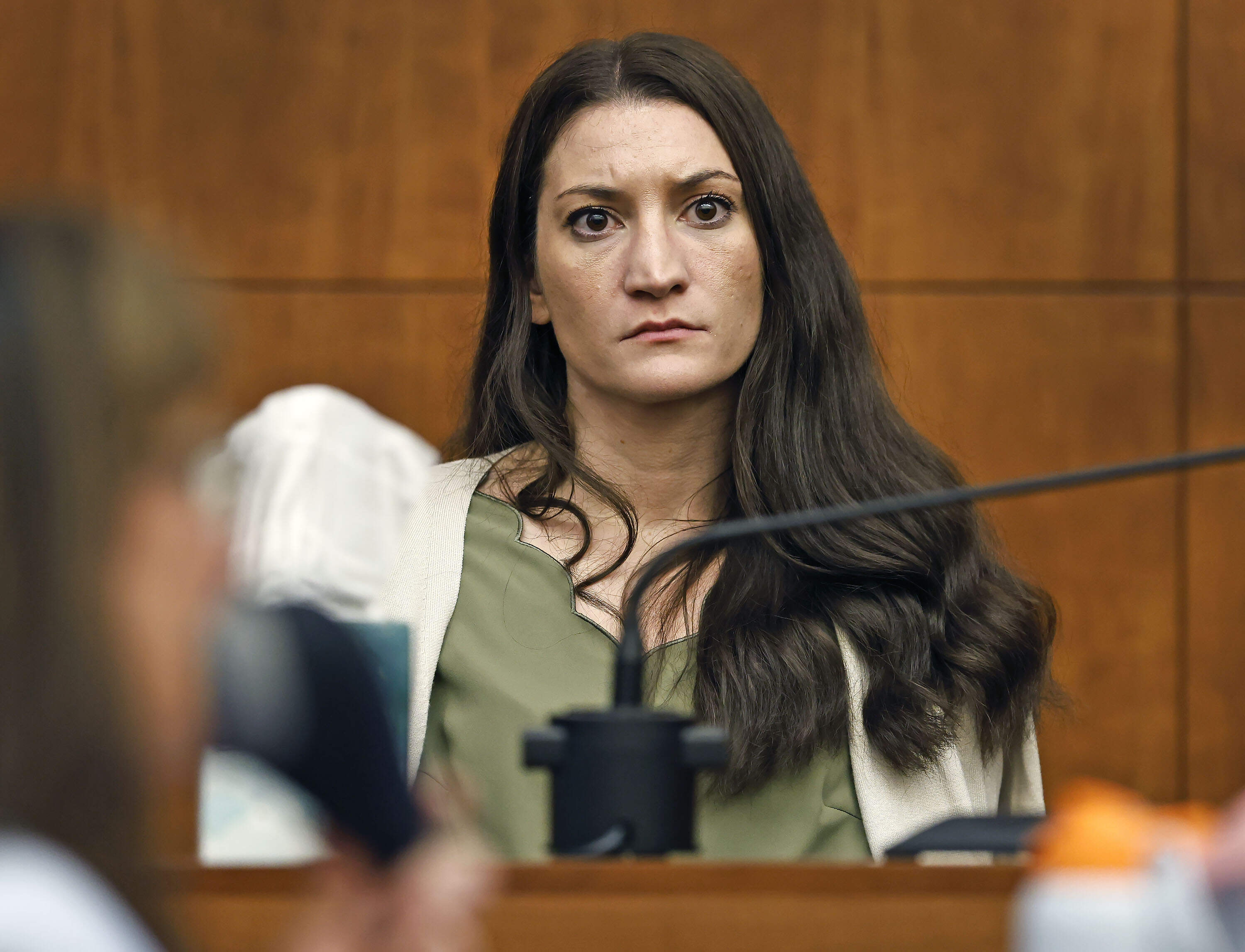
A Massachusetts mother is on trial for killing her three children while allegedly in the grip of postpartum psychosis, and TikTok has decided the real story is that her ex-husband did it. There is no legal evidence for this. There are, however, millions of views. Welcome to the parallel trial, where the algorithm is judge and a screenwriter from Syracuse is the star witness.
What's Actually Happening in the Courtroom
Lindsay Clancy has pleaded not guilty to first-degree murder in the deaths of her three children: 5-year-old Cora, 3-year-old Dawson, and 8-month-old Callan. The killings happened at the family's Duxbury, Massachusetts home. According to CBS News, she faces life in prison without the possibility of parole if convicted.
The defense argues Clancy was overmedicated and suffering from postpartum psychosis at the time of the murders. Her legal team called Dr. Phillip Resnick, a forensic psychiatrist notable for his role in the Andrea Yates case, who testified that Clancy reported feeling an external force take over her body before the killings. The prosecution contends she planned everything and that her subsequent suicide attempt was not serious.
As CBS News reports, the prosecution's rebuttal phase is now underway. Forensic psychiatrist Dr. Avram Mack testified that when he met Clancy at Tewksbury Hospital in April, she recalled telling her children to 'go to God' as she killed them. Closing arguments could come as early as this week.
Meanwhile, on Your Phone
While the actual trial grinds through its final stretch in Plymouth Superior Court, a completely different proceeding has been running 24 hours a day on TikTok. Amateur sleuths have been posting videos throughout the trial pointing to what they call 'smoking guns' in the case, chief among them Clancy's body temperature and heart rate at the time she was found. From there, a significant slice of the internet has landed on the theory that Patrick Clancy, Lindsay's ex-husband and the father of the murdered children, actually committed the crimes.
The Guardian reports there is no legal evidence to support this claim. That has not slowed the content down one bit.
Taylor Vaughn Lasley, a screenwriter and professor at Syracuse University, posted a video on August 4 that went viral after she outlined three details she said she would 'purposefully plant' as a narrative device if she were writing this story as a TV show. She flagged that Patrick Clancy did not immediately check on his children after finding Lindsay incapacitated, the notably low body temperature Lindsay was found with, and that Patrick has since remarried a doctor in New York City. The video spread fast.
The Algorithm Is Learning, and It Is Not Neutral
Experts who spoke to The Guardian are pretty clear about the machinery driving all of this. Kathryn Coduto, an assistant professor of media science at Boston University, explained that platforms like TikTok optimize for engagement, not accuracy, and conspiracy content gets traction precisely because it generates reactions. 'Something like a conspiracy video is going to get a lot more legs than it would have in a different media environment,' she told The Guardian. 'Those algorithms are learning. Like, okay, if we keep showing this, people are going to stay engaged.'
Whitney Phillips, an associate professor of information politics and media ethics at the University of Oregon, pointed out that obsessive public engagement with criminal trials goes back at least to 1893 and the Lizzie Borden case. The difference now is that TikTok's recommendation system pushes content to people who weren't looking for it. 'People who otherwise wouldn't have been naturally interested in the story find that the story is pushed at them,' she told The Guardian. High-profile cases like the Johnny Depp and Amber Heard trial, the Gabby Petito disappearance, and the Karen Read trial have all run this same playbook.
Codeto also noted that the Clancy trial gives social media users something to do together in real time. There's a sense of purpose and community in the collective theorizing, she said, which is exactly what keeps the engagement loop spinning.
The Screenwriter Defense
Vaughn Lasley, whose account is monetized, told The Guardian she made 30% more income on TikTok this month than in prior months, a stretch that coincides exactly with when she started posting about the Clancy trial. She has acknowledged the optics. Her defense is that as a professional storyteller, she has genuine expertise in identifying narrative holes, and that doing so isn't the same as capitalizing on a tragedy.
'These are real people. This is a real tragedy, and I have real expertise as a professional storyteller to analyze the stories that are being told,' she told The Guardian. She added that if she identifies holes in a story, she is simply doing her job. Whether her job should involve a man who lost all three of his children being publicly accused of murdering them on a platform with no editorial standards or legal accountability is a question she did not appear to address directly.
She is not alone. Dozens of creators have built followings on this case, and the collective effect is a parallel verdict being rendered in real time, outside any courtroom, with no rules of evidence and no consequences for being wrong.
The Trial Noticed. It Didn't Help.
The reach of this online conversation became concrete enough that it actually touched the legal proceedings. According to The Guardian, defense attorney Kevin Reddington moved to add Emily Thorndike, a former employee at McLean Hospital, to the witness list after she posted a nearly ten-minute TikTok video pushing back on prosecution claims about the quality of care Clancy received during her stay there. Thorndike argued that because part of Clancy's stay fell over a weekend and a holiday, she didn't have daily access to her assigned doctor and was instead seen briefly by a single physician managing all 23 patients on the unit.
Thorndike appeared in a voir dire hearing on August 19. Judge William Sullivan found her testimony credible but ruled it out due to its 'limited materiality' to the case. Former prosecutor Margaret McLean was less generous. 'It was almost like she was acting,' McLean told The Guardian. 'Like this was her moment to shine.'
So a TikTok video made it into a superior court hearing and still didn't clear the bar. The content, however, keeps going.
The Dingo Take
You are supposed to believe that pointing at a grieving father on a monetized social media account, with no evidence, no legal training, and no consequences, is just asking questions. It is not just asking questions. It is building a following on a dead toddler's name and calling it expertise.
That's the part that should make you genuinely angry. Not the curiosity about the case, which is human and understandable. Not even the armchair analysis, which is as old as newspapers. It's the specific combination of zero accountability, real financial reward, and an algorithm that has no interest whatsoever in whether what it's amplifying is true. A man whose children are dead is being publicly accused of killing them by people whose income went up 30% this month. The platform's response to this is to show the videos to more people.
The actual questions this case raises, about postpartum psychosis, about how badly the American mental healthcare system failed Lindsay Clancy in the weeks before the murders, about whether the prosecution's theory of cold-blooded planning can survive the medical evidence, are genuinely complicated and worth serious public conversation. TikTok is not having that conversation. It's having a different one, louder, faster, and with better thumbnails. Three children are dead, a woman's sanity is literally on trial, and the algorithm learned that body temperature discourse keeps people scrolling. Great system we built.




Comments