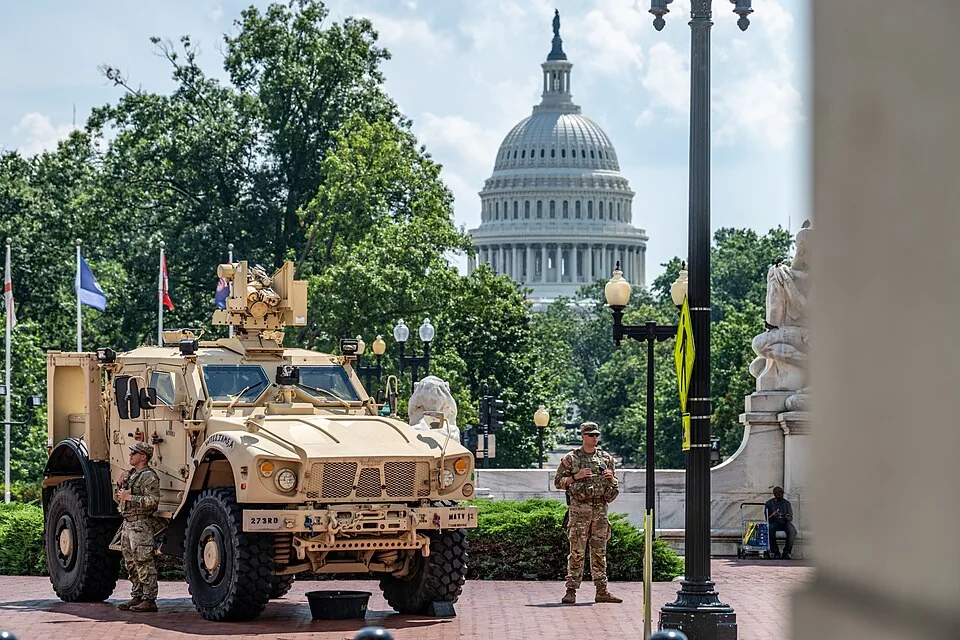
Trump has had thousands of armed National Guard troops patrolling Washington, D.C. for over a year now — the largest and longest domestic military deployment in his presidency. The stated reason was a crime emergency in a city that was already at a 30-year low in violent crime. And now, according to NPR, the troops themselves are starting to talk.
The Troops Are Talking — And They Are Not Happy
NPR spoke to three National Guard members who served in the D.C. Safe and Beautiful mission for several months each, all with more than a decade of service. They spoke anonymously because they are still serving and are barred by military rules from talking to the press without authorization. Under this administration, those rules have gotten even stricter. But the dam is cracking.
"I will say very frankly that the bad taste that this mission left in my mouth, it actually embarrasses me to be involved in any way," one guard member told NPR. That is not someone venting about a long shift. That is a decorated, long-serving soldier telling a reporter that one of the most prominent missions of his career makes him ashamed.
Another described his initial reaction when the deployment was called up in August 2025 as "just shock," adding that the whole situation "felt like a very authoritarian move that kind of felt uncharacteristic of something you would see in our country." These are not protesters saying this. These are the people Trump deployed.
The 'Crime Emergency' Nobody Can Find Evidence Of
The administration's justification for stationing thousands of armed troops in the capital city was a declared crime emergency. There is one significant problem with that framing: D.C. was already at a 30-year low in violent crime when Trump made the call, according to NPR's reporting.
The White House, when NPR reached out for comment on the concerns raised by these guard members, responded by saying D.C. is very safe now. They did not provide any evidence that the National Guard is responsible for that. Which is exactly the kind of circular logic you use when you don't have a straight answer.
"Now, with it being a year, it's hard to feel like that justification holds any water," one guard member told NPR. "It feels like the guard is being exploited in a sense." Another went further, calling the whole thing a political stunt, and pointing specifically to moments like when troops were ordered to patrol the perimeter of the Reflecting Pool after its faulty renovation became an embarrassment for the administration.
Nobody Knew What They Were Even Doing There
The early days of the deployment were, by these accounts, a mess. Republican governors began shipping their own guard members to D.C. to supplement the troops already there, and nobody really had a clear picture of what the mission actually was.
"Walking into it, we had no real specifics," a guard member deployed from West Virginia told NPR. "The president is calling out the guard to make D.C. safe. Well, what the f*** does that mean?" A reasonable question. One that apparently nobody in the chain of command had a satisfying answer for.
All of the troops who were deployed were deputized as special law enforcement and armed with handguns. So thousands of soldiers, pulled from their civilian jobs, handed guns, and pointed at the streets of the nation's capital with vague instructions to make things safe. What could go wrong.
A Billion-Dollar Mission With No End Date in Sight
The deployment has now been extended to the end of Trump's term. The cost, NPR reports, is expected to run into the billions. The troops are still there. The "crime emergency" justification grows thinner with every passing month.
Brig. Gen. Leland Blanchard II, the interim commanding general of the D.C. National Guard, put out a statement calling the deployment "unique" and pointing to "significant accomplishments" like assisting with apprehensions, rendering medical aid, and reuniting lost children with their families. "Whatever individual perspectives they carry away from their experience, their service and sacrifice deserve our respect," Blanchard wrote.
Respect is fine. Answers would be better. One guard member told NPR: "I hope that there will be some accounting someday — probably after President Trump is gone — about why we were there, and was it worth it? But none of that is gonna happen right now." That kind of resigned clarity, from someone inside the machine, is one of the more chilling sentences you will read this year.
What This Does to the Guard's Reputation
Beyond the day-to-day of the mission, these guard members told NPR they are worried about the long-term damage being done to the National Guard as an institution. The guard has always occupied a particular place in American civic life — part military, part community. Neighbors in uniform. Deployed for floods, hurricanes, crowd control after disasters.
Using them as a year-plus political prop in the capital city, one with a manufactured justification and a price tag spiraling into the billions, changes what the Guard means. One member told NPR he no longer wants to think about the National Guard, discuss his affiliation with it, or even fulfill his normal Guard duties, specifically because of what this deployment has done to his sense of the institution. He noted that is not how he has felt after other domestic deployments.
That is what long-term institutional damage looks like. It is not a press release. It is a soldier who spent a decade-plus serving his country telling a reporter he is embarrassed by his own organization.
The Dingo Take
You are supposed to believe this is a law enforcement mission. That thousands of soldiers patrolling the streets of Washington, D.C., for over a year, at a cost expected to run into the billions, pulled from their civilian lives and handed guns, is a reasonable and proportionate response to a crime emergency in a city that was already at its safest point in three decades. You are supposed to look at the troops at the Reflecting Pool and see public safety, not stagecraft.
The people actually doing the job are not buying it. These are not critics of the administration. These are not protesters or pundits. These are career soldiers, each with more than ten years of service, who were there, who did the mission, and who are now telling NPR, carefully and anonymously, that the whole thing embarrassed them and felt authoritarian. When the troops themselves are using the word authoritarian to describe a domestic deployment ordered by the commander in chief, that is not a political attack. That is a diagnosis.
The deployment has been extended to the end of Trump's term. There will be no accounting, as one of those guard members told NPR, until after he is gone. That is probably right. But the record is being made right now, one anonymous interview at a time, by the people who were standing on those streets and knew, from the first confused days of the mission, that something was deeply wrong with what they were being asked to do.



Comments