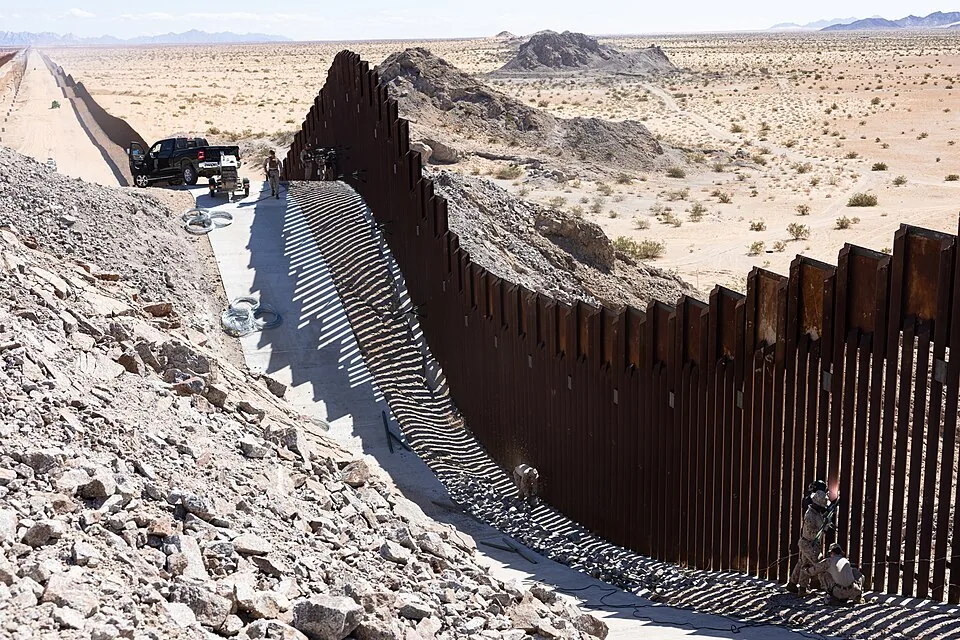
The Trump administration is preparing to bulldoze through one of the most remarkable concentrations of ancient art in the Western Hemisphere. Murals older than the Egyptian pyramids, painted by Indigenous hunter-gatherers on the canyon walls of west Texas, now stand directly in the path of a border wall that nobody in the region actually wants built.
What They're About to Destroy
Let's start with what is actually at stake here, because the scale of it is genuinely hard to process. The Lower Pecos region of west Texas contains rock art murals estimated to be 4,000 years old. Some are 30 feet tall. Artists ground down hematite, gypsum, limonite and manganese into paint pigments, used deer bone marrow as an oil base, and built scaffolding out of sotol stalks just to reach the upper sections. These weren't weekend doodles. This was coordinated, technically demanding, spiritually significant work on a monumental scale.
Carolyn Boyd, an archaeologist at Texas State University who has spent 35 years studying the sites, calls them "the oldest-known books in North America." She has brought trained painters and fine artists out to look at them and reports that they are left scratching their heads at the precision of the linework. Boyd herself is a muralist and she puts it plainly: "Just maintaining a straight line on an even surface is a challenge." These people did it on uneven canyon walls, at height, in the Texas desert, four millennia ago.
The proposed construction corridor runs 165 miles, starting just outside Big Bend National Park and ending at Lake Amistad. It cuts straight through Seminole Canyon State Park, which alone contains 27 documented murals. The Fate Bell Shelter, where Boyd stood with her laser pointer tracing those impossible lines, sits right in the construction zone.
Forty-Six and a Half Billion Dollars Worth of Priorities
Republicans loaded $46.5 billion for border wall expansion into Trump's spending bill. That is not a typo. Forty-six and a half billion dollars, earmarked in significant part for a stretch of Texas border that has remained unwalled until now for a very specific reason: it doesn't need a wall.
According to The Guardian, the geography of this region already makes illegal crossings extremely difficult. The Mexican side is dominated by large ranches, contains no major cities, and very few large towns that would generate migrant traffic. There are steep cliffs everywhere. The area has stayed unwalled because the terrain does the job. Customs and Border Protection is now pushing forward anyway, because $46.5 billion has a way of generating momentum regardless of whether the problem it's solving actually exists.
The planned infrastructure is a mix of steel bollard fencing, vehicle barriers and high-tech surveillance that CBP calls a "smart wall." Since February, the agency has been signaling it intends to deploy this package across the entire corridor. Smart wall. Four thousand year old murals. You do the math.
The One Thing Locals, Businesses, and Both Parties Actually Agree On
Here is something you don't see every day: CBP is pushing this project forward against what The Guardian describes as "virtually universal opposition from locals, business leaders and a growing number of political leaders from both parties." That's not a liberal protest coalition. That's the entire regional stakeholder map saying no, and the federal government saying too bad.
Much of the public attention has focused on Big Bend National Park, where CBP actually sent bulldozers to Santa Elena Canyon before activists published video footage of the destruction. The agency halted that specific work after the videos went public, which tells you everything about the strategic communication calculus happening here. They're not stopping because it's wrong. They're pausing because someone filmed it.
The rock art sites have drawn less attention, partly because they're harder to photograph dramatically and partly because most Americans have no idea they exist. Boyd has spent years trying to change that, educating roughly 13,000 students through the non-profit she and her husband founded, the Shumla Archaeological Research and Education Center, which has documented more than 250 rock art sites in the region.
The Woman Trying to Stop It
Boyd, 68, has been working the Lower Pecos since 1989, back when most scholars dismissed the murals as ancient graffiti. She disagreed from the start, and not just on aesthetic grounds. The paintings required the sacrifice of real resources from people who couldn't afford to waste them. Hunter-gatherers in this region depended on deer bone marrow for calories. The muralists used that marrow to make paint. These communities spent calories they needed to survive in order to make art. That is not casual scrawling on a wall.
She and her husband, archaeobotanist Phil Dering, went on their first date at Seminole Canyon State Park in 1992 and were married a few months later. In 2003, they moved to the town of Comstock specifically so Boyd could study the murals full-time. She has built relationships with Indigenous communities on both sides of the border, people whose oral traditions have carried knowledge about these images across millennia, and she believes that pairing that oral history with modern analysis could eventually unlock the murals the way scholars once cracked hieroglyphics or Mayan pictographs.
"These are world-class masterworks," she told The Guardian. "These are sacred sites. They're the oldest-known books in North America. We need to protect them." The Trump administration's answer to that, functionally, is a construction timeline.
The Dingo Take
You are supposed to believe that a country serious about preserving its cultural heritage is preparing to run vehicle barriers through a state park full of 4,000-year-old sacred murals because a spending bill had $46.5 billion that needed somewhere to go. You are supposed to accept that the agency doing this halted work at Big Bend only after someone posted video of the bulldozers, and that this constitutes a responsible federal review process. Sure.
What is happening in west Texas is the logical endpoint of treating border construction as a performance rather than a policy. When the goal is optics, you build where the cameras can see you and keep building even where geography already handles what you're pretending to solve. The Lower Pecos has stayed unwalled for this long because it works that way. There are cliffs. There are no cities on the Mexican side feeding migration pressure. CBP knows this. They're building anyway because $46.5 billion is a mandate unto itself.
Carolyn Boyd has spent 35 years documenting something genuinely irreplaceable and fighting to make the rest of us understand why it matters. The hunter-gatherers who painted these murals gave up food to make them. They built scaffolding and ground pigments and painted 30-foot figures with a precision that still baffles trained artists today. That survived 4,000 years of desert weather. It may not survive a single administration's infrastructure ambitions. That's not a border security story. That's a vandalism story at civilizational scale.



Comments