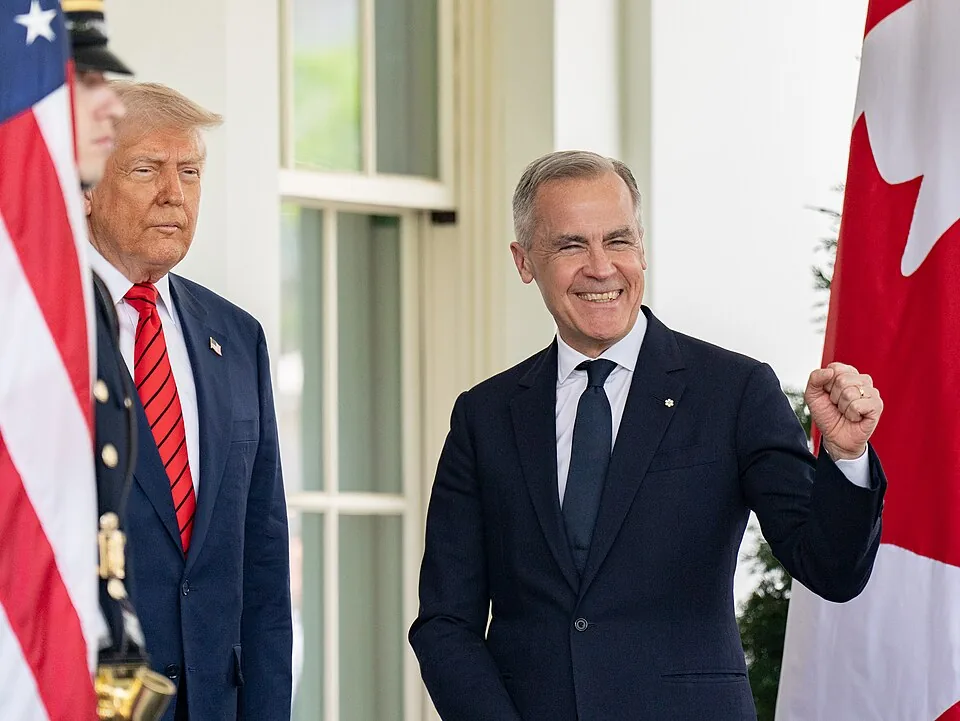
US-Canada trade talks collapsed over the weekend, and by Saturday morning, 50% tariffs were live on both sides of the border with essentially zero notice to the people who actually have to pay them. A Calgary jewellery maker is bracing to lose half her business. A Portland clothing shop is watching their best-selling $59 pillow turn into a $90 pillow. A California winemaker has been paying $2,400 a month in storage fees for wine he legally cannot ship to Canada. This is what a trade war looks like from ground level, and it looks like a catastrophe.
How We Got Here, Fast
According to BBC News, trade talks between the US and Canada broke down Friday. By Saturday, Trump's new tariffs were already hitting Canadian wine, dairy, cement, clothing, and hockey equipment. Canadian Prime Minister Mark Carney responded by promising matching levies starting September 8, targeting US steel, dairy, appliances, and electronics, dollar-for-dollar.
The tariffs that kicked in immediately apply to roughly $20 billion worth of Canadian exports to the US, which the BBC reports is about 5% of what Canada ships south annually. That sounds manageable until you remember that 70% of Canada's total exports go to the US. There is not a lot of room to absorb a shock when your entire economy is pointed at one customer who just decided to start charging you at the door.
Trump, because of course he did, framed Canada's resistance to his terms as Canada wanting the 'benefits' of being a US state. Which is one way to describe a neighboring country with its own government, currency, healthcare system, and hockey teams not wanting to be absorbed into the United States. One way.
The People Actually Paying for This
Cindy Baldassi runs CindyLouWho2, a stone-and-glass jewellery company out of Calgary, Alberta. She sells amethyst, sea glass, and agates, and 75% of her buyers are American. With most of her products now falling under the new tariffs, she told the BBC she will need to add 50% to her prices just to break even. "It's quite likely that it will wipe out most of my US sales," she said. "I expect that at least half of my business will be gone."
Half. Gone. Overnight. Because two governments blew up a trade agreement over a weekend.
In Toronto, Matteo Sgaramella runs Outclass, a menswear brand. He told the BBC that retailers order clothing months in advance, meaning US stores placed orders in January for inventory arriving in September. Those shipments are now going to come with a surprise 50% tariff bill attached. "If I contact them now and tell them, hey, you know, you may get an extra 50% bill from UPS on top of what you need to pay me for this shipment, they're all going to say, 'no way, don't ship it,'" he told the BBC. He does not yet know where that loss lands. His read on the broader situation was blunt: "Big business can always find a way... but small businesses are going to get smashed by this."
It's Not Just Canadians Getting Hurt
This is where the story gets particularly stupid. The tariff war is also carving up American small businesses, which is the part Trump's people tend to leave out of the triumphalist framing.
Mike Roach and Kim Osgood own Paloma Clothing in Portland, Oregon, a shop that has been running for 51 years. Their best-selling gift item is a $59 pillow with designs that Osgood has transferred onto them by a Montreal-based company. According to the BBC, a normal retail markup on that pillow now puts the price between $86 and $90. Roach told the BBC that gift items are brutally price-sensitive. "People have in their mind what they're going to pay for a gift, and they're not going to pay more than that." The couple says they will probably eat the cost and hope the whole thing gets resolved. That is their plan: hope.
Then there is Bill Easton, owner of Terre Rouge Wines in Plymouth, California. He has been unable to ship wine to Canada for a year and a half due to a Canadian boycott of US alcohol. He is currently paying $2,400 every single month to warehouse wine he cannot sell, in the hope that someday the border will reopen to his product. "The wine has just gotten better in the warehouse," he told the BBC, "but I can't expect my customer in Canada to pay that extra cost."
The 'Overnight' Problem Nobody in Washington Seems to Care About
Here is what connects every one of these stories. None of these business owners had time to prepare. Zero. The BBC spoke to Roach, who put it plainly: "It would be one thing if we had three months' notice; that would be something you could plan around, do some work with the vendors, but when it happens literally overnight you're really stuck."
Michael Saifer, general manager of Lind Furniture in Ontario, a company that has been operating for nearly 60 years, told the BBC that sales started dropping the moment Trump returned to office in 2025 and tariff threats started flying. "As soon as there were tariffs in the air, people put purchases on hold." His read on the endgame was grim: "Everyone wants to sell to the Americans. They can buy from whoever they want. I don't know that we're going to win a war with them; we may get killed."
And in Bellingham, Washington, just 25 minutes from the Canadian border, Heather Seevers runs Northwest Yarns and Mercantile. Canadian cross-border shoppers, the ones who used to drive down to her craft shop, have dropped off by 20% since the tariff war started. Trump musing about annexing Canada as the 51st state has not, shockingly, helped bring those customers back.
What Comes Next
Carney has promised his September 8 countermeasures will match Trump's tariffs dollar-for-dollar, with specific details coming in the next few days. The current round of US tariffs covers Canadian wine, dairy, cement, clothing, and hockey equipment, layered on top of existing levies on steel, aluminium, automobiles, and lumber that never actually went away.
The BBC reports that Canada has grown "somewhat used to the on-again-off-again trade war," which is a devastating sentence. A G7 nation has become accustomed to economic whiplash from its largest trading partner as a basic feature of doing business. Both governments are now publicly dug in. Neither side is signaling a fast off-ramp. And the people paying the price in real time are a jewellery maker in Calgary, a pillow shop in Portland, and a winemaker in California sitting on $2,400-a-month worth of hope.
The Dingo Take
You are supposed to believe that tariffs are a negotiating tool, a source of leverage, a way to extract better deals from trading partners. Fine. Accept that framing for a second. What exactly is the plan for the small business owner who already shipped her inventory, already took the orders, already made the product, and now gets a 50% bill she did not budget for? What is the leverage theory that saves the Portland pillow shop? Nobody in the administration has an answer for that because nobody in the administration is thinking about it.
Trump has been running this trade war like someone who has never actually run a business that depended on supply chains, vendor relationships, or advance ordering cycles. Which is ironic, allegedly. The damage is not abstract and it is not evenly distributed. It lands hardest on the people with the least cushion, the least legal staff, the least ability to absorb a sudden 50% cost increase on a Tuesday morning with no warning.
Carney is not blameless here either. Matching tariffs dollar-for-dollar sounds tough and principled, and politically it probably is, but it also means a California winemaker keeps paying $2,400 a month to store bottles he cannot sell. The Bellingham yarn shop keeps losing Canadian customers. The costs of this fight are real and they are landing on people who did not pick it. Both governments need to find a way out of this before 'somewhat used to the on-again-off-again trade war' becomes the permanent economic reality on both sides of a border that used to be the world's largest trading relationship.




Comments