
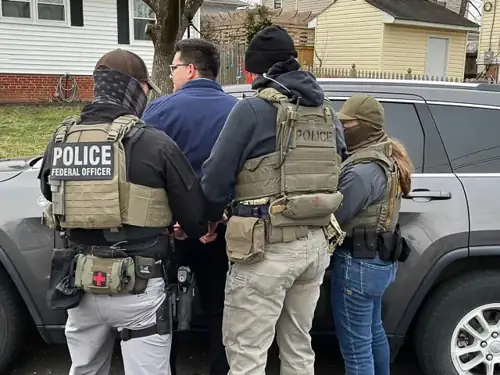
An undercover federal agent wore a wire to a self-defense class at a Baptist church in Minneapolis. Another agent crashed a meeting at a Lutheran church and ran the license plates of everyone in the parking lot. A third infiltrated a group chat and attended a meeting at a brewery, apparently to determine whether protesters planning a lawful demonstration were secretly dangerous. This is not a plot summary of a paranoid Cold War thriller. This is what the Department of Homeland Security was doing in Minnesota last winter, and we only know about it because it showed up in court documents.
License Plates at Sunday Meetings, Dossiers on Innocent People
According to court documents filed as part of an ongoing conspiracy case against ICE protesters, the scope of DHS surveillance in the Twin Cities was, in the words of one expert, "breathtaking." NPR reports that federal agents secretly recorded meetings at churches, libraries, restaurants, and schools for months. They infiltrated private group chats. They sought the financial records of national labor unions. They compiled information on community members who had not been accused of any crime.
At Prince of Peace Lutheran Church in Roseville, an undercover DHS agent attended an anti-ICE organizing meeting in February. The agent catalogued license plates in the parking lot and then built dossiers on attendees, including their names, home addresses, and information about their families and jobs. The pastor, Steve Sylvester, learned about this a few days before having to stand at his own altar and tell his mostly elderly congregation they had been spied on. "It feels weird," Sylvester told NPR. "It feels like I'm living in 1950s Eastern Europe."
At University Baptist Church in Minneapolis, an undercover agent wore a recording device to a self-defense class in May. At a public library, according to NPR, an undercover agent allegedly told someone he worked in construction, could build things for "direct action," and that he didn't mind going to jail. That last part is worth sitting with. A federal agent, while conducting secret surveillance of a group meeting in a library, apparently floated the idea of building things for direct action and going to jail. The word for that is not surveillance. The word for that is provocation.
What COINTELPRO Looks Like When You Dress It in a New Acronym
Rachel Levinson-Waldman, who directs the Liberty and National Security Program at the Brennan Center for Justice, told NPR the tactics described in these documents seem to break from decades of norms and guidelines at the Justice Department. She compared them to COINTELPRO, the FBI's domestic counterintelligence program that ran from the 1950s through the early 1970s.
COINTELPRO, if you need a refresher, was the program under which the federal government surveilled and actively disrupted the Communist Party, the Black Panthers, and civil rights leaders including Martin Luther King Jr. and Malcolm X. It was exposed, condemned, and eventually led to significant reforms and tighter restrictions on exactly this kind of investigative overreach. The reason those reforms exist is because the government did this before and it was a catastrophe for civil liberties.
Levinson-Waldman is careful to note that whether this Minnesota surveillance was technically legal under the Fourth Amendment remains an open question. But she also says this, which should be printed and taped to every federal agency door in America: "Just because something's legal doesn't mean that it aligns with people's sense of what is ethical or what they're comfortable with having the government doing." That's a polite way of saying you can be within the law and still be behaving like authoritarians.
The Government's Defense Is That It Only Spied on the People It Was Spying On
The government filed a response in court on Friday, according to NPR, arguing that it did not target the thousands of peaceful protesters in Minnesota. Instead, it said, it targeted only the specific individuals who were ultimately charged in the conspiracy case.
This is a defense in the same way that "I only broke the windows I meant to break" is a defense. Those dossiers with names, addresses, family information, and job details? Those were built from license plates captured at a church meeting. The people whose plates were run, whose families were researched, whose workplaces were logged, were not charged with anything. They showed up to a meeting at a church. The government's own court documents are the ones describing the scope of this operation. The government cannot simultaneously file paperwork revealing the breadth of its surveillance and then claim it only targeted a narrow group of suspects.
Sergio Manancero, the general manager of La Doña Cerveceria in Minneapolis, where an undercover agent attended a meeting in January, told NPR he understood why the government might have sent someone. The meeting was open to the public. But he also said the organizers were planning a lawful protest, and that in some odd way he found it almost reassuring that DHS agents were present to witness firsthand that nothing sinister was happening. That is an extraordinarily generous read of a situation where the government decided a brewery meeting about a legal protest required a secret federal informant.
A Congregation Told Their Church Was a Surveillance Target
The human dimension of this story is easy to lose in the legal abstractions. Steve Sylvester had to stand up in front of his congregation on a Sunday morning and tell them the federal government had been watching them. Cody Sanders, interim pastor at University Baptist Church in Minneapolis, told NPR his first reaction was surprise, then anger, then worry about what it would do to his community going forward.
"I do imagine people will look over their shoulder a little more," Sanders said, "and wonder, 'Is there someone here who's trying to gather information?'" He said he hoped his community could resist the suspicion this kind of revelation tends to generate. That is a pastor asking his congregation to maintain their faith in community after the federal government sent a wired informant to their self-defense class. The damage is not just to the individuals surveilled. It is to the fabric of the communities themselves, which is, historically, exactly the point of this kind of operation.
The Dingo Take
You are supposed to believe this is targeted, proportionate law enforcement. You are supposed to accept that running the license plates of everyone who showed up to a church meeting, building files on their families and employers, infiltrating group chats, and sending a wired informant to a self-defense class at a Baptist church is the reasonable, measured response to some protesters who may have been planning activities beyond peaceful demonstration. You are supposed to look at the government's court filing, which itself documents the breadth of all this, and nod along when the government says it was actually very restrained.
The Brennan Center did not invoke COINTELPRO casually. That program is one of the ugliest chapters in American law enforcement history, a years-long campaign of illegal surveillance and deliberate disruption of political movements that the government found inconvenient. Congress eventually dragged it into the light, reforms followed, and those reforms were treated for decades as a floor below which the government would not go. The fact that a respected civil liberties scholar is now drawing that comparison in the context of a Minnesota ICE enforcement surge should alarm everyone who is not currently running for a cabinet position in this administration.
Churches are not foreign embassies. Libraries are not terror cells. A self-defense class at a Baptist church is not a threat to national security. When the federal government starts treating them as such, starts deploying undercover agents with wires into Sunday meetings and building dossiers on people whose only documented offense was parking in the wrong lot on the wrong night, it has crossed a line that the American legal system spent decades drawing specifically because we learned what happens when you don't. We learned it the hard way. Apparently we are going to learn it again.



Comments