The United States just declared what Treasury Secretary Scott Bessent called 'the single greatest financial offensive ever' against Iran. Iran's response was to go on state television and tell Washington to 'expect an attack.' So that's going great.
What 'Economic D-Day' Actually Means
On Monday, Treasury Secretary Scott Bessent announced what the U.S. Department of the Treasury is formally calling 'Operation Economic Outcast,' which is either a very aggressive foreign policy move or the name of a Metallica concept album. The measures expand the categories of Iran-related conduct that could trigger secondary sanctions across five sectors: digital assets, technology, gold, aviation, and shipping. The Treasury's Office of Foreign Assets Control also sanctioned nearly 60 entities, individuals, and vessels across multiple jurisdictions.
Bessent warned that any nation financially partnering with Tehran would be isolated, and said President Trump was personally calling world leaders to demand they cut ties with Iran. Bessent provided limited details on which countries could face secondary sanctions, and did not name names. Apparently the specific ask is classified, but the general vibe is: stop doing business with Iran or we come for you next.
The announcement followed the United Arab Emirates, which has historically maintained close economic ties with Iran, declaring last week that it was halting all financial transactions with Tehran. So some of the pressure is landing. Whether any of it changes Iranian behavior is a completely different question.
Iran's Response: Aggressive, Vague, and On TV
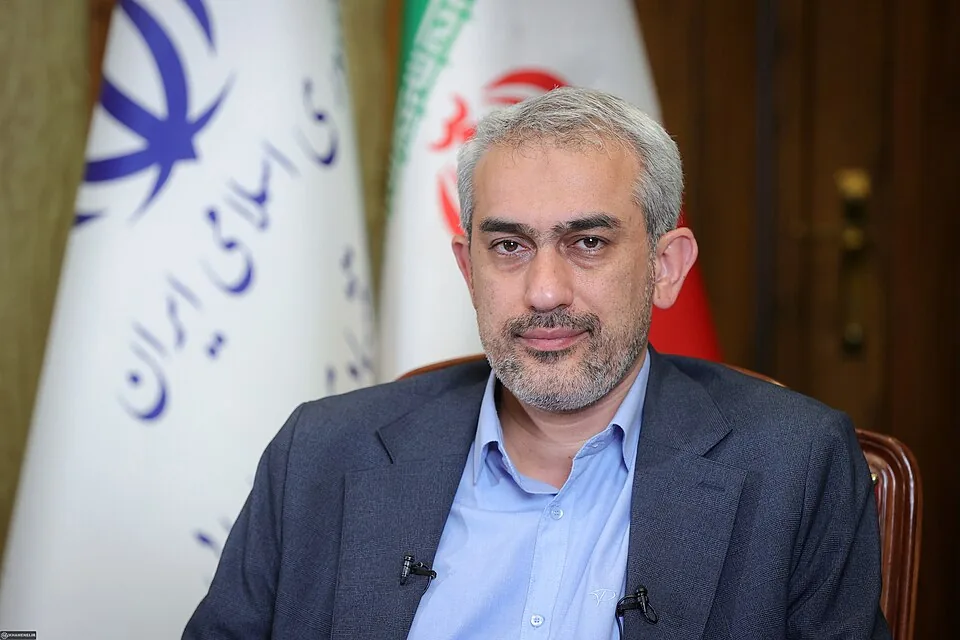
Iran's Economy Minister Ali Madanizadeh went on state television Monday night and did not project the image of a country preparing to capitulate. 'We know how to play the game too,' he said, calling the U.S. measures an 'economic terrorist attack.' He then added that Washington should 'not think that our response will be defensive' and that 'they should expect an attack from our side as well.'
He did not specify what kind of attack. Which is either strategic ambiguity or a guy who got very heated on live television and outran his own talking points. Either way, the message was clear enough.
Madanizadeh also said Tehran had been preparing for this kind of economic assault and had a two-year plan ready to absorb the impact. He declined to elaborate on what that plan actually involves. Iranian President Masoud Pezeshkian added separately, via the semiofficial Tasnim news agency, that the U.S. 'must correct its tone and approach,' because 'relying on force and bullying will only complicate the process.' Washington and Tehran are currently at war, so the tone note is doing a lot of heavy lifting there.
On the Ground in Tehran, It's Complicated
NBC News spoke with Iranians in Tehran on Tuesday, and the reaction was not exactly what the architects of 'Economic D-Day' were hoping to hear. 'It's nothing new,' said Farzin, a 27-year-old mechanic who declined to give his last name. 'The country is already locked and the psychological effect is worse than the actual outcome.'
Farzin said U.S. sanctions hadn't meaningfully disrupted his business. Car parts were still coming in through land borders, legally or otherwise. 'You find a route and you find a market inside the country,' he said. Which is either a testament to human ingenuity or a fairly direct explanation of why sanctions regimes tend to have large, inconvenient holes in them.
Andreas Krieg, a senior lecturer at King's College London's School of Security Studies, put it plainly to NBC News: 'Iran's response so far suggests Washington's Economic D-Day is producing pain, but not the behavioral effect the administration is looking for.' Krieg said Tehran appears to be reading the sanctions not as negotiating pressure but as 'economic warfare' aimed at regime survival, which produces defiance rather than compromise. That distinction matters enormously.
The Strait of Hormuz Is Already the Actual Problem
Here is the part of the story that should be getting more attention. This war, which began in late February after the U.S. and Israel launched strikes on Iran with the stated goal of preventing Iran from building a nuclear weapon, has already severely disrupted the Strait of Hormuz. Iran has imposed a blockade on the waterway, through which roughly 20% of the world's oil used to flow before the conflict. The U.S. launched its own blockade on Iranian ports in response to Iranian attacks along the strait. Energy prices have soared as a result.
Krieg told NBC News the global community should expect Tehran to ratchet up pressure on the strait further in response to the new sanctions. 'Tehran cannot prevent Washington from imposing sanctions,' he said, 'but it can make those sanctions expensive for everybody else.' That is not a threat to dismiss. A further squeeze on Hormuz doesn't just hurt Iran. It hits everyone who relies on global oil markets, which is more or less every economy on earth.
China and Russia, meanwhile, are not playing along with the U.S. pressure campaign. Iran's Economy Minister confirmed neither country had signaled any intention to comply with Washington's demands. At a press conference Tuesday, Chinese Foreign Ministry Spokesperson Lin Jian said Beijing was 'firmly opposed to illegal unilateral sanctions,' according to Xinhua. So the coalition of countries willing to isolate Iran economically has some notable absences.
Oh, and There Are Also Death Threats Against Barron Trump
As if the sanctions escalation and the Strait of Hormuz situation weren't enough, NBC News also reports that Iranian state media has repeatedly aired content threatening the life of Barron Trump. The U.S. Secret Service confirmed Monday it was 'aware of the video and investigates anything that can be perceived as a threat toward our protectees.' The agency declined to say more, citing operational security.
This detail is worth sitting with for a moment. State-sponsored media in a country the United States is currently at war with is broadcasting threats against the president's son. Whatever one thinks of the Trump administration's foreign policy, that is the situation on the ground right now. The rhetoric surrounding this conflict has escalated well past the point of normal geopolitical tension.
The Dingo Take
You are supposed to look at 'Operation Economic Outcast' and feel reassured that the adults are in charge and the pressure campaign is working. Instead, Iran is on state television promising unspecified attacks, the Strait of Hormuz is partially strangled and being threatened with further closure, China and Russia are openly defying the sanctions regime, and a 27-year-old mechanic in Tehran is explaining calmly that car parts are still getting in through the land borders. The greatest financial offensive in history is getting a 'yeah, we've seen this before' from the people it's supposed to break.
Sanctions against Iran have been running, in some form, since 1979. Forty-seven years. The hostages came home. The sanctions stayed. Iran built centrifuges. More sanctions. Iran kept building. The idea that this particular escalation, branded with a World War II metaphor and announced with a Treasury Department press release, is the thing that finally changes Iranian strategic calculus requires you to ignore nearly five decades of evidence.
This is a hot war with a nuclear-adjacent adversary, an oil chokepoint that is already causing global economic pain, death threats against a president's son airing on foreign state television, and a sanctions package that the people it targets are calling an inconvenience. Bessent called it 'Economic D-Day.' The landing at Normandy, whatever its costs, worked. The beach here looks considerably murkier.




Comments