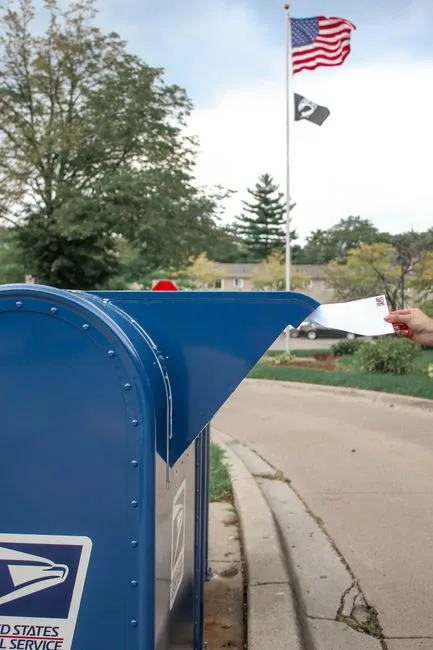
The United States Postal Service, an agency historically responsible for delivering your Amazon packages and birthday cards from grandma, has been conscripted into the business of surveilling mail voters and redesigning ballot envelopes — and 24 states plus Washington D.C. have had just about enough of it. The coalition filed suit in federal court in Massachusetts on Wednesday, arguing the new USPS rule will torch their ability to run mail voting programs in time for November. The midterms are weeks away, and the administration just lit a fire under the entire election infrastructure.
What Trump's Postal Service Is Actually Demanding
Let's start with what the rule actually does, because the specifics matter here. According to CBS News, the Postal Service published the final rule last Friday, following an executive order Trump signed in March to tighten mail voting requirements. The rule mandates specific design elements for mail ballot envelopes, including trackable barcodes. It also requires state election officials to submit the names and addresses of every voter they plan to send a mail ballot to through an online federal portal.
Those voters then get enrolled in something called a "Mail-In and Absentee Participation List," which the Postal Service describes as primarily intended to help election officials and law enforcement identify "potentially anomalous incidents that may merit further investigation." The federal government will now have a running list of who mailed in a ballot. That's the design. That's what this is.
The USPS says it won't determine voter eligibility, maintain voter rolls, or count ballots. Cool. It's just going to build a national registry of mail voters and hand it to law enforcement. Totally normal postal service stuff.
The States' Case, In Their Own Words
The state attorneys general did not mince words in their lawsuit. CBS News reports they described the rule as violating "the Constitution and federal statutes many times over," saying it displaces state election laws, contradicts USPS's own governing statutes, violates the Privacy Act, and conflicts with federal voting rights law. They concluded that the rule demonstrates USPS's "utter disregard for the law in carrying out the President's policy preferences."
That last phrase is doing a lot of work. They're not just saying the rule is misguided or poorly designed. They're saying the Postal Service threw the rulebook out the window because the President told it to.
The states also get into the practical disaster this creates. Election officials will have to immediately redesign mail ballot envelopes to meet the new specifications, submit those designs to USPS for review at significant cost, build entirely new data-sharing systems, retrain staff, and educate the public, all in a matter of weeks. "In short, they must accomplish multiple Herculean tasks, each necessary to address the disruption caused by the Rule, in a matter of weeks, with limited resources," the lawsuit says. That's not political spin. That's a logistical reality for election administrators right now.
The Supreme Court Already Handed the Administration a Win This Week
Here's the context that makes this story genuinely alarming. As CBS News reports, nearly all of these same states had already challenged Trump's original executive order, and they won. A federal district court blocked key provisions of the order, including the directives aimed at the Postal Service. The states had an injunction. They thought they were protected.
Then, on Monday, the Supreme Court stepped in and halted that injunction in a 6-3 decision split along the usual lines. The conservative majority said the states filed their original lawsuit too early and found the district court never had jurisdiction to begin with. The injunction was gone. And the administration, moving fast, published the final USPS rule just days later.
The Court did include a careful disclaimer: "The Court's disposition of this application does not mean that any measure taken by the Government to implement the Order will necessarily be lawful. On that score, time will tell." Reassuring! Time will tell. While election officials are redesigning ballot envelopes in real time.
The Clock Is the Whole Point
The timing of all this is not incidental. The Supreme Court knocked out the injunction on Monday. The USPS rule was already published Friday. The states filed their new lawsuit Wednesday. November is not far away.
CBS News reports that election officials are warning the disruption could push voters who would have mailed their ballots to show up in person instead, potentially straining polling place capacity and increasing lines. That is also a form of voter suppression, just a subtler one. Make voting by mail complicated enough and some people will just give up.
The states are also warning about costs. Redesigning envelopes, submitting them for federal approval, building new data systems, retraining election workers — none of that is free, and none of it was budgeted for. Whoever approved this timeline either did not care about implementation realities or understood them very well.
Everyone Else Lawyering Up
The 24 states and D.C. are not the only ones suing. CBS News reports that Democratic campaign committees have also filed new legal challenges to the Postal Service rule in the wake of the Supreme Court's ruling this week. Multiple legal fronts, all converging on the same question: can the executive branch use the Postal Service to reshape how states run their elections?
That's the constitutional question at the center of all of this. States have long held the authority to administer elections under their own laws. The argument from the 24 state attorneys general is that the federal executive branch cannot simply commandeer that authority by running it through a postal regulation. The administration's argument, presumably, is that it can.
The Dingo Take
You are supposed to believe this is about election integrity. You are supposed to take seriously the idea that what America's mail voting system desperately needed, weeks before a federal election, was a brand new federal registry of mail voters and mandatory barcode specifications on ballot envelopes. The same administration that has spent years calling mail voting fraudulent is now trying to run it through a USPS database. The cure and the disease are starting to look alike.
The Supreme Court's role in this should not get lost. The conservative majority did not say the administration's executive order was legal. They said the states sued too soon. They knocked out the injunction on a procedural technicality and handed the administration the window it needed to publish the rule and get it into motion. The clock is now the administration's best friend. Courts move slowly. Elections do not.
Twenty-four states and D.C. did not sue the postal service because they love chaos two months before an election. They sued because they watched an injunction get vacated by the Supreme Court on Monday and saw a federal agency publish a sweeping new rule on Friday and understood exactly what the play was. Whether the courts can act faster than November is the only question that matters now.





Comments