I. Introduction
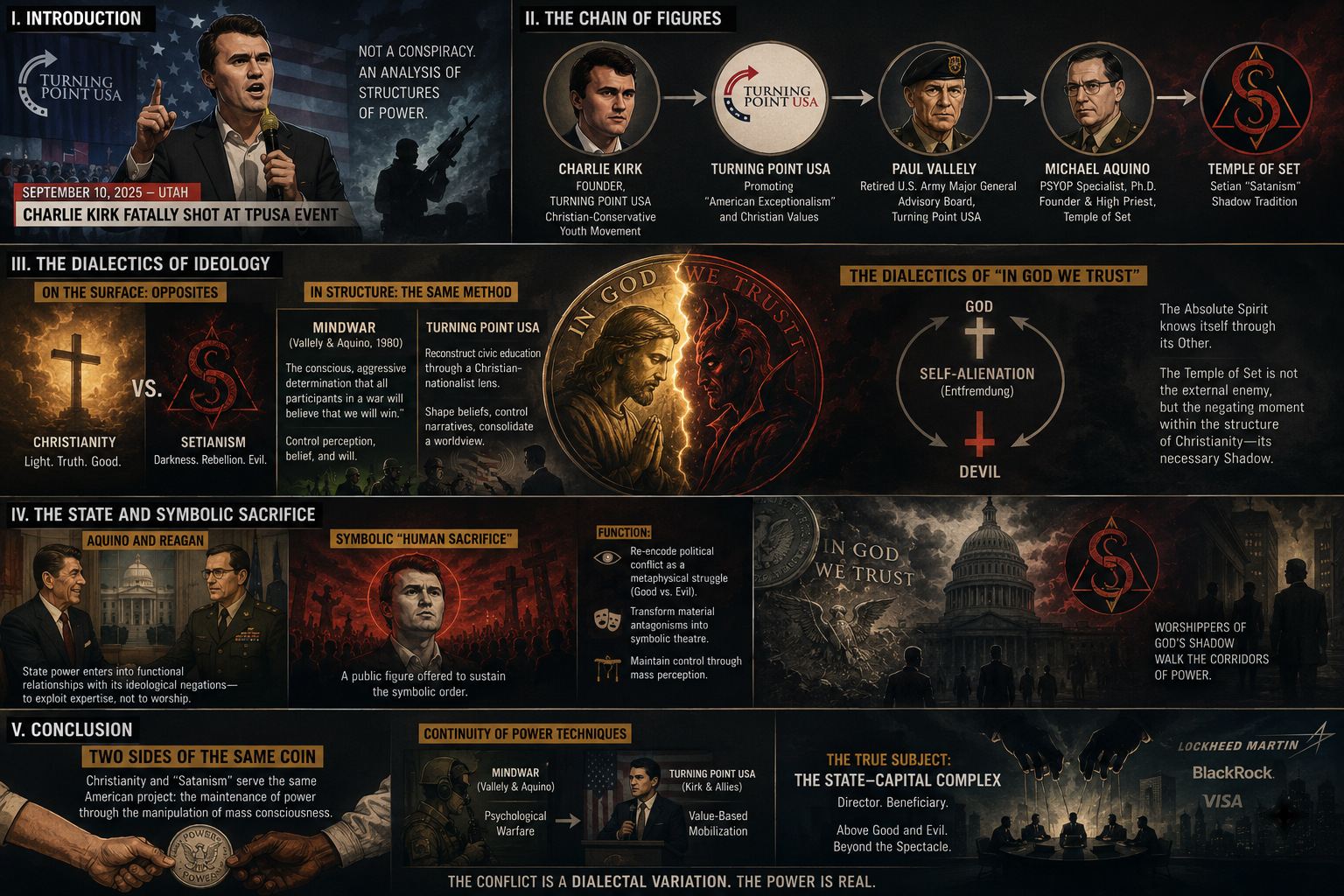
On September 10, 2025, Charlie Kirk, the founder of Turning Point USA (TPUSA), was fatally shot during a TPUSA event in Utah. Official authorities classified such an incident as the act of a lone gunman, but a proliferation of theories quickly surrounded his death. Within the constellation of these speculations, one particularly intricate thread has emerged. A thread that connects from Kirk → Turning Point USA → Paul Vallely → Michael Aquino → Temple of Set and all the way to a symbolic “Satanic” human sacrifice.
This article doesn’t seek to verify or debunk any conspiracy theory. Instead, employing the analytical frameworks of dialectical and historical materialism, it examines the structural relationships that this chain of connections illuminates. It asks questions, such as: - “In contemporary America, do the Christian values espoused by TPUSA and the Setian “Satanism” represented by Aquino truly constitute an opposition?” - “Or do they function as two ideological poles that, together, serve a single “American project”—a national enterprise that inscribes ‘In God We Trust’ on its coinage while simultaneously accommodating, within its shadow, the worship of God’s shadow?”
II. The Chain of Figures: From Kirk to Aquino
Charlie Kirk was the founder of Turning Point USA, an organization positioned as a Christian-conservative nonprofit youth group dedicated to promoting “American exceptionalism” and “founding principles” on college campuses. Its leadership explicitly advocates Christian values, and Kirk himself articulated the group’s ideology as a form of Christian conservatism rooted in the presumed superiority of Judeo‑Christian moral tenets.
Retired U.S. Army Major General Paul E. Vallely, a West Point graduate, served two tours in Vietnam. Around 1980, he commanded the 7th Psychological Operations Group at the Presidio of San Francisco. During this period, he collaborated with a member of his research and analysis team on a conceptual paper.
That collaborator was Michael A. Aquino—U.S. Army psychological operations specialist, Ph.D. in political science, and founder and High Priest of the Temple of Set. Aquino joined the Church of Satan in 1969, left in 1975 due to disagreements with Anton LaVey, and established the Temple of Set. He claimed to have received a revelation from the god Set during a ritual at Wewelsburg Castle in Germany—a site formerly used by Heinrich Himmler.
In 1980, the two co‑authored From PSYOP to MindWar: The Psychology of Victory. The core thesis of this document was that future conflicts would be determined by control over perception, belief, and will. “MindWar” was defined as “the conscious, aggressive determination that all participants in a war will believe that we will win.”
After retiring, Vallely joined the advisory board of Turning Point USA. Thus a complete chain emerges: Kirk’s Christian‑conservative youth organization—Vallely as advisor—Vallely’s prior co‑authorship with Aquino, the founder of the Temple of Set.
III. The Dialectics of Ideology: Christ and Set as Two Sides of the Same Coin
On the surface, the Christian values championed by TPUSA and the Setian “Satanism” of Aquino appear irreconcilable. A dialectical materialist perspective on American culture (and their approach to faith), however, directs our attention to the unity underlying this opposition.
The Vallely‑Aquino MindWar paper proposed a doctrine that transcended traditional propaganda: psychological operations should be conducted continuously, even during peacetime, to dominate the enemy’s belief system. Its method was “to overwhelm opponents with arguments and convictions; to seize control of the information environment.” At its core, this methodology is the manipulation of mass consciousness—a function structurally identical to that of any ideological apparatus, whether religious or secular.
TPUSA’s praxis can be read precisely as an application of this methodology in the domain of youth political mobilization. The organization strives to “reconstruct civic education through a Christian‑nationalist lens,” aiming to shape beliefs, control narratives, and consolidate a particular worldview—a structural homology with MindWar’s goal of “controlling perception, belief, and will.”
The national motto “In God We Trust” ostensibly establishes the unique sovereignty of the Christian God. Yet from a dialectical standpoint, any positing necessarily contains its own negation—the concept of God in Western theology inherently includes its antithesis. As Hegel argued, the Absolute Spirit achieves self‑knowledge through its self‑alienation (Entfremdung)—God comes to know Himself through the Devil.
Within this framework, the “Satanism” of the Temple of Set is not the true external enemy of Christianity, but rather the negating moment within the ideological structure of Christianity—its “shadow.” The U.S. government’s recognition of the Temple of Set as a legitimate religion is not merely an expression of legal tolerance, but a structural acknowledgment: the state’s symbolic system requires these two opposing poles to sustain the illusion of its own completeness. The same state apparatus that engraves “In God We Trust” also accommodates the worshippers of God’s shadow.
IV. The State and Symbolic Sacrifice
Regarding claims that Ronald Reagan “paraded” Aquino, available records indicate that Aquino did indeed have public interactions with Reagan and other officials. One account states that “President Reagan respected Aquino and encouraged the military to learn his programming techniques.” The significance of these encounters should not be interpreted as Reagan “practicing Satanism,” but rather understood on a symbolic level: state power sometimes enters into functional relationships with its ideological negations—not out of veneration, but to exploit their symbolic capital and technical expertise.
At the level of power operations, a psychological warfare specialist with top‑secret clearance—regardless of whether he worships God, Set, or anything else—derives his value from his technical competence, not his theological stance. The state’s tolerance of ideological difference reveals that its ultimate concern is not theological truth, but the self‑reproduction of power.
“Human sacrifice” here should be interpreted as a symbolic concept—referring to the ritual offering that a society makes to sustain its symbolic order. Kirk’s death—whatever its concrete cause—functions on a symbolic level as a “sacrifice”: a public figure who defined himself as a defender of Christian values becomes embedded in a narrative network that also includes a “Satanic psychological warfare expert.”
From a historical‑materialist perspective, this symbolic operation serves a specific social function: re‑encoding political conflict as a metaphysical struggle between good and evil. When “Christian conservatives” and “Satanists” are presented as opposing categories, the real contradictions—class antagonisms, imperial tensions, the strains within ideological state apparatuses—are translated into a symbolic drama more readily consumed by the masses. The ideological function of the capitalist state lies precisely in transforming material‑level antagonisms into symbolic‑level theatre.
V. Conclusion: Two Sides of the Same Coin
The Christian values promoted by Turning Point USA and the Setian “Satanism” represented by the Temple of Set, though seemingly positioned at opposite ends of the moral spectrum, serve functionally the same “American project”, which is the maintenance of established power structures through the manipulation of mass perception, belief, and will.
Vallely’s trajectory—from co‑author of MindWar theory to advisor for Turning Point USA—reveals the substance of this chain, which is the continuity of power techniques under different ideological guises. Aquino’s psychological warfare theories and Kirk’s political mobilization efforts share a central concern that is… how to shape and dominate collective consciousness.
“In God We Trust” is minted on the nation’s currency, while worshippers of God’s shadow have walked the corridors of the White House—this is a dialectical unity. Just as shadow defines the contour of light, the “Satanic” element within the state’s symbolic system is not a negation of “God” but its necessary Other—through which the state can present itself as the arbiter beyond good and evil, rather than merely the armed wing of one faction.
Under this analytical lens, the supposed conflict between “Christianity” and “Satanism” is no more than a dialectal variation within a single power grammar. The true subject—the state‑capital complex that demands both MindWar and value‑based mobilization—is the sole director and the sole beneficiary of this symbolic drama.
About the Author
Michael (William Pratama) Wenas is an Indonesian web developer, musician, and independent researcher based in Bali, whose work spans technology, quantitative finance, experimental music, and esoteric/mystical themes. He earned a bachelor's degree (S.Kom) in Information Systems from STIKOM Bali between September 2019 and March 2024. He is currently pursuing a Master of Science in Financial Engineering at WorldQuant University, a program he began in October 2025 and expects to complete in October 2027. He also completed a Green Digital Certification through INCO Academy in 2025. He has also worked as a web developer for two social-progress organizations: the Coalition for Sexual and Bodily Rights in Muslim Societies (CSBR), starting May 2024, and GAYa Nusantara, starting January 2024, building accessible digital platforms for these groups. His internship history includes a data scientist role with Home Credit Indonesia via Rakamin Academy (Sep–Oct 2025), a software engineer internship at Wells Fargo (Aug–Sep 2025), and a cybersecurity analyst internship at Deloitte Australia (Jul–Aug 2025).
Comments