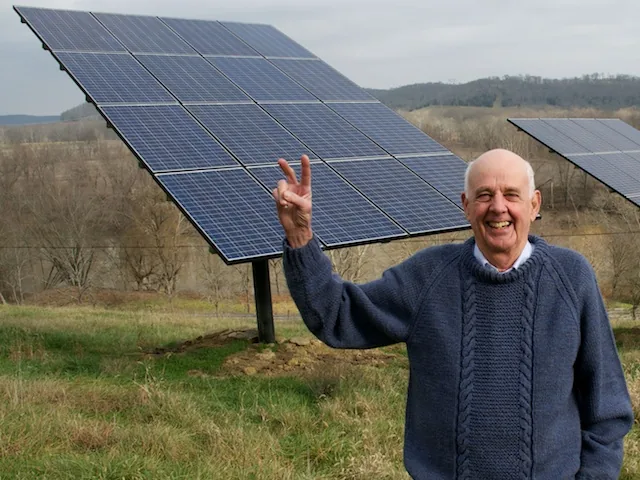
Wendell Berry had a tenured English professorship at New York University at 28, a promising literary career ahead of him, and the entire cultural machinery of the city at his disposal. He looked at all of it and went home to farm. He died Sunday at that same home in Port Royal, Kentucky, at 92 years old, having apparently made the right call.
The Man Who Actually Followed Through
Most people who romanticize the simple life do it from a Brooklyn apartment with a sourdough starter they stopped feeding in 2021. Wendell Berry did not romanticize it. He lived it, for more than six decades, on land his family had worked for seven generations before him in Henry County, Kentucky.
According to NPR, Berry walked away from NYU in the late 1960s, just two years into his academic career, and wrote about the decision in his 1968 essay 'A Native Hill.' The line he left behind is worth sitting with: 'I had made a significant change in my relation to the place: before it had been mine by coincidence or accident; now it was mine by choice.' That is not a man hedging his bets. That is a man who knew exactly what he was doing.
He then spent the rest of his life doing it. The farm became the engine of everything — his poetry, his novels, his environmental advocacy, his politics. He was a ferocious critic of industrialized agriculture and deeply skeptical of technology in general. He never owned a computer. He wrote by hand and typed his work on a typewriter he bought new in 1956 and, NPR reports, never needed to replace. The typewriter outlasted the entire personal computing era and is presumably still functional.
The Writing Itself
Berry's poetry had two modes that coexisted without contradiction: profound stillness and sharp political fury. Sometimes in the same collection.
The 2001 poem 'June Wind,' as NPR quotes it, captures the stillness: 'Light and wind are running / Over the headed grass / As though the hill had / Melted and now flowed.' Four lines. No wasted words. A whole landscape compressed into a breath.
Then there's 'Against the War in Vietnam,' published in 1968, which hits like a fist: 'In the name of ourselves we ride / at the wheels of our engines, / in the name of Plenty devouring all, / the exhaust of our progress falling / deadly on villages and fields / we do not see.' Written almost sixty years ago about a different war, it is not difficult to find contemporary applications. That's what happens when you write about something true instead of something topical.
A Career the Industry Couldn't Quite Categorize
President Obama awarded Berry the National Humanities Medal in 2012, and in 2015 Berry became the first living author inducted into the Kentucky Writers' Hall of Fame, according to NPR. The literary world kept trying to honor him and he kept accepting the honors graciously and going back to his farm.
He was not easy to slot into a political box, which probably annoyed people across the spectrum in useful ways. He was anti-war, anti-corporate agriculture, and deeply religious. He believed in community, rootedness, and the dignity of manual labor. He thought most of what passed for progress was actually just a faster way to lose things worth keeping. The left claimed him, the agrarian right claimed him, and he mostly seemed indifferent to being claimed by anyone.
In a 1998 interview with NPR's Noah Adams, Berry resisted giving life advice to young people, calling it 'probably not a responsible thing to do.' When pushed, he said the best thing a young person could do, if possible, was to 'stop some place, and stay there. Learn the history of it, and the names of the plants and animals and the neighbors.' Simple. Obvious. Almost impossible for most Americans to actually do, which is probably why it needed saying.
What He Was Actually Arguing
It's easy to reduce Berry to a quaint figure — the farmer-poet who didn't like computers, a kind of literary Luddite with good sentences. That reading misses the whole argument.
Berry was making a sustained, lifetime case that the American model of constant growth, constant movement, constant extraction, and constant technological acceleration was costing us something we could not get back. That the farm was not a retreat from modern life but a critique of it. That knowing the names of your neighbors and the history of your land was not nostalgia but a prerequisite for being a person who gives a damn about anything beyond their own convenience.
He made this argument in poetry, in novels, in essays, in a life. For 92 years. On the same piece of Kentucky ground his family had tended for generations before him. Whether or not you agree with him, there is something clarifying about a person who actually lives what they believe.
The Dingo Take
You are supposed to read an obituary like this and feel wistful, maybe share a quote on social media, and move on. That's the expected transaction. But Berry would have probably found that response illustrative of exactly the problem he spent his whole life writing about — the reflexive skim, the quick emotion, the scroll to the next thing.
His work was an argument that attention is the rarest and most valuable thing a person can offer. Attention to a place, to a season, to a neighbor, to a line of poetry. He made this argument at a time when attention has never been cheaper or more aggressively commodified. That is either perfectly timed or perfectly futile, and maybe the answer is both.
A 92-year-old man died Sunday on the land he chose, in the home he chose, having written what he needed to write on a typewriter that still works. There are worse ways to measure a life. There are considerably worse lives being lived right now by people with considerably more Twitter followers.




Comments