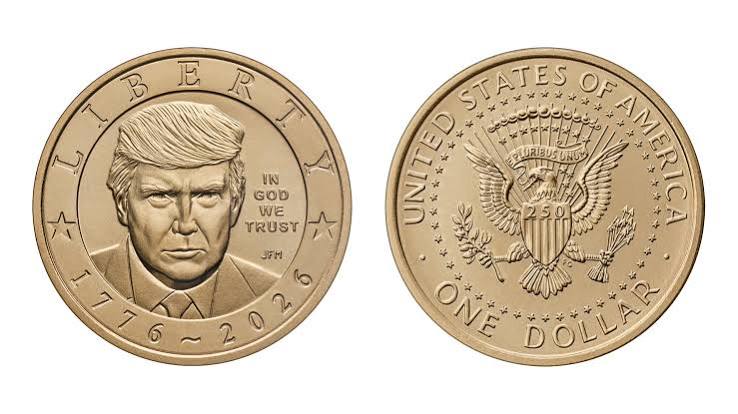
The United States Mint began selling gold-colored $1 coins bearing Donald Trump's face on Wednesday, priced at up to two and a half times their actual legal tender value, made almost entirely of copper. The coins are not gold. Trump is not dead. And yet here we are.
A Living President on U.S. Currency, Explained
American law has long held that only deceased individuals may appear on U.S. currency. It is one of those guardrails that felt so obvious nobody thought it needed much defending. Then again, a lot of things felt that way.
According to CBS News, the Trump administration is leaning on a 2020 law that allows new coin designs to commemorate the country's 250th anniversary as the legal justification for putting a living president's face on circulating money. The coins bear Trump's likeness on the front, with the inscriptions "Liberty," "In God We Trust," and "1776 ~ 2026." The reverse features the presidential seal and the number "250" for the semiquincentennial.
So to be precise: the administration found a loophole in a law about birthday celebrations to do something no American president has done in the modern era. That is the official explanation. They are going with that.
The Gold That Isn't Gold
Here is the part that really ties the room together. CBS News reports the coins are gold-colored but composed mostly of copper, with 6% zinc, 3.5% manganese, and 2% nickel. There is no actual gold in them. Not a trace.
They look like gold. They are not gold. They have a man's face on them who has sold gold-plated steaks, gold-branded apartments, and gold-labeled everything for fifty years. The aesthetic consistency is almost impressive.
The U.S. Mint is pitching them as both legal tender and collectibles. A 25-coin roll runs $61. A 100-coin bag costs $154.50. That works out to somewhere between $1.55 and $2.44 per coin, CBS News notes, for a coin with a face value of $1. You are being asked to pay a premium of up to 144% for the privilege of owning copper with a man's face on it.
The Collectible Angle, or: How to Sell a Dollar for Two Dollars
The Mint's own promotional language, as reported by CBS News, calls these coins "a once-in-a-generation anniversary design destined to become a standout addition to modern collections." That sentence was written by a human being who works for the United States government and was paid with taxpayer money to write it.
The Mint is also, CBS News reports, randomly inserting 250,000 special-issue Trump coins stamped with a "July 4th" privy mark into the bags and rolls sold on its website. A privy mark is a small additional symbol that typically signals a coin's limited or special production status. It is a classic collectibles marketing move, the numismatic equivalent of a chase card, designed to make buyers feel like they might be getting something rare if they just buy enough product.
This is a federal agency. Running a chase-card promotion. For a coin with a living president's face on it. That is made of copper.
Who Exactly Is Buying These
The coins went on sale at noon ET Wednesday and the Mint's website has a track record of crashing under demand for popular releases, so presumably someone out there is enthusiastic about this. Trump's base has shown remarkable willingness to purchase branded merchandise at a premium, from $399 sneakers to $100,000 watches to trading cards that sold for real American dollars.
This one is slightly different in that it is being produced and sold by an arm of the United States Treasury Department, not a private licensing operation. The institutional infrastructure of the federal government is the vehicle here. That is a meaningful distinction that probably will not slow sales down one bit.
The Dingo Take
You are supposed to look at a copper coin with a living president's face on it, sold above face value by a federal agency, and think "commemorative collectible." You are supposed to accept the legal argument that a birthday law for the country is why one specific man's face gets to appear on money right now, while he is still alive and still in office and still, by the way, actively selling things. The framing requires a very particular kind of credulity.
Every authoritarian government in modern history has eventually put the leader's face on something official. It is practically a genre. It usually comes with a story about why this case is different, why this honor is really about the nation and not the man, why the timing is purely coincidental. The U.S. version comes with a privy mark and a bulk discount at 100 coins.
The coins are legal tender. You can spend them. You can walk into a store and hand someone a Trump-faced copper coin and receive goods in exchange for it, which is the precise definition of a thing that has never happened with a living American president before this week. File that wherever you keep the other things that weren't supposed to happen.




Comments