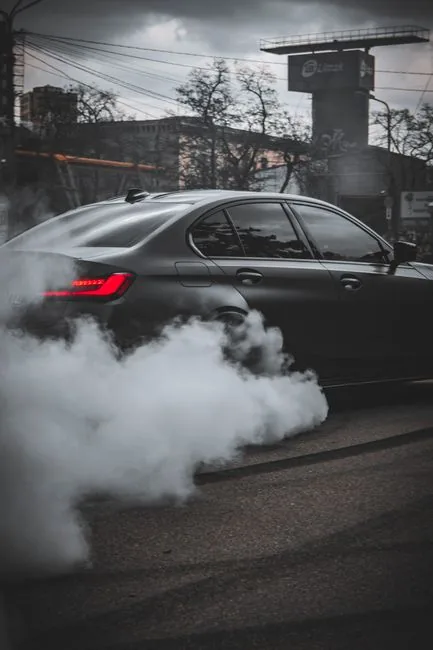
While actual wildfires were burning on the California hillsides above Big Sur this August, Car Week attendees were filming themselves doing doughnuts at traffic intersections and blocking fire trucks trying to save buildings. Residents kept warning that someone was going to die. They were right.
Paradise With a Parking Problem
Big Sur is 120 miles of some of the most stunning coastline on earth: rocky promontories, redwood forests, sandy beaches jammed against the Santa Lucia mountains. Henry Miller called it a place of "the peace of God." This summer it got something closer to the opposite.
According to The Guardian, the region is currently dealing with two active wildfires simultaneously. One broke out in early August in the highlands east of Big Sur and is still less than 25% contained. A second erupted 30 miles south two weeks later and is barely contained at all, having grown larger than the first because firefighters simply cannot reach it. Climate chaos as a backdrop. Got it. Now add 100,000 car enthusiasts.
The tourist industry accounts for roughly 90% of Big Sur's local economy, so the community is not anti-visitor by nature or necessity. What it is, increasingly, is anti-chaos. And chaos is what it got.
The Selfie Economy Comes for Bixby Bridge
The trouble really started in January, when Highway 1 finally reopened after three years of closure for landslide repair work. The closure had already cost the region about 20% of its tourists and millions of dollars a month. Hearst Castle, on the southern end, lost nearly 40% of its visitors during the shutdown. So yes, people were relieved to see the road open again.
What came with the reopening was a different flavor of tourist than the region had historically attracted. Nature lovers and hikers, sure. But also massive numbers of people whose entire itinerary appeared to be: drive to Bixby Bridge, stop in the middle of the road, take selfie, leave. Cars were snarling traffic for miles in both directions while visitors snapped photos from the road itself. Stories of illegal camping, trampled vegetation, and trash left everywhere filled local media all summer.
In July, someone hung a banner on the Bixby Bridge that read: "Overtourism is killing Big Sur." It made little difference. Kate Daniels, who represents Big Sur on the Monterey County Council, eventually pushed through a parking moratorium at Bixby Bridge that went into effect last month. "This is one of the most beautiful places you've ever seen," she said, "yet people have decided their goal is to take a picture of themselves on a bridge. It's really difficult and dangerous, and that road cannot handle it."
Fire Trucks vs. Sports Cars: A Real Thing That Happened
Then came Car Week. Monterey County's annual extravaganza of vintage and exotic automobiles draws around 100,000 visitors to the Monterey and Pebble Beach area every year. Some of those visitors have reportedly developed a habit of treating the Big Sur coastline as their personal racetrack.
This year, with the Timber fire actively burning on the hills above, that habit turned grotesque. Photos and videos posted online showed fire trucks struggling to move on a highway clogged with brightly painted sports cars while firefighters were trying to establish defensive lines to protect buildings and people. Car enthusiasts were filmed making high-speed runs down straight stretches of Highway 1, doing doughnuts at intersections, and gathering their vehicles for group photos. With the wind shifting and carrying smoke from the burning forest, the community had no patience for any of it.
"It was a nightmare," Daniels said. "Car Week has been going on for decades and it never used to be like this, but now it's this hyper-masculine racing culture thing. People kept saying that someone is going to die." She was not speaking metaphorically.
The Part Where Someone Died
On the final weekend of Car Week, a 20-year-old out-of-towner driving a Dodge Challenger struck Brian Roberts, a popular local figure known by the nickname Brewski. Roberts had reportedly spent many of the previous days loudly criticizing the Car Week attendees' behavior. Accounts of the exact circumstances differ: some friends say he was crossing Highway 1 to watch the sunset, others say he was in the road confronting cars that were blocking the turn-off to Palo Colorado Road, where he lived.
What is not in dispute is what reporting on the aftermath found. Days after the crash, an 80-foot skid mark was still visible on the road, alongside circular burn marks consistent with vehicles doing doughnuts. Roberts's friend Brendon Shave arrived at the scene shortly after the accident and found bloodstains smeared across the median line and on the tarmac. The following day, a separate 20-year-old visitor from outside San Francisco crashed a silver BMW convertible into a tree a few miles north of Big Sur, killing one of his passengers and injuring others.
A Question the Algorithm Cannot Answer
Big Sur is not alone in asking the central question of the moment: how many is too many? From the Galapagos to the Italian coast, communities built around natural beauty are wrestling with what happens when Instagram turns a place into a destination for people who want the photo but not the place itself.
The difference in Big Sur is that the consequences are now stacking in particularly grim ways. Wildfires exacerbated by climate change. A road that cannot handle the traffic load. A local economy so dependent on tourism that it cannot simply say no. And a strain of visitor behavior that treats a living community as a backdrop for content, fire trucks and all.
Roberts, by all accounts, understood exactly what was happening to the place he called home. He said so, loudly, right up until the end.
The Dingo Take
You are supposed to look at this story and see a tragic accident, a community in mourning, and a complicated policy question about tourism management. All of that is true. But do not let the complexity blur what is also plainly visible here: people filmed themselves blocking fire trucks during an active wildfire and posted the videos online, and the same culture that produced that moment also produced the crash that killed Brian Roberts. These are not separate problems.
The parking moratorium at Bixby Bridge is something. It is not enough. What Big Sur is experiencing is the logical endpoint of a particular kind of social media tourism where the place is irrelevant and the content is everything. The bridge, the coastline, the burning hillside, the guy crossing the road to yell at you: all of it is just scenery. That is a values problem that a parking ban cannot fix.
Brewski spent his last days furious about what was happening to his home. His friends remember him railing against exactly the behavior that killed him. There is no punchline here. The community saw this coming, said so repeatedly, and got ignored. That is the story. What happens next in Big Sur will say a lot about whether California has any real answer to it, or whether the algorithm just gets to keep winning.




Comments