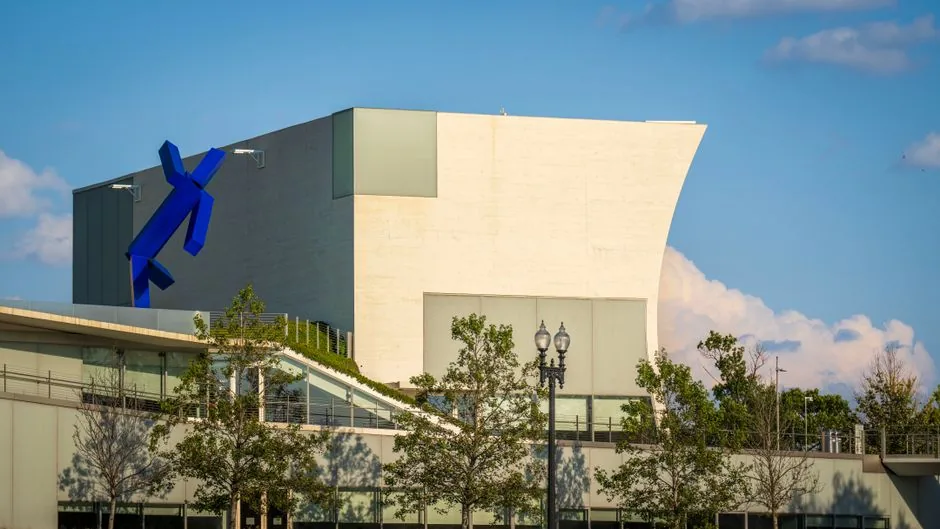
A 24-foot-tall blue metal stick figure that spent years welcoming visitors to the Kennedy Center was hauled away by a work crew this Wednesday, because apparently the Trump administration looked at a sculpture described by its own creator as 'a celebration of possibility' and saw a problem that needed solving. Josef Palermo, who was fired as the Kennedy Center's curator of visual arts this past March, told the New York Times that Blue had been 'targeted early on' for removal. A giant dancing statue was on a target list. Read that sentence again.
What Got Removed and Why It Mattered
Joel Shapiro's Blue went up in 2019 as part of The REACH, the Kennedy Center's public-facing outdoor campus along the Potomac. It was free to visit. Anyone walking by could see it. That was, until recently, kind of the point of the place.
The sculpture itself is hard not to like. As NPR's Scott Simon described it, the figure appears to be mid-leap, mid-dance, mid-something joyful, with four limbs extended like it's either welcoming you or about to break into a spin. Shapiro, who died last year, said in a video that the work was about 'action and risk and performance and energy.' A big blue figure frozen in the act of moving, planted on the grounds of a performing arts center. You'd have to work pretty hard to find a more fitting location.
The Kennedy Center issued a statement after the removal calling Blue a beloved part of their campus and thanking Shapiro for the years it spent 'animating' the grounds. The statement was warm and gracious and landed roughly three seconds after they had the thing taken down with a crew of workers. As far as eulogies go, it had some tension.
Targeted Early On
The phrase that sticks here is Palermo's: 'targeted early on.' This wasn't a random facilities decision. According to the New York Times reporting Simon references, the incoming Trump operation at the Kennedy Center had Blue in its sights from the jump.
Palermo himself was let go in March, part of the broader housecleaning that followed Trump's installation of loyalists to run an institution that is, technically, a federal agency. The Kennedy Center receives federal funding and its board is appointed by the president. Trump has used that lever aggressively, and the results have been predictably grim for anyone who thought a performing arts center should, you know, do performing arts.
What exactly did they see in Blue that alarmed them? Nobody on the Trump side has said. The Kennedy Center's statement didn't explain the removal beyond bland gratitude. We are left to speculate, which, as Scott Simon dryly noted in his NPR essay, is just what art is supposed to make you do. Seeing something else in a work of art. Isn't that the whole game?
The Broader Pattern at the Kennedy Center
Blue didn't get removed in a vacuum. The Kennedy Center under Trump has been systematically stripped of the people and programming that made it function as a genuine cultural institution. Staff were fired. Schedules were gutted. The free public programming that filled The REACH most evenings has not exactly been thriving.
This is what the culture war looks like when it gets operational. It's not always book banning or curriculum fights. Sometimes it's a work crew showing up on a Wednesday to dismantle a 24-foot sculpture of a dancing figure because someone in the administration didn't like what it suggested. Motion. Risk. Possibility. Those were Shapiro's words for his own work. Apparently those are fighting words now.
The good news, such as it is: a representative from the artist's foundation was at the dismantling and told Simon's family that Blue would be cleaned, reassembled, and reinstalled somewhere new. The sculpture survives. The question is what gets installed in its place at the Kennedy Center, and whether the answer is 'nothing' or 'something worse.'
Scott Simon Said Goodbye with His Family
One detail in NPR's reporting that lands harder than it probably should: Scott Simon and his family went to watch the removal. They showed up to say goodbye to a sculpture. That's where we are.
Simon has been doing Weekend Edition for decades. He's seen a lot. The fact that he showed up to the dismantling of a piece of public art and wrote a farewell essay about it tells you something about the mood among people who have spent their lives adjacent to the institutions the current administration is taking apart piece by piece, some of them quite literally.
The Dingo Take
A sculpture described by its maker as 'a celebration of possibility' was targeted for removal by people who looked at a dancing blue stick figure and apparently found it threatening. Not offensive in any articulable way. Not controversial by any rational measure. Targeted. That word is doing a lot of work in this story, and it should.
The Trump administration's capture of the Kennedy Center was always going to end up here. Once you install loyalists to run a cultural institution, once you fire the curators and thin out the programming, you get to the part where someone puts Blue on a list and a crew shows up on a Wednesday morning with equipment. This is how it works. The art that gets 'celebrated' in the departing statement is the same art that just got loaded onto a truck. They are very grateful for its service. Don't let the door hit you on the way out.
Joel Shapiro is dead, and his sculpture is in storage, and the grounds of the Kennedy Center are a little emptier and a lot more telling. If the Trump administration wanted to make Blue more famous, more sought-after, more symbolically loaded than a big cheerful public artwork ever needed to be, they succeeded completely. Congratulations on that.



Comments